
 English
  Spanish
  German
  Russian
  Italian
  French
Low-volume production is usually the better choice when a product needs real manufacturing output, but the project is still too unstable for full mass production.
That usually means demand is still uncertain, engineering changes are still active, or the team is not ready to commit to heavy tooling, large inventory, or a fixed long-run process. At this stage, the goal is not the lowest possible piece price. The goal is to keep production moving while controlling risk and leaving room for change.
For most buyers and engineers, the real question is not whether low-volume production is possible. The real question is whether it still aligns with the current product stage, part design, and demand patterns. If the project is still learning from each batch, low-volume production often makes sense. If repeat orders are already routine, that flexibility may already be costing more than it is worth.
What Is Low-Volume Production?
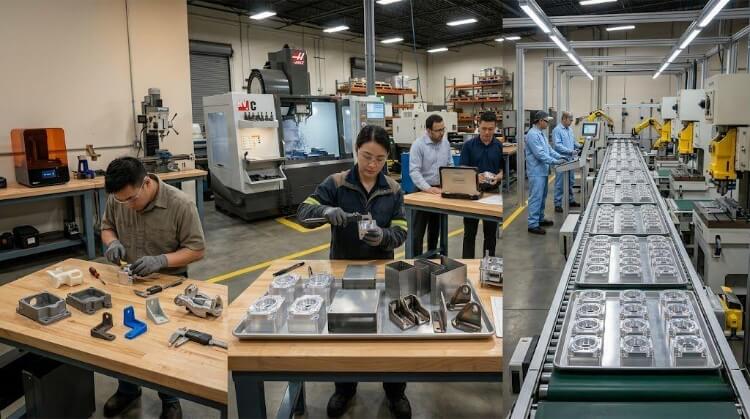
Low-volume production is a manufacturing approach used when a company needs more than prototype quantities, but is not ready for full mass production. It is often used in the stage between product validation and stable scale-up.
In factory work, low-volume production usually means small-batch manufacturing with controlled repeatability. The exact quantity can vary by product type, material, and process. For one project, it may mean tens of units. For another, it may mean hundreds or a few thousand.
A simple way to judge it is this: the part is already real enough for pilot runs, launch supply, validation, service support, or early customer delivery, but the project still carries too much uncertainty for full-scale production commitment.
How does it differdoes differ from prototyping and mass production?
The difference is not mainly in quantity. The difference is purpose.
Prototyping is used to test shape, fit, and early function. Mass production is built for stable demand, repeatable output, and lower long-run cost. Low-volume production sits between these two stages.
It is used when the part must be manufactured as a real product, but the project still needs more flexibility than a true mass-production system can handle.
A useful rule is this: low-volume production usually makes sense when uncertainty is still higher than repeatability. If the team is still learning from each batch, low volume is often the right model. If the design is stable and repeat orders are already normal, the project may already be moving beyond a true low-volume stage.
When Does Low-Volume Production Make Sense?
Low-volume production works best when a project needs real output but still carries uncertainty. The cases below show where it creates the most practical value.
New product launches with uncertain demand
This is one of the strongest use cases.
A company may be ready to launch, but still have weak forecast confidence. In that situation, moving straight to full production can create excess stock, early tooling pressure, and costs tied to demand that has not yet proved itself.
Low-volume production is usually the safer path because it allows smaller releases, faster learning, and easier adjustment after early market feedback.
Bridge production begins before full-scale manufacturing is ready.
Sometimes the product is ready before the production system is ready.
A mold may still be in progress. A stamping die may not be finished. A supplier may still be qualifying material or finishing steps. At the same time, the business may already need parts for launch support or early shipment.
This is where low-volume production works as a bridge strategy.
It keeps supply moving while the long-term production model is still being prepared. For example, a company may begin with CNC-machined housings before shifting to molded parts, or use laser-cut and bent sheet metal enclosures before a higher-volume tooling route is ready.
Spare parts, service parts, and custom-demand supply
Low-volume production also makes strong sense when demand is inherently uneven.
Spare covers, replacement brackets, legacy panels, custom enclosures, and service-driven components often do not justify a large inventory or a highly fixed production system. Demand may come in small batches, at irregular times, or only when repair or replacement is needed.
For these parts, low-volume production is often not a temporary stage. It can be the right long-term supply model.
Why Companies Choose Low-Volume Production?
Companies do not choose low-volume production to make fewer parts. They choose it when flexibility, timing, and risk control matter more than full-scale efficiency.
Lower upfront risk
A full mass-production setup often requires more tooling, more preparation, and a stronger volume commitment. That can make sense when the product is already stable. It is a much riskier move when the design may still change or forecast confidence is still weak.
Low-volume production reduces that exposure. It lets the team enter real manufacturing without locking too much cost into tooling, inventory, or a process that may soon need revision.
Faster engineering changes
Low-volume production also makes more sense when the team is still learning from each batch.
At this stage, design changes are often driven by real production feedback. Hole positions may need adjustment. Bend details may need correction. Assembly access may need to be opened up. A machined housing may need a fit update after the first build. A welded bracket may need a simpler joint layout after early assembly review.
These changes are easier to manage in a low-volume model because the process is not yet built around heavy fixed tooling and rigid long-run control.
Lower inventory pressure
This is common in launch-stage products, slow-moving industrial parts, and custom-demand programs. If the company builds too much before demand becomes clear, it can end up with outdated inventory, tied-up cash, or parts that no longer match the latest revision.
A smaller-batch approach reduces that risk. It keeps supply closer to actual demand and gives the team more chances to adjust quantity, revision level, and replenishment timing.
Which Process Is Best for Low-Volume Production?
There is no single best process for every low-volume project. The right choice depends on the part, the material, and the job stage.
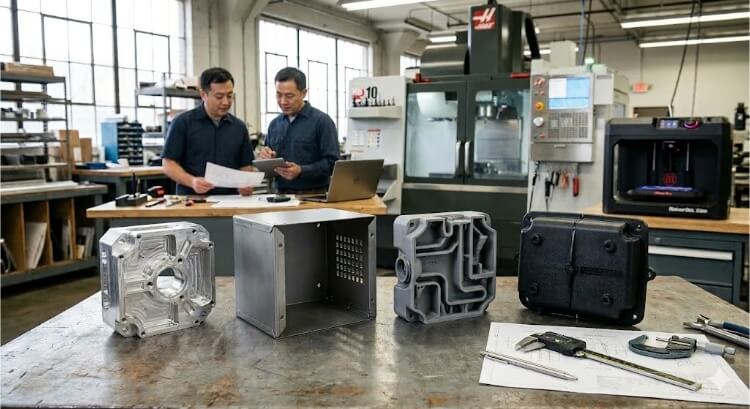
CNC machining for precise parts
CNC machining is usually the better choice when dimensional control matters more than tooling efficiency.
It works well for machined housings, structural blocks, precision brackets, mounting plates, and functional parts with tight interfaces. It is especially useful when the team still expects design changes, because revisions can often be handled through programming and setup updates instead of new hard tooling.
Its limit is clear. Once cycle time becomes too high, CNC gets expensive quickly. If the same part is being reordered regularly and the geometry is no longer changing, CNC may no longer be the best long-term option.
Sheet metal fabrication for enclosures
Sheet metal fabrication is usually the better choice when the part is built around cut, bend, punch, and weld logic.
It is a strong fit for electrical enclosures, control box panels, equipment covers, support brackets, cabinet parts, and welded frame assemblies. For these parts, sheet metal production can move quickly while still allowing hole layout changes, bend adjustments, and assembly improvement.
It works best when the design already adheres to practical sheet-metal rules. If bend spacing, hardware placement, weld access, and coating allowance are poorly planned, cost can rise quickly even at low volume.
3D printing for complex parts
3D printing is usually the better choice when shape complexity and speed matter more than cosmetic consistency or traditional process structure.
It is useful for short-run custom parts, internal channels, lightweight forms, jigs, fixtures, and geometries that would be inefficient to machine or fabricate from flat stock. It also helps when the team wants to test several design versions without committing to a specific tool.
Its boundary is also clear. If the part now needs stronger repeatability, more production-like material behavior, or better visible-surface consistency, 3D printing may no longer be the best route for the next stage.
Low-volume molding for plastic parts
Low-volume molding becomes the better choice when a plastic part is already stable enough to justify a more repeatable batch process.
It is often a good fit for covers, housings, clips, and other plastic functional parts that require greater consistency than printing can usually deliver. It also makes sense when the project needs production-like material behavior before a full mass-production mold is justified.
It makes sense when the design is becoming fixed, and the order pattern is becoming more predictable. If the plastic part still changes often, or if the quantity is still very low, the tooling step may come too early.
What Makes Low-Volume Production Expensive?
Low-volume production is not expensive simply because the batch is small. Costs usually rise when the part, process, or requirements require too much production effort.
Part complexity
A simple part is easier to program, easier to fixture, and easier to repeat. A complex part usually needs more machine time, more bend steps, more welding, more hardware insertion, or more manual handling. In low-volume work, those extra steps show up directly in the quote.
This is common in machined housings with deep pockets, sheet metal assemblies with many bends and welds, or multi-part builds that still need fitting during assembly.
If the part is complicated, the quote usually reflects production time risk more than raw material cost.
Material choice
It affects not only material price, but also cutting speed, bend difficulty, weld behavior, finish requirements, and sourcing stability. A bracket in mild steel requires less effort to produce than the same bracket in stainless steel. A machined aluminum housing does not behave the same way as one made from a harder alloy.
A material may be acceptable on the drawing, but it still adds unnecessary cost if it slows production, increases tool wear, or increases finishing difficulty without providing enough functional value.
Tolerance and finish requirements
Tight tolerances and cosmetic finish requirements can raise costs faster than many teams expect.
A part may look simple, but once it needs close positional control, visible-surface consistency, coating compatibility, inserted hardware, or extra post-processing, the route becomes more demanding. More checking, more handling, and more secondary work are often required.
Poor DFM decisions
The process may still be possible, but the part is harder to produce than it needs to be. Tight internal corners, weak bend relationships, awkward weld access, unnecessary tolerance stacking, or overcomplicated assemblies can all slow production and reduce stability.
In low-volume work, these problems appear early because the batch has less room to absorb inefficiency. That is why the best cost reduction often comes from design adjustment, not price negotiation.
When Low-Volume Production Stops Making Sense?
Low-volume production is useful, but it is not the right model forever. The points below show when flexibility starts losing value.
When the unit cost stays high
A clear warning sign is that unit cost remains high even as the part and demand become more stable.
This often happens when a project keeps using a convenient short-run process long after the original reason for that flexibility has faded. The team avoids tooling or process changes but continues to pay a high per-part cost on every repeat order.
If the same enclosure, bracket, housing, or cover is reordered repeatedly with little design change, the project may already be beyond a true low-volume stage.
When design changes no longer drive the project
If the design is no longer changing in a meaningful way, the value of that flexibility starts to fall. A team may still say the product is “not fully final,” but if the main dimensions, assembly logic, materials, and finish requirements are already steady, that remaining uncertainty may be too small to justify a short-run model.
They stay in low volume out of caution, even though the original design risk is already low. In that case, the business may still be paying for change freedom that the project barely uses.
When quality control needs a more fixed process
In early batches, some variation may be acceptable because the team is still learning. But once the product moves closer to regular supply, the process often needs stronger repeatability, clearer inspection logic, and tighter control from batch to batch.
This matters even more for visible assemblies, plastic housings, and components with repeat fit requirements.
If the part now requires a more structured process to maintain consistency, low-volume production may still be possible, but it may no longer be the most practical option.
When Should You Move to Mass Production?
The move to mass production should happen when the project is ready, not just when the team wants a lower unit price. The signs below help clarify that decision.
Design Stability
If the part is no longer changing in major ways, the project is usually closer to scale-up readiness. That means the main dimensions, material choice, assembly method, and finish requirements are no longer shifting from batch to batch. Small improvements may still happen, but the core production logic is already steady.
Repeat Demand
The forecast does not need to be perfect, but the order pattern should be stable enough to support more committed production planning. If the same enclosure, bracket, housing, or plastic cover is being reordered regularly, that is often a strong signal that a more fixed process warrants review.
Process Maturity
If the team already understands the main production risks, inspection priorities, and repeatability limits, the project is in a much better position to scale. At that point, mass production is more likely to reduce costs and improve delivery than to increase risk.
Conclusion
Low-volume production works best when a product requires real manufacturing output, but the project still carries too much uncertainty for a fully fixed-mass production model.
It is often the right choice for new product launches, bridge production, spare parts, and custom-demand supply. In these cases, the real value is not just a smaller quantity. The real value is lower commitment, faster response to change, and better control while the product, demand, or process is still settling.
Start Your Low-Volume Production Project with the Right Process
Low-volume production works best when the process matches the part, the quantity, and the stage of your project. Our team can review your drawings, materials, tolerances, and volume needs, then recommend a practical manufacturing route for faster turnaround and better cost control.
Send us your RFQ or part drawings to discuss your project with our engineering team.