
 English
  Spanish
  German
  Russian
  Italian
  French
Brass is a strong choice when a part needs clean machining, a controlled visible finish, moderate corrosion resistance, or enough conductivity for terminals, connectors, and similar hardware. It is a weaker choice when low weight, high structural loads, or a salt-heavy service environment drive the design.
Most brass problems do not start with the word brass. They start with the wrong grade, the wrong bend assumption, or a finish decision that looks fine on a sample but becomes unstable in production.
When Brass Fabrication Makes Sense for a Project?
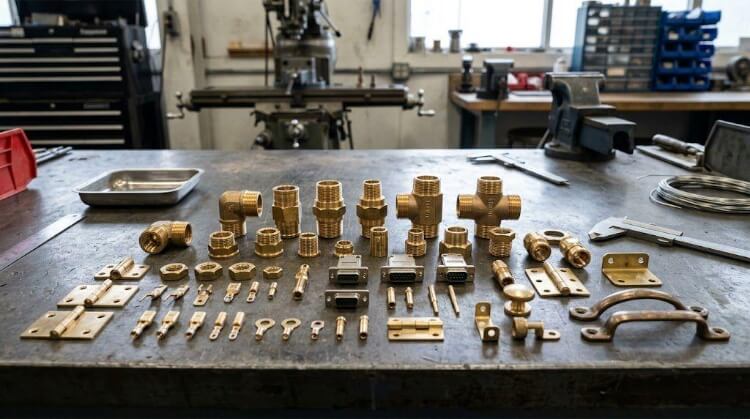
Brass works best when one part needs several advantages at once. That is why it shows up so often in fittings, finish hardware, hinges, terminals, clips, connector parts, lamp hardware, and other components that need a workable mix of machining quality, appearance, corrosion resistance, and electrical performance.
What makes brass useful in fabricated parts?
Brass machines cleanly and usually gives a better-looking surface than many purely functional alloys. That makes it a practical choice for inserts, fittings, lock parts, terminals, and visible hardware with drilled holes, threads, or other small details.
It also works well in many indoor and light-duty commercial environments where plain steel may rust too easily and where surface appearance still matters. For many visible parts, that balance is enough to justify brass before higher-strength materials are considered.
For contact-related parts, brass often gives a more practical balance than either steel or pure copper. Common brass grades used in connectors, clips, sockets, and contacts offer moderate conductivity, better shape stability, and easier fabrication than softer, higher-conductivity copper.
When is brass a better choice than steel, aluminum, or copper?
Brass is often a better choice than steel when rust resistance, machining quality, or a visible finish matter more than maximum strength. It can also beat aluminum when thread durability, surface feel, or decorative finish matters more than low weight.
Compared with copper, brass is usually easier to control in production when the part also needs stiffness, wear resistance, and more stable forming or machining behavior. That is a big reason brass appears so often in formed hardware, connectors, and machined fittings, rather than only in high-conductivity parts.
When is brass the wrong material choice?
Brass is usually the wrong choice for high-load structural parts. It is also a poor fit for weight-sensitive products where aluminum solves the job more efficiently.
It is not the best default choice for salt-heavy service either, especially when the alloy has been chosen only for appearance or machining convenience. Marine or saltwater exposure should push the discussion toward alloys such as C46400 rather than general decorative or machining-first brasses.
Brass can also be the wrong choice in cost-driven parts that do not need its machining, finish, or conductivity advantages.
How should the part function guide material selection?
The part function should decide the material. A decorative trim piece, an electrical terminal, a threaded fitting, and a bent cover may all be brass parts, but they do not need the same alloy logic.
If the part is mainly decorative, finish response and surface consistency should lead the decision. If it is mainly electrical, conductivity and forming behavior matter more. If it is machining-heavy, thread quality, burr control, and cycle stability should lead.
How to Choose the Right Brass Grade?
Brass grades do not behave the same way on the shop floor. Some are better for formed sheet parts. Some are better for drilled and threaded components.
Brass grades used for forming and bending
For bent or stamped sheet parts, C26000 and C26800 are usually the best place to start. Both are associated with formed and visible applications such as hinges, decorative hardware, connectors, clips, lamp hardware, socket shells, and similar sheet-based products. Alpha brasses in this range are also known for good ductility and cold-workability.
If the part is appearance-sensitive, these grades make even more sense, since bend quality and surface consistency are more likely to become production issues before strength. By contrast, C28000 fits a stronger sheet, architectural trim, door-frame-style hardware, and other jobs where tighter cold-forming is not the priority.
Brass grades used for machining and threaded parts
For drilled, tapped, turned, or threaded parts, C36000 is usually the first grade to review. It is a standard free-cutting brass widely used in fittings, inserts, adapters, sensor bodies, lock hardware, and other machining-intensive parts.
Its advantage is simple: cleaner cutting, better thread quality, and more stable machining on parts with several secondary operations. The tradeoff is just as important. C36000 is a machining-first grade, not the default answer for bend-heavy geometry.
Brass grades are used for electrical, visible, and corrosion-focused parts
For electrical and formed contact parts, C26000 and C26800 are usually more useful than C36000. They fit parts that need both conductivity and formability, such as clips, terminals, sockets, and similar formed hardware.
For visible hardware, C26800 is a practical grade to consider because it performs better than a machining-first alloy for finish hardware, lamp fixtures, hinges, and other appearance-sensitive parts.
For salt-heavy or marine-adjacent service, C46400 should be reviewed separately. It is associated with marine hardware, shipboard equipment, decorative fittings, valve stems, shafting, bolts, nuts, and other parts that require better resistance to both fresh and salt water.
How to match brass grade to the job?
A short selection rule works well. Start with C26000 or C26800 for bent or stamped sheet parts. Review C28000 when a stronger sheet or larger hardware is more important, and when tight cold forming is not the main concern. Use C36000 when machining speed, thread quality, and repeatability drive the part. Review C46400 early when corrosion exposure is part of the service condition.
Which Fabrication Processes Work Best With Brass?
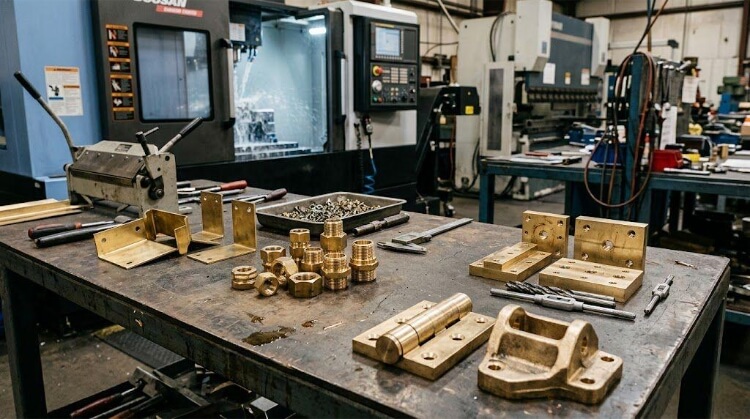
Brass can be cut, formed, machined, and assembled in several ways. In general, brasses are well suited to rolling, drawing, stamping, cold forming, and machining.
Cutting methods for brass sheet and plate parts
Laser cutting is usually the best starting point for prototypes, low-volume parts, and flat parts with frequent geometry changes. Punching makes more sense when the geometry is stable, and the volume is high enough to reward a repeat process. Shearing and sawing still make sense for simple blanks.
Bending, forming, and stamping considerations
Brass can form well, but the bend quality drops quickly when the grade, thickness, bend radius, and feature placement are misaligned. That is why formed sheet parts should be matched to a formable grade early, not after a crack shows up on the first sample. Alpha brasses used in formed products are especially suited to cold working.
Press brake bending is usually the better starting point for low- to mid-volume parts such as covers, brackets, channels, and small housings. Stamping becomes more attractive when the geometry is stable, and the volume is high enough to justify tooling.
Machining, drilling, and hole-making for brass parts
Machining is often the main reason brass is selected in the first place. That matters in fittings, inserts, adapters, sensor bodies, valve parts, and other components with drilled holes, threads, chamfers, grooves, or tight diameters. C36000 is especially associated with this kind of route.
Many brass parts follow a mixed route: cut first, form second, and machine last on critical features. That sequence usually provides better control than forcing every feature into a single stage.
Joining options for brass parts and assemblies
Mechanical fastening is often the cleanest choice when the assembly needs service access or easy replacement. Soldering and brazing are common when the joint needs to be sealed or when the assembly includes smaller brass parts. Welding is not always the best first choice for visible brass parts or smaller, detailed components. Brasses generally solder and braze well, while some leaded machining grades are a poor fit for welding-intensive jobs.
How to Design Brass Parts for Better Manufacturability?
Good brass design reduces scrap, protects finish quality, and keeps costs under control.
Bend radius, thickness, and crack risk
Tight bends create crack risk faster than many teams expect. Even a workable alloy can fail if the bend is too sharp for the thickness and the material condition. On visible parts and narrow flanges, a small crack at the bend line may look minor in a sample but become a real rejection problem in production.
Hole placement, edge distance, and feature spacing
Holes placed too close to bends are a common design mistake. They can distort during forming, shift slightly, or create weak material zones that crack more easily. Small edge distances, narrow tabs, and tight slots can create the same kind of instability during cutting or forming. Some features are safer after forming, not in the flat pattern.
Surface protection during forming and handling
Brass is often selected for appearance, so surface protection cannot be treated as a small detail. On decorative brass parts, scratches and contact marks often result in more rejects than dimensional errors.
The visible face should be defined before production starts. If the part is brushed, polished, or plated, the handling method should already be part of the process plan.
Tolerance limits that make sense for brass parts
Tighter tolerances do not automatically make a brass part better. In many cases, they only make the part slower to quote, harder to produce, and more expensive to inspect. Control what affects fit, function, or visible alignment, and relax the rest.
How Surface Finish Affects Brass Part Performance?
Finish affects more than the look of a brass part. It also affects tarnish behavior, handling damage, contact performance, inspection standards, and batch stability.
Natural brass, brushed brass, and polished brass
Natural brass works well for internal hardware or parts where aging is acceptable. It maintains the material’s base look, but it will darken over time, so it is not the best choice when appearance must stay bright and stable.
Brushed brass is usually the safer option for visible parts that require a more controlled surface finish. It hides small marks better than a polished surface.
Polished brass is usually chosen when appearance is the main goal. It gives a brighter finish, but it also makes scratches, fingerprints, and handling marks much easier to see. Use polished brass only when the appearance target justifies the extra handling risk.
Plating and coating options for functional or cosmetic needs?
Plating is often used when bare brass does not give the right final result. Nickel or chrome plating may be chosen when the part needs a more stable appearance, different surface behavior, or a cleaner decorative finish.
Clear coatings are often used when the goal is to slow tarnish without fully hiding the brass look. The real question is whether the finish supports the service and whether it can be cleanly repeated in production.
How does finishing affect conductivity, corrosion behavior, and appearance?
The finish choice can change how the part performs. A decorative coating may improve appearance but reduce conductivity at a contact area. A bright-plated finish may look cleaner, but it can also increase process costs and the risk of cosmetic inspection failures.
Color variation, gloss differences, edge buildup, and handling marks can all become rejection points on visible brass parts, even when the dimensions are still acceptable.
What should be confirmed before approving a finish for production?
The finish approval process should start with a clear sample standard. The team should agree on color, texture, gloss, and what counts as an acceptable visible surface.
The visible side should also be defined clearly before production starts. Confirm whether the finish is mainly cosmetic, mainly functional, or both. A finish should be approved as a production condition, not just as a sample appearance.
How to Control Cost, Quality, and Supplier Risk?
A brass part can look simple and still become expensive if the alloy, process route, finish standard, or inspection logic does not match the job.
What drives the cost of a brass fabricated part?
In brass work, cost is often driven as much by process route, finish risk, and inspection level as by raw material. Machining-intensive brass parts become expensive quickly when threads, secondary features, or cosmetic standards are combined. Decorative parts can also cost more to protect and inspect than to cut or bend.
How do prototype and production strategies differ?
Prototype routes usually optimize for speed and flexibility. Production routes optimize for repeatability, handling control, and finish consistency. A route that works with manual touch-up on a sample may be too unstable for production brass parts with a visible finish.
Quality checks that matter for brass parts
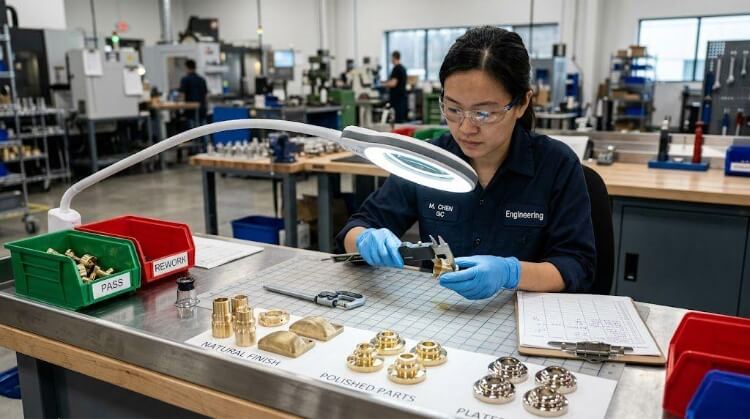
For formed parts, the main checks are usually bend angle, flatness, hole location, and edge condition. For machined parts, thread quality, burr control, diameters, and assembly fit matter more.
Visible brass parts need clear cosmetic rules. A part can be dimensionally correct yet unusable if the visible face is scratched, uneven, or poorly finished.
What buyers should include in an RFQ?
A good RFQ should include the drawing, the alloy (if known), the finish requirement, quantity, critical dimensions, and any visible-side note. It should also say whether the quote is for prototype supply or production supply.
A weak RFQ often creates more delay in finish approval and process alignment than in raw pricing.
Conclusion
Brass works well when the alloy, process, and finish match the part’s real job.
Most brass problems stem from mismatches, not from the material’s name itself. The wrong grade gets used on a bend-heavy part. A machining-first alloy gets pushed into a finish-sensitive application. A sample finish gets approved without asking whether it can hold up in production.
Need Help Choosing the Right Brass Grade or Process? If you are planning a brass part and want to avoid the wrong grade, unstable forming, finish problems, or unnecessary cost, our team can help. Send us your drawings, material requirements, or project details. We will review the part, suggest the right brass grade and process, and provide a quote for prototyping or production.
FAQs
Is brass a good material for fabricated parts?
Yes, when the part needs a mix of machinability, visible finish, moderate corrosion resistance, or workable conductivity. It is less suitable when the design is driven by low weight, high structural load, or more aggressive service conditions.
What brass grade is best for bent sheet parts?
Start with C26000 or C26800. They are usually the most practical first choices for bent or stamped sheet parts.
What brass grade is best for machined and threaded parts?
C36000 is usually the first grade to review for fittings, inserts, adapters, and other machining-heavy parts where thread quality and cutting stability matter.
Does surface finish matter on brass parts?
Yes. Finish affects appearance, contact-area conductivity, corrosion behavior, handling risk, and batch consistency.
What should be included in an RFQ for brass fabrication?
Include the drawing, grade if known, finish requirement, quantity, critical dimensions, and any visible-side or cosmetic notes. Also, say whether the request is for prototype supply or production supply.