
 English
  Spanish
  German
  Russian
  Italian
  French
Copper is not the right material for every fabricated part. It is usually chosen when the part must do more than hold shape, such as carrying current, moving heat, or maintaining reliable surface performance in service.
That added performance can justify the extra cost, but only when the material is used with a clear purpose. Copper also offers softer surfaces, higher material costs, and greater handling sensitivity than many standard fabrication metals.
That is why good copper fabrication starts with selection, not processing alone. The best results usually come from choosing copper only where it adds real value, then matching the grade, process, drawing, and surface requirements to the actual job.
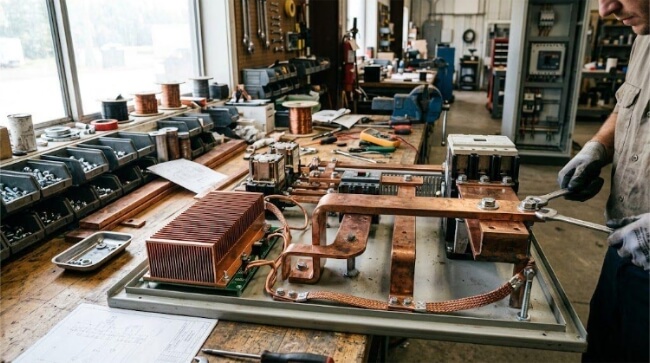
When Copper Is the Right Choice for a Part?
Copper makes sense when the material itself helps the part do the work. In these cases, the value comes from function, not from material preference.
Where copper makes sense for electrical performance?
Copper is a strong choice for busbars, terminals, contacts, connectors, and grounding parts. In these parts, conductivity is not a side benefit. It is part of the function.
Copper becomes more valuable when current load, voltage drop, or contact reliability is part of the design target. It also helps when strong conductivity must fit into a limited space.
Where copper makes sense for heat transfer?
Copper is also widely used for heat sinks, thermal spreaders, cooling plates, and other heat-transfer parts. Its value is clear when heat must move quickly and predictably through the part.
This is common in electronics, power systems, and similar assemblies where thermal control affects stability, output, or service life. In these cases, copper is paying for performance.
When is copper a better choice than aluminum or brass?
Copper is often the better choice when conductivity or heat transfer is the main reason the part exists. Aluminum may be a better fit when lower weight or lower cost matter more. Brass may be a better choice when machinability or appearance matter more than peak conductivity.
The best choice comes from the job of the part, not from habit in the drawing.
When does copper add cost without adding enough value?
Copper is often overspecified in brackets, covers, and support parts where electrical or thermal performance is not the real function. In these cases, it adds cost and process sensitivity without adding much value.
A better question is simple: does the full part need copper, or only one functional area? That one check can remove a lot of unnecessary costs.
Which Copper Grades Make Sense for Different Jobs?
Choosing copper is only the first decision. Grade choice affects performance, cost, sourcing, and the practicality of building the part.
When is C101 C101 worth the extra cost?
C101 makes the most sense when very high conductivity is a real requirement, not just a premium callout on the drawing. It is easier to justify when part performance depends on pushing electrical efficiency to the limit.
If the design does not clearly benefit from that extra performance, C101 can become an expensive upgrade with little practical return.
Why is C110 C110 often the more practical option?
C110 is often the more practical choice because it offers strong conductivity with a better balance of cost, availability, and production use. For many fabricated copper parts, it meets real requirements without pushing the project toward a higher-cost material.
That is why C110 often becomes the working grade in day-to-day manufacturing.
How does grade choice affect conductivity, cost, and availability?
Higher-purity copper can improve performance, but it can also raise cost and narrow sourcing options. That tradeoff should be tied to function, not assumed by default.
If the performance gain is clear, the extra cost may be justified. If the gain is small, a more common grade is usually a better basis for a project decision.
How to match copper grade to the real function of the part?
Start with the real job of the part. Is it carrying current, moving heat, serving as a contact surface, or mainly supporting assembly?
Then choose the grade that meets that need without overspecifying the material. The best grade is usually the one that delivers the required function at the least unnecessary cost and with the least supply risk.
Which Fabrication Processes Fit Copper Best?
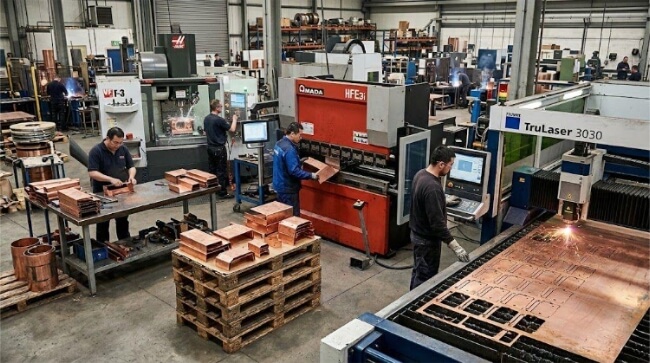
Copper can be cut, formed, machined, and joined in many ways, but the choice of process still matters. The best route depends on part shape, order volume, surface sensitivity, and how the part works in the final assembly.
When cutting, punching, or stamping, which is the better route?
Cutting, punching, and stamping are often the right starting points for flat copper parts. The better choice depends on geometry, edge requirements, and production volume.
Laser cutting is useful for flexible shapes and lower-volume work. Punching and stamping make more sense when the part is repeatable, and volume is high enough to justify tooling. For simple copper parts, the wrong process can raise cost without improving the result.
What to watch for in copper bending and forming?
Copper forms well, but that does not make bending risk-free. Soft materials mark easily, and visible surfaces can degrade quickly if handling and tool contact are not controlled.
Bend layout also matters. Tight bends, short flanges, and features placed too close to bend lines can make the part less stable and harder to build consistently. In copper work, good forming results often depend as much on protection and layout as on forming force.
Where can machining create surface or stability problems?
Machining is useful when copper parts need tighter features, local detail, or finished contact areas. It is often used for blocks, terminals, mounting faces, and precision connection features.
The main risk is that soft copper can mark, deform, or lose surface quality more easily than harder metals. Poor clamping, weak support, or rough handling can damage a part that looks easy to machine on paper.
What matters in welding, brazing, and final assembly
Joining matters more when the copper part must also carry current, transfer heat, or maintain a clean contact surface. In these parts, assembly quality affects function, not just fit.
Welding and brazing require control of heat, cleanliness, and oxidation. Final assembly also needs clear planning around which surfaces are functional, which can be touched, and which need protection. A copper part can be made correctly and still lose value if the wrong area is damaged during assembly.
What Design Choices Make Copper Parts Easier or Harder to Build?
A well-designed copper part reduces costs before production starts. Small drawing decisions can improve yield, protect critical surfaces, and make the part easier to quote and build with fewer problems.
How do bend layout and hole placement affect manufacturability?
Bends and holes need enough space to work together. When holes, slots, or cutouts sit too close to bend lines, the part becomes harder to form cleanly and more likely to distort.
This is a common drawing problem in copper parts because the material forms easily, but soft material can still shift or mark during bending. Cleaner bend layout usually means better consistency and less rework.
Why do thin features and soft sections create more risk?
Thin tabs, narrow sections, and unsupported features are more vulnerable in copper because the material is softer and more easily deformed during handling. A part may look simple in CAD but still be fragile in production.
This risk becomes more obvious during cutting, forming, stacking, and transport between processes. Features that are too light for the job can reduce yield even when the drawing looks easy.
Which surfaces need protection before production starts?
Some copper surfaces matter more than others. Contact areas, visible faces, and finished mounting surfaces often need protection from the beginning, not after damage happens.
That plan should be clear before fabrication starts. If the drawing does not identify which areas are functional and which are cosmetic, the part is more likely to pick up avoidable marks or handling damage.
Which tolerances raise cost without improving the part?
Tight tolerances should solve a real problem. If they do not support fit, function, or performance, they often add cost without adding value.
This matters even more in copper because soft material can be harder to keep stable through multiple steps. A better drawing applies tight control only where the part truly needs it, leaving the rest practical for production.
Common Copper Fabrication Problems and What Causes Them?
Copper is often described as easy to work with, but real production problems still happen when the material is treated like a standard sheet or machined metal. Most issues come from softness, surface sensitivity, heat behavior, or unclear handling rules.
Why do copper surfaces get marked so easily during handling?
Copper marks easily because its surface is softer and less forgiving than those of many common fabrication metals. Normal contact during stacking, bending, clamping, or assembly can leave dents, scratches, or tool marks.
This becomes a bigger problem when the part has visible faces or functional contact areas. In copper work, surface quality often depends as much on handling discipline as on the process itself.
How do oxidation and contamination create downstream problems?
Copper reacts quickly at the surface, which can create problems with joining, electrical contact, and the final appearance. Dirt, oil, fingerprints, and shop contamination can worsen the problem.
If surface condition matters, cleanliness cannot be treated as a late-stage fix. A copper part may be dimensionally correct and still miss the real requirement if the wrong surfaces are oxidized or contaminated.
Why can heat affect the quality during cutting or joining?
Copper conducts heat quickly, which can make thermal processes less predictable if the setup is poorly controlled. During cutting, welding, or brazing, heat behavior can affect edge conditions, joint quality, and the condition of nearby surfaces.
This is one reason copper projects should not be judged solely by geometry. The part may look simple, but the heat response can still make the job harder than expected.
Where does dimensional variation show up in soft or thin copper parts?
Dimensional variation often appears in thin sections, unsupported features, and parts that undergo multiple handling steps. Soft copper can shift, flex, or pick up small changes more easily than harder materials.
This does not mean copper cannot be made accurately. It means the design, process route, and support method need to match the part. In many cases, the problem is not the material alone. It is the lack of control over how the part moves through the production process.
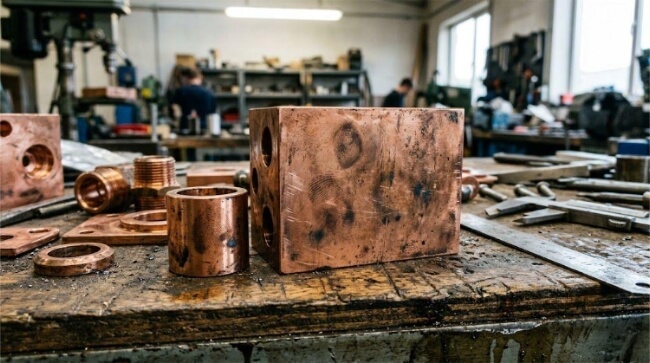
How Buyers Can Reduce Cost and Quote Risk in Copper Projects?
Copper projects go more smoothly when the RFQ clearly defines the actual requirement. A good quote depends on more than part shape. It also depends on the function, surface priorities, volume, and the level of performance the design actually needs.
What usually drives cost in copper fabrication?
Material price is only part of the cost story. Process choice, scrap rate, surface protection, handling risk, and secondary steps can all increase the quote.
In many copper projects, costs rise because the material is overspecified, the process does not match the volume, or the drawing requests protection and precision without clearly showing where they matter.
How does volume change the best process choice?
Volume changes what makes sense. A low-volume part may be better suited to flexible cutting and forming, while a repeat part may justify punching, stamping, or dedicated tooling.
The same copper part can have very different cost logic at different order quantities. Good quoting starts with the actual production volume, not just the part’s shape.
What should buyers confirm before sending an RFQ?
Buyers should confirm the copper grade, thickness, expected volume, and any critical performance requirements before asking for a quote. It also helps to identify contact areas, cosmetic surfaces, and any zone that cannot be damaged or coated.
That information helps the supplier choose the right process and reduces the chance of a slow quote, a wide price range, or avoidable back-and-forth during review.
How to choose the right manufacturing route for the project?
The best route starts with the part’s real job. If the part carries current, moves heat, or depends on clean contact areas, those needs should drive the material, process, and protection plan from the start.
The goal is not to choose the most advanced option on paper. The goal is to choose the route that gives the required performance with the least unnecessary cost, risk, and production friction.
Conclusion
Copper fabrication works best when the part truly depends on what copper does well. That usually means electrical performance, thermal performance, or a functional surface that cannot be treated like a standard structural metal part.
It also means copper should be specified with care. In many projects, the better results come from using it only where it supports the function, choosing a grade that meets the real requirement, and avoiding design or tolerance decisions that add cost without improving performance.
Need help with a copper part that must carry current, move heat, or protect a critical contact surface? Send us your drawing, quantity, and performance requirements. Our engineering team can review the part, recommend the appropriate copper grade and process route, and help you reduce unnecessary costs before production starts.
FAQs
Is copper easy to fabricate?
Copper is workable, but it is not automatically easy to manufacture well. It forms well, but its soft surface, heat behavior, and handling sensitivity can still create quality problems if the process is not controlled.
What copper grade is most commonly used in fabrication?
C110 is often the more practical choice for many fabricated copper parts because it offers strong conductivity with a better balance of cost and availability. C101 makes more sense when very high conductivity is a defined design requirement.
Is copper always better than aluminum for electrical parts?
Not always. Copper is often the better choice when conductivity is central to the function. Still, aluminum may be a better fit when lower weight or lower cost matters more, and the design can accept lower conductivity.
What is a common mistake in copper part design?
A common mistake is specifying copper across the full part when only one area actually needs copper performance. Another is failing to define functional surfaces, bend-sensitive features, or tolerance priorities clearly on the drawing.
What usually increases the cost of a copper part?
Cost often rises because of material grade, handling risk, surface protection, scrap rate, and process choice. It also rises when copper is overspecified or when the RFQ does not clearly show which requirements truly matter.
What should be included in a copper part RFQ?
A strong RFQ should include the copper grade, thickness, quantity, part function, and any critical surface or contact area. It should also show which areas are cosmetic, which are functional, and where damage, coating, or oxidation is not acceptable.