
 English
  Spanish
  German
  Russian
  Italian
  French
Q235 steel is the workhorse carbon structural steel in Chinese manufacturing. Engineers and buyers rely on it to drive down costs on frames, brackets, machine bases, and welded assemblies. It delivers a reliable strength-to-cost ratio, fast forming, and excellent weldability.
But treating Q235 as a universal “cheap steel” is a costly mistake. Without strict grade selection (A to D), thickness control, and a defined surface treatment strategy, your low-cost fabrication project will quickly fail due to severe welding distortion or early-stage rust.
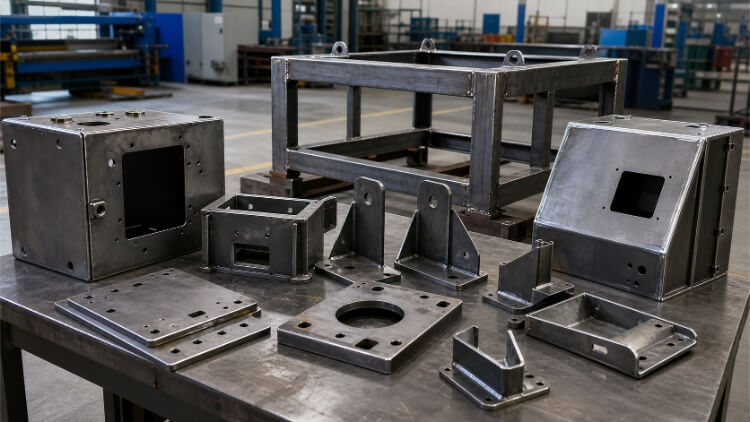
Q235 Steel at a Glance
Q235 steel is widely used because it is affordable, weldable, and easy to fabricate. Before choosing it, engineers need to understand its basic strengths and limits.
Carbon structural steel for general fabrication
Q235 belongs to the family of plain carbon structural steels. The “Q” stands for yield point (Qu Fu Dian), and “235” represents the approximate yield strength of 235 MPa.
Q235 typically caps carbon content around 0.22%. This specific chemical baseline is why it performs so well on the shop floor. It allows aggressive bending and fast welding without the pre-heating or post-weld heat treatment (PWHT) cracking risks associated with higher-carbon alloys.
Strength, weldability, and cost profile
The material handles typical structural loads efficiently, offering a yield strength around 235 MPa. It is not designed for high-stress or lightweight aerospace applications. Its primary engineering value lies in fabrication speed. Welders and CNC operators can process Q235 rapidly, keeping your overall manufacturing overhead firmly under control.
Common supply forms and typical applications
Steel mills supply Q235 primarily as hot-rolled plates, sheets, tubes, and structural profiles (like angle or channel steel). In heavy fabrication and sheet metal shops, you will see it specified for machine chassis, electrical enclosures, heavy-duty mounting brackets, and industrial platforms.
Grades, Standards, and Substitution Risk
Q235 is not a single fixed choice for every project. Grade, standard, and approval details can affect safety, inspection, and international sourcing.
Chemical and mechanical baseline
The low-carbon chemistry dictates Q235’s mechanical limits. It limits maximum hardness but guarantees ductility. This ductility prevents cracking during heavy press brake operations. However, if your design demands high load capacity within a restricted, lightweight footprint, Q235 will simply be too heavy and weak for the job.
Q235A, Q235B, Q235C, and Q235D selection
Many engineers specify “Q235” on a drawing without realizing it dictates four distinct quality grades. The critical difference lies in the strict control of impurities (sulfur and phosphorus) and mandatory impact testing temperatures.
| Grade | Practical Use | Selection Logic |
| Q235A | Non-critical parts | Basic use with lower testing requirements |
| Q235B | General manufacturing | Industry standard for fabricated parts |
| Q235C | Lower temperature or impact-risk parts | Better impact requirement than B |
| Q235D | Colder or higher-risk structures | Better low-temperature impact requirement |
Q235B is the industry standard for general manufacturing. You must step up to Q235C or Q235D when the fabricated part faces sub-zero temperatures, heavy vibration, or dynamic impact loads. Using Grade A in these conditions guarantees premature structural failure.
ASTM A36, SS400, and S235JR comparison
Q235, ASTM A36, SS400, and S235JR frequently cross paths in international supply chains. While they share similar structural applications, they are not automatically interchangeable.
European and US standards often enforce stricter limits on phosphorus and sulfur impurities. Swapping A36 for Q235 just because the yield strength matches on paper will cause your parts to fail incoming quality control (IQC) if the client strictly audits the chemical composition.
Material certificate and approval risk
Material substitution remains a major risk point for global manufacturing projects. If a client drawing explicitly specifies an ASTM, JIS, or EN standard, never default to Q235 without formal engineering approval.
Before substituting, secure written sign-off. Verify exactly what documentation the client requires to release the parts, whether that involves a Material Test Certificate (MTC), specific heat numbers, or third-party laboratory verification.
Mechanical Performance in Real Parts
Material data only matters when it connects to real part performance. Load, thickness, deformation, and fatigue risk all change how Q235 behaves in use.
Yield strength and load capacity
At roughly 235 MPa yield strength, Q235 excels in static, load-bearing applications like machine bases, mounting plates, and equipment frames. It carries typical industrial loads predictably and safely.
However, if your design dictates a high strength-to-weight ratio, Q235 will force you into bulky, heavy geometries. It is not the right material for lightweight mobility or aerospace structures.
Tensile strength and deformation risk
Structural failure in sheet metal rarely means the part snaps in half; it usually means unacceptable deformation. Large Q235 panels or long brackets will sag under heavy, concentrated loads.
Relying solely on material thickness to prevent warping is a costly mistake. You must incorporate bends, structural ribs, or gussets into your design to maintain rigidity and dimensional stability.
Thickness effect on strength
Thin sheet Q235 (1mm – 3mm) works perfectly for folded enclosures and light brackets. Heavy plate (10mm+) provides massive stability for industrial chassis.
But stepping up thickness to chase strength creates a cascading effect on production costs. Thicker plates dramatically increase laser cutting time, require higher-tonnage press brakes, and demand massive heat input during welding. Once you exceed 8mm or 10mm, you also add the hidden cost of edge beveling (chamfering) just to achieve full weld penetration.
Fatigue risk under repeated stress
Q235 performs exceptionally well under static loads. But under continuous vibration, cyclic loading, or repeated mechanical shock, fatigue becomes a critical failure point.
Micro-cracks will initiate at areas of high stress concentration. If your part operates on a vibrating motor mount or moving robotic arm, you must closely monitor sharp internal corners, punched holes, and the toe of weld joints.
Fabrication Limits in the Workshop
Q235 is easy to process, but it still has workshop limits. Cutting, bending, punching, welding, and machining must be controlled to avoid quality problems.
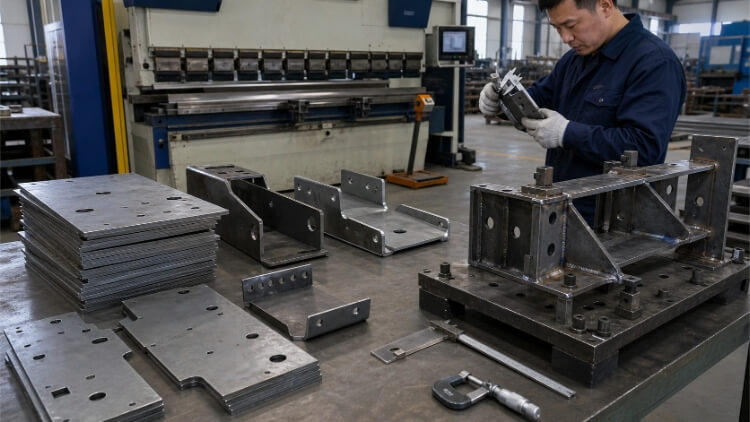
Laser cutting edge quality and heat effect
Q235 cuts fast and clean on modern fiber lasers. However, processing heavy plates generates a localized Heat-Affected Zone (HAZ). The intense heat hardens the cut edge significantly.
If your drawing calls for CNC tapping, countersinking, or precision reaming immediately adjacent to a laser-cut edge, that hardened zone will destroy cutting tools, snap taps, and ruin thread quality. As a rule of thumb, keep tapped holes or precision reamed features at least 1.5x to 2x the material thickness away from any laser-cut edge.
Bending radius and springback control
Q235 yields predictably on a press brake, but material springback is unavoidable. The exact springback angle fluctuates based on plate thickness, tooling radius, and the steel mill’s rolling direction.
Furthermore, placing punched holes or hardware cutouts too close to the bend line will force those features to stretch and deform during forming. Always design hole edges at least 2.5x to 3x the material thickness away from the bend line to guarantee assembly tolerances.
Punching, stamping, and hole accuracy
For high-volume runs, CNC turret punching often beats laser cutting in sheer speed. Q235 punches cleanly, provided the die clearance perfectly matches the material thickness.
Incorrect die clearance instantly leads to severe edge roll, heavy burrs, and localized part distortion. This drives up manual deburring time and increases your final piece price.
Welding distortion and stress relief
Q235 boasts exceptional weldability, but heat inevitably causes metal to move. Long, continuous welds on thin Q235 panels will cause the part to warp and buckle out of tolerance.
Controlling this requires rigid fixturing, stitch welding, and strict weld sequencing. For high-precision machined weldments, you must specify a thermal stress relief (annealing) cycle. Without it, the residual welding stress will release during CNC machining, causing the final part to twist completely out of spec.
Surface Treatment and Service Cost
Q235 has a low material cost, but corrosion protection can change the total cost. The right surface treatment depends on environment, appearance, assembly, and service life.
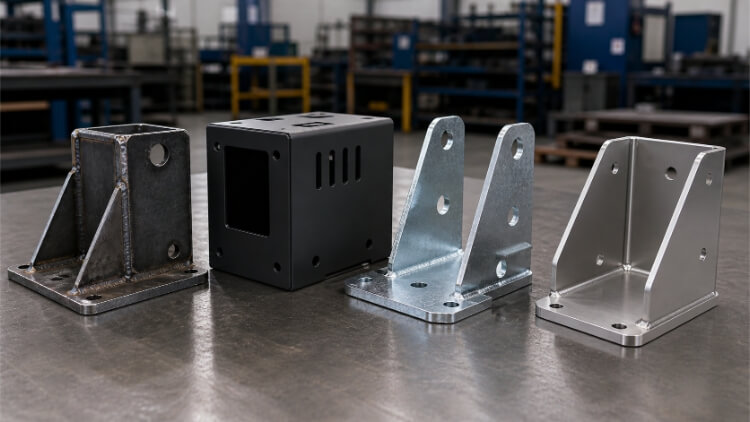
Bare steel rust risk
Bare Q235 rusts aggressively when exposed to moisture. It is completely unsuitable for outdoor environments, ocean freight, or high-humidity facilities without proper surface protection.
Even if the part is designed for a climate-controlled indoor environment, the bare steel will still require a light oil coating just to survive transport and warehouse storage.
Powder coating, painting, and e-coating
Powder coating provides a tough, scratch-resistant finish ideal for machinery enclosures, equipment panels, and standard industrial parts. Liquid painting serves as a flexible option for highly budget-sensitive projects.
For complex weldments or parts with hidden internal cavities, standard spray methods fail to provide full coverage. In these cases, E-coating (electrophoretic deposition) is the mandatory choice to ensure complete, uniform rust prevention on every internal surface.
Galvanizing for outdoor structures
Hot-dip galvanizing (HDG) is the industry standard for outdoor brackets, structural frames, and platforms exposed to the elements. The molten zinc creates a robust metallurgical bond with the steel.
However, engineers often overlook the thermal impact. The galvanizing bath operates at roughly 450°C. Dipping thin-gauge Q235 panels into molten zinc will cause massive thermal distortion, warping the sheet metal beyond repair. HDG should be reserved for thicker plates and heavy structural sections.
Coating thickness and assembly fit
This is where many assemblies fail on the shop floor. Surface treatments add measurable volume to the part. Powder coating typically adds 60 to 100 microns of thickness, while galvanizing can add anywhere from 50 to 120 microns.
If you design sliding tracks, hinge points, or tight assembly clearances based on the raw material dimensions, the parts will not fit together after coating. You must strictly specify masking requirements for critical mating surfaces and plugged tapped holes on your manufacturing drawings. Powder coat inside an M4 thread will lock your assembly completely.
Long-term maintenance cost
Focusing solely on the low raw material cost of Q235 is a trap. If you under-spec the surface treatment for a harsh environment, you will face severe long-term life-cycle costs (LCC). The initial savings disappear completely when you factor in the labor costs of field repairs, repainting rusted installations, and handling angry client claims.
Q235 vs Alternative Materials
Selecting Q235 is often a baseline decision. When structural or environmental requirements increase, you need to know when to pivot to an alternative material.
| Material | Best For | Main Advantage | Main Concern |
| Q235 | General structures and fabricated parts | Low cost and fast fabrication | High rust risk |
| Q345 | Higher load structures | Higher yield strength | Higher material cost |
| Stainless Steel | Corrosion-resistant parts | Excellent corrosion resistance | High cost and tougher machining |
| Aluminum | Lightweight assemblies | Low weight and natural rust resistance | Higher cost and specialized welding |
| Cold Rolled | Thin sheet enclosures and aesthetic parts | Better surface and dimensional control | Limited structural use compared to plate |
Q235 vs Q345
Choose Q235 when cost reduction and general fabrication matter most. Upgrade to Q345 (now often designated as Q355) when your design demands higher load capacity, superior structural integrity, and better low-temperature performance without adding excessive material thickness.
Q235 vs stainless steel
Q235 wins easily on upfront material cost, but it demands continuous corrosion management. Stainless steel (like 304 or 316) is significantly more expensive and wears down cutting tools faster, but it is strictly required for food-grade processing, medical equipment, or highly corrosive chemical environments.
Q235 vs aluminum
Q235 provides a robust strength-to-cost ratio but carries a heavy weight penalty. Aluminum alloys (like 5052 or 6061-T6) slash the weight by nearly two-thirds and offer natural oxidation resistance. However, aluminum increases your material costs and requires more strictly controlled TIG or MIG welding processes.
Q235 vs cold rolled steel
This distinction is critical for sheet metal fabrication. Q235 is typically supplied hot-rolled, leaving a rough, scaled surface with looser thickness tolerances. Cold Rolled Steel (CRS, such as SPCC) undergoes further processing, resulting in a smooth finish and tight dimensional accuracy. Specify CRS when designing visible electronic enclosures, tight-tolerance housings, and cosmetic panels that require a flawless powder-coated finish.
Conclusion
Q235 is a highly practical carbon structural steel for a vast range of general fabrication projects. It offers an excellent balance of moderate strength, reliable weldability, easy formability, and aggressive cost control. It performs predictably for machine bases, brackets, structure frame, and welded enclosures.
However, the main engineering risks involve corrosion, improper grade selection for low temperatures, severe welding distortion on thin panels, and failing to account for coating thickness during assembly. Engineers and buyers must evaluate Q235 based on structural loads, operating environments, and strict surface treatment planning.
If you are planning a Q235 steel part, send your drawing for a strict DFM review. Our engineering team has 10 years of experience in sheet metal fabrication. We help you check the material grade, thickness, forming risks, welding sequence, and surface treatment options.