 English
  Spanish
  German
  Russian
  Italian
  French
In CNC machining and sheet metal fabrication, anodized aluminum is the default surface finish for a reason: it hardens the exterior, prevents corrosion, and delivers a professional appearance. However, when a batch of anodized parts fails quality inspection, the root cause is rarely the anodizing bath itself.
Anodized aluminum is created via an electrochemical process that converts the metal’s surface into a durable, non-conductive oxide layer. Integrated directly into the substrate, it cannot chip or peel, maximizing surface hardness and corrosion resistance while preserving tight dimensional tolerances.
This guide focuses on the practical side of anodized aluminum in manufacturing. It explains how anodizing affects dimensions, how different aluminum alloys behave, and what engineers should pay attention to before production starts.
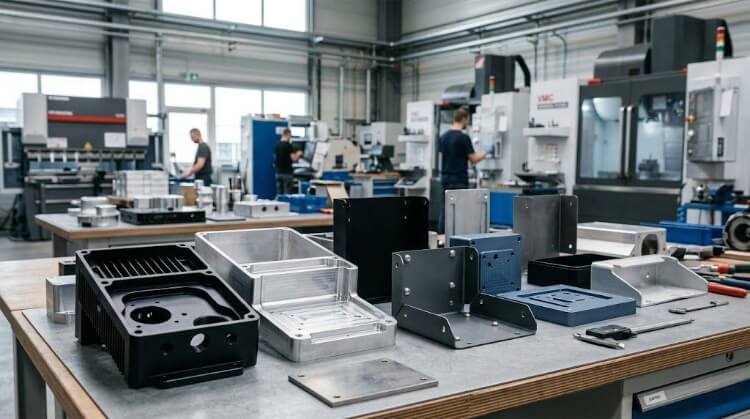
How Anodizing Changes Aluminum Surfaces?
To control the outcome of an anodized part, you must first understand that anodizing is fundamentally different from adding a surface coating. Anodizing is an electrochemical process that converts the existing aluminum surface into a durable oxide.
Porous structure and dye absorption
During the process, the aluminum substrate is submerged in an acid electrolyte bath while an electrical current is applied. This forces the aluminum to oxidize rapidly and uniformly across the exposed geometry.
As the aluminum oxide layer grows, it forms a highly ordered, microscopic honeycomb pattern. This porous structure dictates how the surface handles color and sealing.
The microscopic pores act like a sponge for industrial dyes, drawing the color deep into the material rather than just painting the surface. Once sealed in the final stage, the color is locked in, providing excellent UV resistance and mechanical durability.
Type II vs Type III physical benchmarks
Type II (Standard Anodizing) typically creates an oxide layer between 5 to 25 microns thick. It allows for vibrant dyeing and provides adequate corrosion resistance for general cosmetic and protective use.
Type III (Hardcoat Anodizing) runs at lower temperatures and higher voltages to create a denser layer ranging from 25 to over 50 microns. This process elevates the surface to microhardness levels of 500-600 HV—making it comparable to hardened steel for wear resistance. However, its natural dark gray or bronze tint severely limits dyeing options.
Quick Reference: Type II vs. Type III Specification
| Feature | Type II (Standard Anodize) | Type III (Hardcoat Anodize) |
| Typical Thickness | 5 – 25 µm (0.2 – 1.0 mil) | 25 – 50+ µm (1.0 – 2.0+ mils) |
| Microhardness | 200 – 300 HV | 500 – 600+ HV |
| Dimensional Growth | Minimal (~2.5 – 12.5 µm outward) | Significant (~12.5 – 25+ µm outward) |
| Dyeing Capability | Excellent (Accepts vibrant colors) | Poor (Limited to dark gray/black) |
| Primary Application | Cosmetics, enclosures, paneling | Gears, sliding friction, extreme wear |
The Engineering Rule: Never specify Type III hardcoat purely for cosmetic reasons. The extreme thickness will complicate your CNC machining tolerances, and the natural dark tint of the hardcoat layer will make vibrant color matching impossible.
Dimensional Changes in Precision Parts
The most common engineering oversight regarding anodized aluminum is failing to account for dimensional shifts. Anodizing permanently changes the geometry of your part.
The 50/50 oxide growth rule
Anodizing does not simply add thickness on top of the surface. As a rule of thumb, the oxide layer penetrates 50% into the substrate and grows 50% outward.
For example, if you specify a Type III hardcoat with a total thickness of 40 microns, the part’s actual physical dimension will only increase by 20 microns per surface.
Thread binding and tight tolerances
That outward growth becomes highly problematic for internal features like tapped holes and tight-tolerance bores. A 10-micron outward growth on the walls of a threaded hole decreases the effective pitch diameter from multiple angles simultaneously.
For M4 or smaller threads, standard anodizing can easily cause a functional fastener to bind or cross-thread. The best practice is to oversize the tap during CNC machining to accommodate the anticipated oxide growth.
Masking and rack contact realities
The anodizing process requires a continuous electrical circuit, meaning the part must be physically clamped to a conductive titanium or aluminum rack. Wherever the rack grips the part, the aluminum will not oxidize, leaving a visible bare spot known as a “rack mark.”
Additionally, if critical tight-tolerance areas (like bearing press-fits) cannot be anodized, they must be manually masked with silicone plugs or tape. Masking is a labor-intensive, manual process that significantly increases unit cost and lead times.
Drawing callouts and tolerance planning
Effective design for manufacturability (DFM) requires explicit communication on the engineering drawing. Never leave the final dimension state up to supplier interpretation.
To avoid disputes, use explicit drawing notes such as: “ALL DIMENSIONS AND TOLERANCES APPLY AFTER FINISH” or “MASK BORE A PRIOR TO ANODIZING.” This forces the machine shop to calculate the pre-plating machining tolerances accurately.
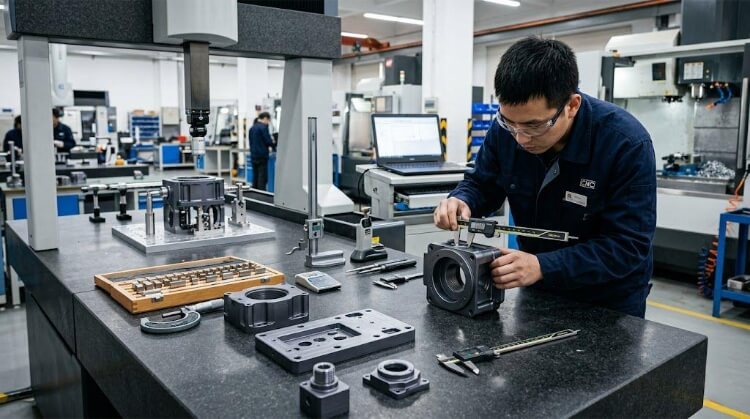
Finish Quality Across Aluminum Alloys
A common misconception in procurement is that “aluminum is aluminum.” In reality, the chemical composition of your chosen alloy strictly dictates the final cosmetic yield.
6061 consistency in structural and cosmetic applications
If you need a predictable, uniform finish, 6061 is the undisputed industry standard. Its balanced magnesium and silicon alloying elements respond perfectly to the electrochemical process. It consistently produces a clear, dense oxide layer that accepts dyes flawlessly, making it the safest choice for high-volume production.
7075 discoloration and hardcoat risks
If you want a perfect, uniform black finish, hardcoat anodizing 7075 aluminum will be a nightmare. The high zinc content fundamentally alters the oxidation rate. When subjected to Type III hardcoat, 7075 typically develops a muddy, yellowish-gray or olive-green tint.
- The Engineering Workaround: If the project strictly requires 7075 for its tensile strength but demands a uniform dark cosmetic finish, engineers should downgrade to Type II anodize (which accepts dye much better) or pivot entirely to a thin-film Cerakote finish.
Copper-rich alloys and bath dissolution
Alloys in the 2000 series, such as 2024, rely on heavy copper content to increase mechanical strength. Copper, unfortunately, dissolves in the acidic anodizing bath instead of oxidizing. This leaves a highly porous, dull surface that often looks splotchy and offers significantly lower corrosion protection compared to a 6000 series equivalent.
Cast aluminum limits and coating alternatives
Die-cast aluminum, such as A380, simply does not anodize well. The extremely high silicon content required to make the metal flow into molds does not oxidize; it remains on the surface as microscopic dark specs. Attempting to clear-anodize die-cast parts results in a dirty, dark gray finish that cannot be dyed evenly.
- The Engineering Workaround: For die-cast components, engineers must explicitly change the finish callout on the drawing to powder coating or electroless nickel plating.
Quick Reference: Anodizing Suitability by Alloy
| Alloy Series | Anodizing Suitability | Type II Dye Quality | Type III Hardcoat Quality | Common Application |
| 6xxx (e.g., 6061) | Excellent | Vibrant & Consistent | Excellent (Dark Gray) | Structural parts, enclosures |
| 7xxx (e.g., 7075) | Fair to Good | Good | Poor (Yellow/Olive tint) | High-stress aerospace parts |
| 5xxx (e.g., 5052) | Excellent | Very Good | Good | Sheet metal enclosures |
| 2xxx (e.g., 2024) | Poor | Poor (Splotchy) | Poor (Soft layer) | Parts requiring high fatigue limit |
| Die Cast (A380) | Not Recommended | Unusable | Unusable | Housings, complex castings |
Surface Appearance and Production Defects
Even with the right alloy and proper dimensioning, cosmetic defects can still derail a mass production run. Most of these shop-floor issues are predictable and entirely preventable by establishing realistic, enforceable cosmetic acceptance criteria during the prototyping phase.
Machining mark amplification
Anodizing will never hide a poor surface finish; it will actually amplify it. The acid bath chemically cleans the base metal, stripping away oils and highlighting every CNC step-over, tool mark, and chatter pattern.
- The Metric: To ensure a premium cosmetic finish, specify a pre-process surface roughness of Ra 0.8 µm (32 µin) or better on your drawing, typically achieved via fine bead blasting or orbital sanding prior to the bath.
Edge burning on sharp geometry
Sharp edges act as lightning rods for high-voltage current during the Type III hardcoat process. This concentrated current density causes sharp corners to overheat, creating a brittle oxide layer that chips off instantly during assembly.
- The Metric: To prevent edge burning, engineering drawings must explicitly mandate a minimum edge break or radius of R0.5mm (0.020″) on all external corners intended for hardcoat.
Seal failure and moisture penetration
The final and most critical step in anodizing is sealing the microscopic pores to lock in the dye and block out moisture. If the hot water or nickel acetate sealing bath is contaminated, the pores remain open.
Unsealed parts will quickly fade under UV light and permanently absorb human oils, leaving irremovable fingerprint stains. A simple dye spot test on the shop floor can instantly verify sealing integrity before the batch ships.
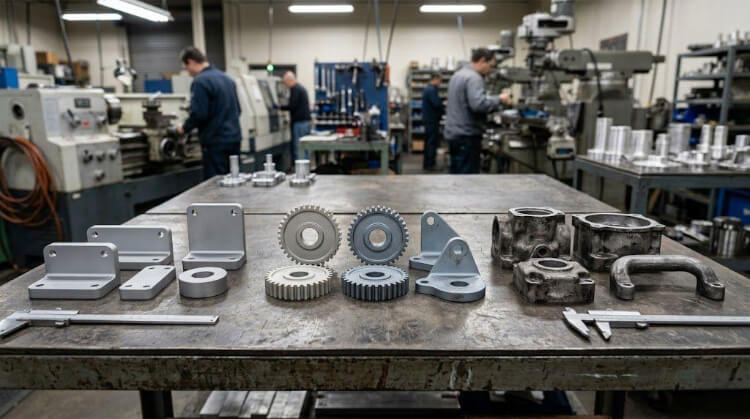
Process Selection for Production Parts
Before freezing a design, engineers must evaluate if anodizing is actually the right surface treatment for the part’s operating environment. Defaulting to anodizing without analyzing the mechanical application often leads to unnecessary costs or premature part failure.
Type II vs Type III applications
Specify Type II when the primary goals are aesthetics, color matching, and general corrosion resistance (e.g., consumer electronics enclosures, architectural panels). Specify Type III strictly for components subjected to sliding friction and severe abrasive wear, such as pneumatic cylinders, gears, and structural brackets.
Powder coating comparison
When extreme impact resistance or budget constraints take priority, powder coating outperforms anodizing. Powder coating is generally cheaper at high volumes, effortlessly hides minor machining marks, and works flawlessly on cast aluminum or sheet metal assemblies with mixed alloys.
Conductive coatings for EMI shielding
A perfectly anodized surface is an electrical insulator. If you are designing an electronics chassis that requires electrical grounding or EMI/RFI shielding, anodizing will break the circuit.
In these cases, engineers must specify a chemical conversion coating (often called Alodine or Chem Film) which prevents corrosion while maintaining electrical conductivity.
Production Consistency in Mass Manufacturing
Scaling a precision part from a prototype batch of 10 to a production run of 10,000 requires strict supply chain controls. Managing surface finishes at scale is about setting objective boundaries rather than subjective opinions.
Limit samples for batch control
To eliminate disputes over color matching, suppliers and buyers must agree on boundary boards. These are physical, signed-off metal tags that establish the lightest acceptable shade and the darkest acceptable shade for a specific part. If a production batch falls within this physical range, it passes QA.
Cosmetic zones and the hidden cost of masking
Not every surface of a CNC machined part needs to look like a smartphone casing. Drawings should clearly define A, B, and C cosmetic zones. “A surfaces” (highly visible) demand flawless finishing. “C surfaces” (internal, unseen) should allow for rack marks, minor scratches, and looser color consistency.
- The Cost Reality: Over-specifying cosmetic zones or demanding perfect anodizing on critical dimensions forces the manufacturer to manually mask the part. Manual masking is highly labor-intensive and can easily increase the per-unit finishing cost by 30% to 50%.
Conclusion
The vast majority of anodizing problems do not happen in the chemical bath; they happen because of decisions made in CAD. A successful production run relies heavily on understanding how the oxide layer alters tight tolerances and how the selected aluminum alloy will react to the process.
Ready to lock down your manufacturing process? Before production begins, the engineering team at TZR can review your drawings, tolerances, and alloy selection. Reach out today for a comprehensive engineering review.