 English
  Spanish
  German
  Russian
  Italian
  French
Aluminum chromating (also known as chem film or Alodine) is a chemical conversion process that creates a thin protective layer on aluminum. It provides excellent corrosion resistance, maintains surface electrical conductivity, and serves as an ideal base for paint, without altering part dimensions.
However, simply adding “clear chem film” or “yellow chromate” to a manufacturing drawing is a recipe for rejected parts. The final performance—and the color—depends heavily on the specific aluminum alloy, the surface pretreatment, and strict environmental compliance rules (like RoHS).
This guide breaks down exactly what engineers and procurement teams need to specify the right finish. We will cover how to choose between MIL-DTL-5541 Type I and Type II, the critical differences between Class 1A and Class 3, and how to avoid common Design for Manufacturing (DFM) traps that cause chromate failures on the factory floor.
What Chem Film Changes on the Aluminum Surface?
Chemical Conversion, Plating, and Anodizing
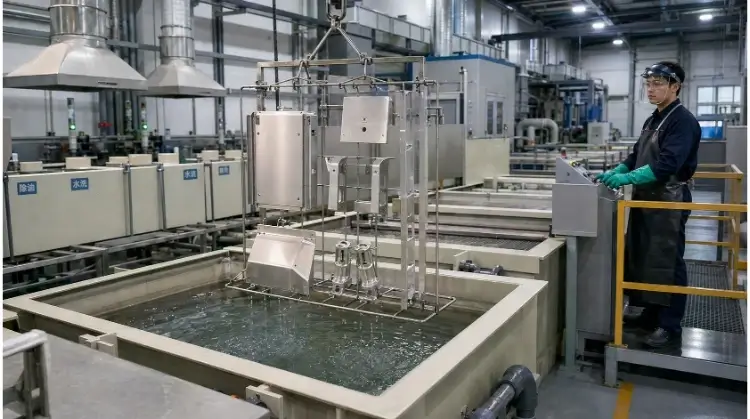
Chromating is a chemical conversion process. Instead of depositing a new layer of metal on top of the part (like plating), the chemical bath reacts directly with the aluminum substrate to modify its surface. This process occurs through immersion or spraying and does not require an external electrical current, which separates it mechanically and functionally from anodizing.
You will see this process referred to interchangeably as chromating, chemical film, chem film, or chromate conversion coating. The term Alodine is frequently used on engineering drawings, but it is a commercial brand name (similar to Iridite), not a generic process or specification.
| Property | Chromating | Anodizing | Powder Coating |
| Process role | Final finish or pretreatment | Functional oxide finish | Organic topcoat |
| Dimensional buildup | Minimal | Measurable | Significant |
| Electrical contact | Relatively low resistance possible | Generally insulating | Insulating |
| Wear resistance | Low | Medium to high | Medium |
| Appearance control | Limited | Wide range | Wide range |
Note: Chromating and powder coating are not always alternatives to each other. They are frequently used together as a complete coating system, with chem film acting as the pretreatment base.
Corrosion, Paint Adhesion, and Electrical Contact
The primary functions of chem film are to inhibit corrosion, provide a bonding surface for paints or adhesives, and maintain surface conductivity. Because it balances these three requirements, it is commonly specified for electronic chassis, RF housings, internal brackets, and precision machined components.
Dimensional buildup is minimal. Typically, chem film adds less than 0.00001 to 0.00004 inches (0.25 to 1 micron) to the surface. This means tapped holes and precision bearing fits usually do not require pre-machining allowances.
When specified correctly, the coating provides low electrical contact resistance. However, applying chem film does not automatically guarantee that a part will pass EMI shielding or grounding tests. The actual grounding performance of the assembly depends heavily on the mating contact area, fastener clamping pressure, and the overall mechanical joint design.
Self-Healing and Performance Limits
Traditional hexavalent chromium coatings possess a unique self-healing characteristic. The soluble hexavalent chromium ions in the film can migrate slightly in the presence of moisture to re-passivate minor scratches.
Trivalent chromium and newer chrome-free systems do not inherently share this same active ion migration capability. For assemblies exposed to salt spray that mandate Type II (RoHS compliant) coatings, engineers often specify a Class 1A finish followed by a protective primer to offset the lack of self-healing. Regardless of the chemistry, deep scratches that expose the bare aluminum substrate require an approved manual touch-up or rework procedure to prevent localized corrosion.
It is also critical to understand that the visual appearance of chem film will vary significantly across different aluminum alloys, surface roughness, and even between wrought and cast materials. A cosmetic match between a 6061-T6 machined housing and an A380 die-cast cover should not be expected from chem film alone. As a standalone finish, the bare film has low wear resistance and is generally not suitable for continuous outdoor exposure without a topcoat.
Choose the Chemistry and Specification by Function
Hexavalent, Trivalent, and Chrome-Free Alternatives
| System | Typical Appearance | Main Strength | Main Concern |
| Hexavalent chromium | Yellow or iridescent | Strong corrosion inhibition | Health and regulatory controls |
| Trivalent chromium | Clear or lightly iridescent | No hexavalent chromium | Product-specific performance |
| Chrome-free conversion | Usually clear | Environmental and process benefits | Requires system validation |
Visual color is not a reliable way to verify chemical composition. A yellow coating does not automatically indicate higher performance or longer salt spray hours, as actual corrosion resistance is tied closely to the specific aluminum alloy and pre-treatment process.
Furthermore, “trivalent chromium,” “no hexavalent chromium,” and “completely chrome-free” refer to different chemical technologies. Chrome-free systems (often based on zirconium or titanium) act as alternative conversion treatments. Suppliers must independently validate that these alternative systems meet the specific salt spray and electrical requirements of your application.
MIL-DTL-5541 Type I and Type II
In the most commonly used aerospace and defense specification, MIL-DTL-5541, the “Type” designates the chemical composition of the coating.
- Type I specifies the use of hexavalent chromium chemistries.
- Type II specifies chemistries that contain no hexavalent chromium.
While Type II is often achieved using trivalent chromium, the two terms are not strictly synonymous in the specification language; Type II simply dictates the absence of hexavalent chromium. The Type designation only controls the chemistry and cannot be used to specify performance criteria. When calling out these specifications, verify that the chemical products used by the supplier are listed on the applicable Qualified Products List (QPL).
Class 1A, Class 3, and Standard Selection
The “Class” dictates the functional performance requirements of the coating.
- Class 1A is intended to provide maximum protection against corrosion and serves as an optimal base for paint or powder coating. It is typically thicker than Class 3.
- Class 3 is formulated specifically to provide low electrical contact resistance while still offering moderate corrosion protection.
Specifying Class 3 means the coating will be tested for contact resistance, but it does not mean the component automatically satisfies all system-level grounding requirements.
Specifying “Class 1A and Class 3” simultaneously on a drawing creates conflicting requirements for the plater. If localized grounding is needed on a heavily protected part, the standard practice is to apply Class 1A overall and mask off specific grounding pads.
When writing drawing notes, it is critical to combine both Type and Class. International or commercial standards like ASTM B449 or EN 12487 use different classification structures and testing criteria. They cannot be directly substituted for MIL-DTL-5541 without reviewing the specific acceptance criteria required by your project.
| Requirement | Specification Direction |
| Hexavalent-chromium chemistry | Type I |
| No hexavalent chromium | Type II |
| Corrosion and paint base | Class 1A |
| Low contact resistance | Class 3 |
Alloy and Surface Preparation Change the Result
A common manufacturing misconception is that specifying the same chem film standard will yield identical results across different parts. In reality, the final appearance and performance are heavily dictated by the substrate’s metallurgical composition and the mechanical condition of the surface before it ever enters the chemical bath.
Alloy and Surface Condition
The chemical reaction that forms the conversion coating depends entirely on the alloying elements present in the aluminum.
- Wrought Alloys (5052, 6061): These generally process predictably and produce a relatively uniform, continuous coating.
- High-Strength Alloys (7075): The higher copper and zinc content can cause the reaction to occur more rapidly, often resulting in a darker or more heavily iridescent finish.
- Die Castings (ADC12, A380): These alloys contain high levels of silicon to improve flow during casting. Silicon does not react with standard chromating chemistry, which frequently results in a dark, mottled, or dull gray appearance rather than a clear or yellow finish. Engineers should view chem film on die castings purely as a functional anti-corrosion and paint-prep layer, not a cosmetic final finish.
Surface mechanical condition also alters the result. A smooth, CNC-machined surface will yield a different color intensity than a rough, sandblasted texture. In sheet metal assemblies, the heat-affected zones (HAZ) and the weld filler metal will almost always process to a different color than the surrounding parent material.
Cleaning, Etching, and Desmutting
The coating cannot form if the chemical solution cannot reach the raw aluminum. Thorough pre-treatment is often the deciding factor between a part that passes salt spray testing and one that fails.
- Degreasing: Removes heavy stamping oils, CNC cutting fluids, and fingerprints. A properly cleaned part will pass a “water break-free” test, meaning a film of water sheets evenly across the surface without beading.
- Etching: A mild alkaline or acid etch removes the naturally occurring, irregular aluminum oxide layer, providing a uniform, active surface for the conversion coating.
- Desmutting: Etching leaves behind insoluble alloying elements (like copper, magnesium, and silicon) as a dark residue called smut. Desmutting dissolves this residue.
For high-silicon die-cast alloys, standard desmutters are ineffective. These materials require specialized, fluoride-based activation systems designed specifically to dissolve surface silicon without over-etching the aluminum.
Process Control and Defect Signals
Consistent chem film requires strict control over bath concentration, pH, temperature, immersion time, and aluminum ion buildup in the tanks. Loading density and rinse water purity also play critical roles in avoiding contamination.
When process parameters drift, the resulting defects usually fall into predictable categories:
| Defect | Possible Causes |
| Powdery film | Excessive reaction, low pH or long treatment |
| Bare areas | Oil, trapped air or poor activation |
| Dark cast surface | Silicon, smut or unsuitable pretreatment |
| Water stains | Poor rinsing, drainage or drying |
| Bleed-out | Trapped solution in seams |
| Paint failure | Contamination or damaged conversion film |
Drying conditions are equally critical. Chromate conversion coatings contain moisture in their structure that contributes to their protective properties. Baking the parts at temperatures exceeding the limits specified by the chemical manufacturer’s Technical Data Sheet (TDS) or the governing standard will dehydrate and crack the film, permanently destroying its corrosion resistance.
Design Parts for Drainage and Complete Coverage
For sheet metal and machined components, Design for Manufacturing (DFM) must account for how liquids flow into and out of the part. If a component traps air, it won’t be coated; if it traps acid, it will corrode.
Drainage, Venting, and Solution Traps
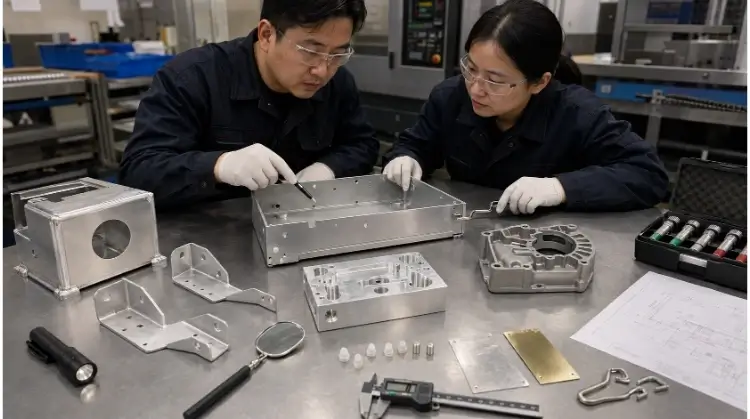
When reviewing a DFM drawing for an aluminum chassis or welded frame, manufacturing engineers look for potential fluid traps.
- Venting and Drainage: Enclosed cavities and tubular structures require strategically placed vent holes to let air escape during immersion, and drain holes to let the solution flow out during extraction. The location of these holes depends entirely on how the part will be racked and oriented on the line.
- Blind Holes: Deep tapped holes or blind machined pockets require vigorous agitation and thorough rinsing to prevent chemical residue buildup.
- Solution Traps: Sheet metal features like tight hems, rolled edges, and overlapping spot-welded joints act as capillary traps. They will draw in acids that are extremely difficult to rinse out, leading to “bleed-out” and localized corrosion weeks after shipping.
DFM Rule: If a joint cannot be continuously seal-welded, design it with enough gap to allow free flow and rinsing, or apply the chem film to the flat pattern before folding and spot welding.
Threads, Masking, and Rack Contact
Unlike anodizing, chem film is exceptionally thin and typically does not cause interference issues in standard tapped holes or precision mating surfaces. It is generally unnecessary to mask threads simply to protect their dimensional tolerance.
However, masking becomes critical if the part will subsequently be powder coated or painted, and the threads or specific grounding pads must remain conductive bare metal.
Because chem film requires an electrical ground path (though minor) or physical support during immersion, the part must be held by a rack. The contact points where the rack grips the part will not receive the coating. Engineering drawings must explicitly indicate where these bare rack marks are permissible, ensuring they are kept off critical cosmetic faces.
Welding, Hardware, and Finishing Sequence
A reliable production plan dictates the exact sequence of manufacturing and finishing. A standard flow for a sheet metal assembly is:
Cutting → Bending → Welding → Grinding → Machining → Cleaning → Chromating → Painting → Assembly
- Welding and Grinding: These must be completed prior to chromating. Welding leaves heavy oxides and flux residues that must be mechanically or chemically removed for the chem film to take.
- Post-Process Welding: Any welding performed after chromating will instantly burn away the local conversion coating. The affected area will require an approved manual touch-up method.
- Hardware Insertion: Standard zinc-plated steel hardware can be stripped or damaged by the acidic pretreatment baths. The manufacturing plan must choose one of two paths: either install stainless steel inserts before chem film, or mask the holes and install the zinc-plated hardware after the finish is complete.
- Thermal Limits: If the chem film is used as a base for powder coating, the high-temperature curing oven can dehydrate the conversion layer. The complete coating system (chem film plus powder coat cure cycle) should be validated to ensure the base layer’s corrosion resistance is not compromised.
Conclusion
Specifying aluminum chromating requires much more than just calling out “yellow” or “clear” on an engineering drawing. As we’ve explored, the true performance of a chem film finish—whether it’s for corrosion resistance, electrical conductivity, or paint adhesion—relies heavily on the specific aluminum alloy, rigorous surface preparation, and smart DFM practices like proper drainage.
By understanding the strict boundaries between Type I and Type II chemistries, and avoiding common pitfalls like overlapping sheet metal traps or masking overuse, you can ensure your parts meet both functional requirements and environmental compliance.
Send us your drawings, alloy specifications, and finish requirements. Our engineering team will conduct a DFM review to spot potential solution traps, masking issues, and alloy mismatches before quoting and production.