
 English
  Spanish
  German
  Russian
  Italian
  French
Metal phosphating is a chemical conversion process that treats steel and iron with a dilute phosphoric acid solution. It creates a bonded crystalline layer that prevents corrosion, reduces friction, and acts as an optimal primer for paint, powder coating, and rust-preventative oils.
While the basic chemistry is straightforward, applying it in manufacturing is not. Phosphating an indoor steel enclosure for powder coating requires an entirely different system than phosphating a transmission gear for oil retention. Furthermore, relying on a generic “phosphate finish” callout on an engineering drawing leaves critical dimensions and material integrity up to chance.
For mechanical engineers and sourcing teams, success relies on controlling the process variables. This guide explains how to select the right process, protect critical features, write measurable requirements, and prevent costly coating failures.
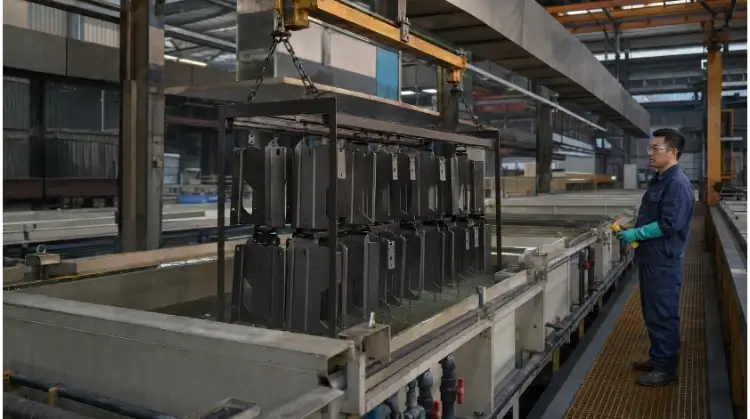
Choose the Phosphate Type by Part Function
Phosphating is a chemical conversion process. The substrate surface chemically reacts with an acidic bath to form a crystalline or amorphous phosphate layer. It does not sit on top of the metal like an electroplated finish; it is integrated into the surface.
A phosphate coating is usually just one component of a complete surface finishing system. The final corrosion resistance and functional performance depend heavily on the subsequent application of oil, wax, wet paint, powder, or e-coat.
Iron Phosphate for Paint Preparation
- Produces a thin, usually amorphous film, typically ranging from 0.2 to 1.0 g/m².
- Operating costs are relatively low compared to zinc or manganese systems.
- Commonly used for indoor steel enclosures, appliance panels, and furniture frames.
- Provides an adequate base for subsequent wet painting or powder coating.
- Offers limited corrosion protection when used as a standalone finish.
Zinc Phosphate for Paint and E-Coat
- Usually provides a better foundation for paint adhesion and under-film corrosion resistance than iron phosphate.
- Frequently specified as a pretreatment for e-coat (KTL), wet paint, and heavy-duty powder coating systems.
- Coating mass can range widely from 1.5 g/m² (for a paint base) up to 30 g/m² (for cold forming lubricants).
- Heavier zinc phosphate coatings can hold oil for rust prevention or act as a lubricant carrier for forming operations.
- A thicker coating does not automatically equal better corrosion resistance; overly thick layers can become brittle under a paint system.
Manganese Phosphate for Lubricated Parts
- Forms a thicker, highly porous crystalline structure, typically between 5 to 15 g/m².
- Absorbs and retains lubricating oils effectively.
- Suitable for gears, shafts, cams, fasteners, and other moving components.
- Improves initial break-in performance and reduces the risk of galling between sliding surfaces.
- Usually requires a rust-preventative or lubricating oil post-treatment.
- Cannot replace hard, wear-resistant treatments like nitriding or hard chrome.
Phosphate Selection Matrix
| Feature | Iron Phosphate | Zinc Phosphate | Manganese Phosphate |
| Primary Function | Paint pretreatment | Paint base, corrosion, cold forming | Oil retention, wear break-in |
| Typical Coating Mass | 0.2 – 1.0 g/m² | 1.5 – 30 g/m² | 5.0 – 15.0 g/m² |
| Coating Structure | Thin, usually amorphous | Crystalline | Thicker, highly porous |
| Common Post-Treatment | Paint or powder coat | Paint, e-coat, oil, or wax | Oil or sealer |
| Relative Cost | Lower | Moderate | Higher |
| Dimensional Impact | Usually minimal | Varies heavily by coating weight | Requires evaluation for tight fits |
| Typical Parts | Sheet metal enclosures | Automotive and structural parts | Gears, shafts, and fasteners |
| Main Limitation | Poor standalone corrosion resistance | Requires stricter process maintenance | Not a substitute for hard coatings |
Material Selection Tips
- Carbon steel and cast iron are the most common materials for phosphating.
- Galvanized steel requires adjusted bath chemistry to prevent over-etching the zinc layer.
- Aluminum requires a dedicated multi-metal bath system or a different conversion coating entirely.
- Stainless steel cannot be phosphated effectively; chemical passivation is usually specified instead.
- Copper and brass are typically plated or painted directly.
- Mixed-material assemblies must be evaluated with your surface treatment supplier before processing.
When Another Pretreatment Makes More Sense
- If stainless steel needs its corrosion resistance restored, choose passivation.
- If aluminum parts require high corrosion protection or cosmetic finishes, consider anodizing or chromate-free conversion coatings.
- If steel parts need sacrificial corrosion protection, consider zinc plating or zinc flake coatings.
- If the part requires a high-hardness wear layer, consider nitriding, hard chrome, or other hardening treatments.
- If the coating line needs to reduce energy, water usage, and sludge, evaluate zirconium or silane pretreatments as an alternative to iron phosphating.
Protect Tolerances and High-Risk Features Before Processing
Phosphating alters the surface of the metal. If the engineering drawing does not account for the coating build-up, acid exposure, or fluid drainage, the finished parts may fail assembly or fracture under load.
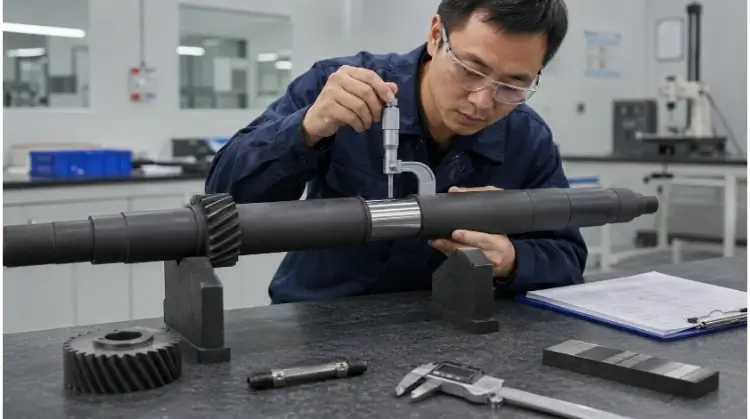
Coating Mass and Critical Fits
During the phosphating process, the acidic bath consumes a microscopic amount of the base metal before growing the phosphate crystals. The coating weight and crystal structure directly affect the final dimensions of the part.
Standard thin-film pretreatments usually have a negligible impact on dimensions. However, heavy zinc and manganese phosphating will affect precision fits. For dimensional tolerances tighter than 0.02 mm (0.0008 in), the dimensional build-up of heavy manganese or zinc coatings must be calculated into the machining drawing.
An engineering drawing must explicitly state whether critical dimensions apply before or after surface treatment. Carefully evaluate the dimensional risks for these features:
- Internal and external threads
- Bearing journals
- Dowel pin holes
- Sliding fits (e.g., H7/g6)
- Sealing surfaces
- Electrical ground points
Rework Risk: Reworking a failed part by chemically stripping the phosphate will remove an additional micro-layer of base metal. This process frequently scraps parts with tight sliding fits.
Hydrogen Embrittlement in High-Strength Steel
The risk of hydrogen embrittlement primarily originates from the acid pickling step used to remove rust and scale prior to phosphating. When atomic hydrogen diffuses into the steel lattice, it can cause delayed, catastrophic fracture under stress.
Parts with a hardness above 32 HRC (or tensile strength >1000 MPa)—such as class 10.9 or 12.9 high-strength bolts, springs, and bearing steels—require careful evaluation. Because hydrogen embrittlement is invisible to visual inspection, procedural prevention is the only reliable control. Whether a part requires a hydrogen relief bake is determined by the material’s tensile strength, the pickling conditions, and the governing specification.
Engineering Note: Do not specify a universal baking cycle without identifying the material strength, cleaning route, and applicable standard. Baking temperatures, hold times, and the time limit to begin baking (often required within 4 hours of acid exposure) vary significantly across different specifications.
Drainage, Masking, and Process Sequence
For fabricated sheet metal and complex machined parts, the physical design directly affects the coating quality, unit cost, and lead time.
- Drainage: Closed structures require dedicated drain and vent holes. Blind holes and tubular sections trap air pockets, which prevents the solution from reaching the surface. Process chemicals and rinse water must not pool inside cavities. (See sheet metal drainage diagram below for proper hole placement).
- Welding: Welding, spot welding, and weld cleaning should usually be completed before phosphating. Welding oxides will prevent phosphate formation, and the hardened oxide edges left by laser cutting often require mechanical or chemical removal prior to processing.
- Masking: Threads, grounding points, and tight-tolerance surfaces may require masking. Masking is a highly manual process that significantly drives up the unit cost. If possible, design grounding points or toleranced features to allow for full coating, or plan for post-machining to remove the coating locally instead of masking.
- Hardware: The installation sequence for press-in hardware (like PEM nuts) must be confirmed with the plating supplier and the hardware manufacturer. Trapped acids in hardware crevices can cause localized corrosion.
- Racking: Rack contact points will not receive a coating. These points must be planned away from critical cosmetic surfaces.
Control Every Step from Cleaning to Final Sealing
Most phosphate coating failures begin with poor surface preparation, not with the phosphate chemistry itself.
A standard phosphating line follows a strict sequence: Degreasing → Rinsing → Pickling (Rust Removal) → Activation → Phosphating → Rinsing → Post-Treatment → Drying. Skipping or rushing any of these stages directly increases the scrap rate.
Surface Cleaning and Activation
Stamping oils, rust preventatives, and cutting fluids act as physical barriers, stopping the phosphate reaction dead. For castings, baked-on mold release agents will cause patchy, bare areas. Visual inspection is inadequate. While the “water-break test”—where water sheets evenly over the surface without beading—is a standard baseline, it is not the only metric for a clean surface.
Acid pickling removes rust and laser-cut oxides, but leaving parts in the acid too long causes over-etching, which destroys tight tolerances and drastically increases the risk of hydrogen embrittlement.
Before entering the main tank, parts pass through an activation (surface conditioning) stage. This chemical rinse provides nucleation sites for the phosphate crystals. A degraded activation bath leads to coarse, uneven crystal growth, which ruins paint adhesion and causes excessive oil absorption.
Bath Control and Coating Formation
The phosphating bath is highly dynamic. As parts are processed, the chemistry is continuously depleted. Consistent coating weight relies on strict control of several variables:
- Acid Balance & pH: The ratio of Free Acid to Total Acid dictates the etching rate and crystal formation.
- Temperature & Time: Operating below the specified temperature slows the reaction; excessive time creates thick, powdery, and brittle coatings that easily flake off.
- Agitation & Loading: Overloading racks or barrels restricts fluid flow. Whether using spray pressure or bath circulation, the solution must constantly replenish at the part surface.
- Iron Contamination & Sludge: The reaction naturally generates iron phosphate sludge as a byproduct. Excessive sludge settles on parts, creating a powdery residue that causes paint delamination. Furthermore, excessive sludge requires frequent tank dumping, which disrupts the supplier’s production schedule and threatens your delivery times.
Production Process Control Matrix
| Process Stage | Primary Risk | Key Control Point |
| Degreasing | Localized bare spots (no coating) | Surface cleanliness and water-break status |
| Pickling | Over-etching or hydrogen embrittlement | Immersion time and material strength limits |
| Activation | Coarse or uneven crystal growth | Conditioner concentration and bath pH |
| Phosphating | Out-of-spec coating weight (too thin/powdery) | Time, temperature, and acid ratio |
| Rinsing | Chemical residue and blistering | Water quality (conductivity) and cascade stages |
| Drying | Flash rust and water stains | Oven temperature and drying time |
| Post-treatment | Inadequate corrosion resistance or lubricity | Correct application of oil, sealer, or paint |
Rinsing, Drying, and Post-Treatment
Inadequate rinsing leaves acidic residues and unreacted salts trapped in blind holes and tight corners. When these parts are later painted or powder-coated, the trapped salts cause osmotic blistering and under-film corrosion. These defects often remain invisible during final inspection and only appear as massive paint peeling in the field months later, leading to catastrophic warranty claims.
Parts must be racked in a direction that allows gravity to drain all cavities completely. Drying must be rapid; slow drying in humid shop air causes immediate flash rust. For manganese phosphate, the highly reactive porous surface must be sealed with a rust-preventative oil promptly. If parts are destined for powder coating or e-coat, the holding time between phosphating and painting must be strictly minimized.
Put Measurable Requirements in the Drawing and RFQ
“Phosphate coating” is not a complete drawing or sourcing requirement.
Relying on generic callouts forces the supplier to guess the part’s intended function, leading to incorrect process selection, inaccurate pricing, and rejected batches.
Finish Requirement and Applicable Standard
An engineering drawing or Request for Quote (RFQ) must specify the base material, the exact phosphate type, the required coating mass (or class), and the post-treatment.
Never apply a universal coating mass across different phosphate types. A 1.5 g/m² requirement might be perfect for a zinc phosphate paint base, but it is physically impossible to achieve with a heavy manganese process.
Common Phosphate Specifications
- DIN EN ISO 9717: Phosphate conversion coatings on metals.
- MIL-DTL-16232: US Military spec for heavy phosphate (Type M = Manganese, Type Z = Zinc).
- AMS 2480 / AMS 2481: Aerospace material specifications for paint base and wear resistance.
- DIN EN ISO 9227: Corrosion tests in artificial atmospheres (Salt spray testing).
Dimensions, Inspection, and Acceptance
Clear acceptance criteria prevent disputes between the machine shop and the plating supplier. The documentation must clarify:
- Dimensions: State explicitly whether tight tolerances apply before or after the coating process.
- Masking: Identify which threads, sliding fits, or electrical grounding points must remain bare.
- Rework: Establish a strict rule that no parts may be chemically stripped and reworked without prior engineering approval, due to the severe risk of dimensional loss and hydrogen embrittlement.
- Color: Visual appearance can indicate process shifts, but color alone cannot be used as a primary pass/fail metric.
- Corrosion Testing: Clarify if the salt spray requirement applies to the raw phosphate with oil, or to the fully painted system. Bare, unsealed phosphate coatings offer virtually zero long-term corrosion resistance and will flash rust within hours. Never specify a 96-hour salt spray test for a dry, unsealed phosphate part.
Supplier Capability and Quotation Inputs
Surface treatment pricing is volume-dependent, but hidden factors drive the unit cost. Heavy rust, complex internal cavities, and manual masking requirements will significantly increase labor. Because phosphate sludge is classified as hazardous waste, environmental compliance and sludge disposal directly inflate the supplier’s overhead costs.
If a supplier cannot produce continuous process data, you are paying for a chemical gamble, not a controlled process. A qualified surface treatment supplier must be able to provide:
- Routine bath maintenance and titration records.
- Coating weight inspection reports.
- Batch tracking and applicable adhesion/corrosion reports.
- Hydrogen embrittlement relief (baking) logs with oven charts.
- Documented procedures for wastewater and hazardous sludge management.
Diagnose Defects Before Approving Rework
When a batch of phosphated parts fails inspection, the immediate instinct on the shop floor is often to chemically strip the parts and run them through the line again. This is a dangerous gamble. Reprocessing a part can cause more severe dimensional and metallurgical damage than the original defect.
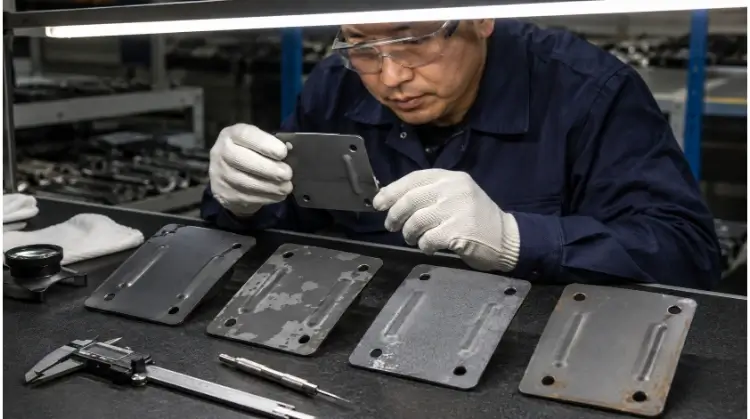
Patchy, Missing, or Coarse Coating
When a phosphate coating is patchy or entirely missing in spots, do not simply increase the treatment time. Missing coatings are rarely caused by insufficient time in the phosphate tank; they are almost always caused by physical barriers.
Residual stamping oils, rust preventatives, or unremoved laser-cut oxide scale prevent the acid from reaching the steel. If parts nest together (touch) on the rack, or if blind holes trap air pockets, the solution cannot react with the surface.
Conversely, if the coating is present but the crystal structure is excessively coarse and powdery, the root cause is typically a dead activation (surface conditioning) bath, extreme acid imbalance, or over-exposure. Before altering the phosphate bath parameters, always verify the water-break status out of the degreasing tank and check material certs for recent changes in the raw steel alloy.
Flash Rust, Residue, and Paint Failure
Use the following troubleshooting matrix to identify the root cause of common phosphate failures before they compromise the final paint system or field performance.
| Defect Manifestation | Common Root Cause | First Verification Point | Corrective Direction |
| Bare spots / Missing coating | Oil barrier, scale, or parts nesting | Water-break test and rack spacing | Re-evaluate degreasing and pickling stages |
| Mottled or streaky finish | Uneven wetting, bath fluctuation | Rinsing overflow and material batch | Audit cleaning tanks and bath titration |
| Coarse crystal structure | Degraded activation, over-exposure | Conditioner pH and immersion time | Replenish activation bath; reduce time |
| Powdery / Sloughing coating | Excessive coating weight, high sludge | Titration records and sludge levels | Filter tank; evaluate if rework is permitted |
| Flash rusting | Contaminated rinse, slow drying | Rinse water conductivity and oven temp | Increase rinse cascade flow and drying speed |
| White residue in cavities | Trapped salts from poor drainage | Part orientation and drain hole design | Redesign racking or add DFM drain holes |
| Paint/Powder delamination | Oil bleed-out, weak coating, long queue time | Coating weight and cross-hatch adhesion (e.g., ASTM D3359) | Audit the timeline between phosphate and paint |
| Batch-to-batch color shift | Substrate alloy shift, bath aging | Material certs and bath maintenance logs | Approve via functional testing, not just color |
Rework Limits and Root-Cause Approval
Never approve a chemical strip and rework based solely on visual appearance. Before authorizing rework, the engineering and quality teams must evaluate the following risks:
- Cosmetic vs. Functional: Is the defect actually impacting corrosion resistance or paint adhesion, or is it a benign color variation? If it passes functional testing, accept it as-is.
- Tolerance Loss: Stripping phosphate removes the conversion layer and an additional microscopic layer of the base metal. Will threads, pin holes, or sliding fits drop below the minimum tolerance limit? Chemically stripping a complex CNC-machined component can instantly scrap thousands of dollars in manufacturing value over a minor cosmetic flaw.
- Embrittlement Risk: For high-strength steels (>32 HRC), a second trip through the acid pickling tank drastically multiplies the risk of hydrogen embrittlement.
- Customer Approval: Does the contract or drawing explicitly permit rework? Many aerospace, defense, and automotive specifications strictly forbid chemical stripping without an approved deviation request.
- Root Cause Elimination: Do not put stripped parts back into a flawed process line. Confirm the root cause is fixed before reprocessing.
Conclusion
Select the phosphate type by part function, not by color or thickness alone. Define the post-treatment, critical dimensions, and acceptance requirements before requesting a quote. Diagnose the process before approving stripping and rework.
Don’t leave your surface treatment to chance.
Specifying the wrong phosphate system or ignoring dimensional build-up can lead to scrapped batches and failed assemblies. Send us your drawing, base material, and operating environment. Our engineering team will provide a comprehensive Design for Manufacturability (DFM) review—optimizing your phosphate type, masking strategy, and critical tolerances before you issue the PO.