
 English
  Spanish
  German
  Russian
  Italian
  French
The primary difference between 304 and 430 stainless steel is nickel. Grade 304 contains nickel, making it highly corrosion-resistant, non-magnetic, and easy to form. Grade 430 contains no nickel, making it a cheaper, magnetic alternative suited for dry environments but more prone to cracking and rust.
While they look identical on the material rack, treating them as interchangeable on the shop floor is a costly mistake. For engineers and procurement managers, choosing the wrong grade often leads to cracked corners in the press brake, burned-out CNC tools, or field failures—like rust spotting—within the first year of service.
This guide compares both grades strictly from a manufacturing and procurement perspective. It will help you specify the right material based on service environment, part geometry, total production cost, and inspection requirements.
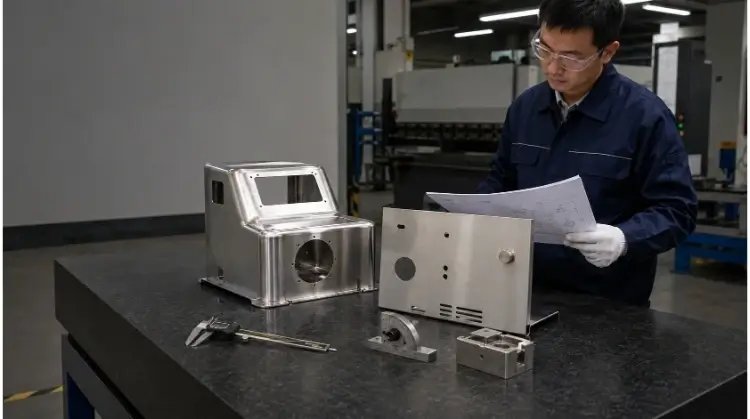
304 vs 430 Stainless Steel: Key Differences
Material selection requires looking past the surface. The differences in how these two grades perform on the shop floor come down to their microstructure and chemical makeup.
Composition and Microstructure
The most significant difference between the two grades is the presence of nickel.
Grade 304 is an austenitic stainless steel. It contains approximately 18% chromium and 8% to 10.5% nickel. The nickel stabilizes the austenitic crystal structure, giving 304 its high ductility and strong resistance to corrosion across various environments.
Grade 430 is a ferritic stainless steel. It contains 16% to 18% chromium but has little to no nickel (usually capped at 0.75%). Removing nickel reduces the base material cost, but it also means 430 retains a ferritic structure at room temperature. This structural difference directly affects its forming limits, thermal expansion, and magnetic properties.
Both grades rely on chromium to form a protective passive layer against rust. However, the lack of nickel in 430 means its passive layer is less resilient. This is why grade 430 parts can sometimes develop surface rust simply from sitting in a humid warehouse or during sea freight if not properly oiled or packaged, whereas 304 typically remains clean.
Properties That Matter in Manufacturing
| Property | Grade 304 | Grade 430 | Impact on Manufacturing or Service |
| Corrosion Resistance | Usually higher | Moderate | Determines service life in wet or chemical environments. |
| Magnetism | Usually weak/none | Noticeable | Affects assembly, sensor operation, and sorting. |
| Formability | Good | Limited to simple bends/shallow draws | Defines how well the material handles tight radii. |
| Weldability | Good | Requires controlled heat input | Affects weld joint quality, brittleness, and rework rates. |
| Work Hardening | Noticeable | Usually low | Impacts CNC tool wear and machining efficiency. |
| Thermal Expansion | Relatively high | Relatively low | Influences welding distortion and high-temperature dimensional stability. |
| Material Cost | Usually higher | Usually lower | Directly impacts initial procurement price. |
Note: Mechanical properties depend on the standard, product form, and material state. When reviewing data sheets, ensure you are comparing equivalent states—do not evaluate annealed 430 sheet against severely cold-rolled 304 bar stock.
Magnetism Without Shortcuts
Because 430 is a ferritic alloy, it exhibits a strong, noticeable magnetic pull in all conditions. Grade 304, in its fully annealed state, has an austenitic structure and does not respond to a magnet.
However, when 304 sheet metal is cold-worked—such as during stamping, deep drawing, severe bending, or heavy shearing—the physical stress alters the crystal lattice locally. This causes a small amount of martensite to form, which can leave the bent corners or sheared edges of a 304 part with a weak but measurable magnetic pull.
Magnetic does not automatically mean 430, and non-magnetic does not automatically prove 304.
Relying on a pocket magnet to verify incoming material can lead to rejected parts or accepting the wrong grade. If material verification is critical, the shop must use X-Ray Fluorescence (XRF) analyzers or request verifiable mill test certificates (MTC). Furthermore, if your product design includes magnetic sensors or electromagnetic latches, the engineering drawing must specify the acceptable magnetic permeability range rather than simply stating “use non-magnetic stainless steel.”
Corrosion Resistance Across Different Service Environments
Before evaluating machining or forming costs, the material must be capable of surviving its intended environment.
Dry Indoor Service
Grade 430 works well for appliance exterior panels, equipment backplates, indoor trim, dry shelving, and internal brackets. The material cost is lower, it provides a standard stainless steel appearance, and it handles simple bending and stamping. In low-corrosion environments, its service life is more than sufficient.
Indoor does not always mean dry.
Equipment interiors can trap condensation, steam, cleaning chemicals, or suffer from poor ventilation. These factors can quickly make an initially dry environment unsafe for 430.
Water, Food, and Cleaning Chemicals
For sinks, worktables, food processing equipment, beverage dispensers, and washdown enclosures, grade 304 is usually the safer choice due to frequent water contact.
However, specifying 304 does not automatically make a part “food grade,” nor does it mean 430 can never touch food. The type of cleaning chemical often dictates the corrosion risk. Salts, acids, and chlorides will accelerate localized corrosion on both grades. Welds and crevices are much more prone to chemical attack than flat surfaces. Proper drainage design and surface roughness (Ra) impact cleanability and lifespan just as much as the alloy grade itself.
Outdoor, Salt, and High-Temperature Exposure
Grade 304 is generally more stable than 430 in wet environments, but it is not rust-proof.
For high-temperature oxidation environments—such as oven internals or exhaust heat shields—430 often performs well. However, high-temperature performance must always be evaluated based on exact peak temperatures, exposure time, and thermal cycling. For high-temperature welded structures, alternatives like 439 or 441 may offer better structural stability than standard 430.
If the part will be exposed to coastal salt spray, heavy de-icing salts, or high-chloride cleaning agents, both 304 and 430 will likely fail prematurely. In these specific conditions, 316 stainless steel should be evaluated.
304 and 430 During Forming, Machining, and Welding
Material selection is not only about where the part will live; it is also about how the part is made. A grade that survives the service environment is useless if it cracks in the press brake or drastically slows down the welding line.
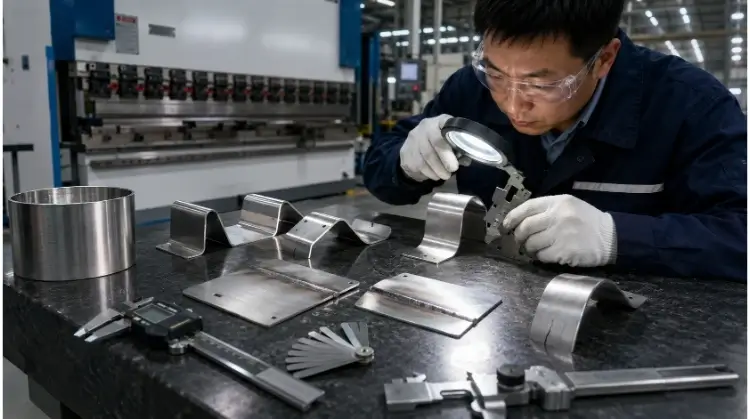
Bending, Stamping, and Deep Drawing
Grade 304 and 430 behave very differently under mechanical stress.
Because of its austenitic structure, 304 offers excellent ductility. It handles deep drawing and complex stamping with a relatively wide forming window. Grade 430, being ferritic, is less ductile. While it works perfectly fine for standard right-angle bends, as the draw depth increases or the bend radius tightens, 430 becomes much more susceptible to cracking.
As a general shop rule, while 304 can often handle a bend radius of 1t (one times the material thickness), grade 430 typically requires a minimum radius of 1.5t to 2t to prevent micro-cracking along the bend line.
When forming 430, operators must pay close attention to the material’s rolling grain direction (bending across the grain rather than parallel to it), die clearances, and proper lubrication. Grade 430 is also prone to “roping” (surface ridging) during deep draws, which can ruin a cosmetic finish. Furthermore, differences in yield strength mean the two materials will exhibit different springback characteristics, requiring separate press brake setups.
| Part Geometry | Typical Material Choice |
| Flat cosmetic cover plates | 430 is usually sufficient. |
| Simple bent indoor cabinets | Evaluate 430 for cost savings. |
| Deep-drawn sinks | Usually 304. |
| Complex enclosures with stretched areas | Usually 304. |
| Stamped parts requiring heavy subsequent welding | Evaluate 304 or 304L first. |
304 usually gives the forming process more room for error. Grade 430 can work well for simple shapes, but tighter radii and deeper draws require more careful control.
CNC Machining and Tool Wear
Grade 304 is notorious for work hardening. As the cutting tool engages the material, the localized heat and deformation actually harden the surface.
This causes accelerated wear on drills, taps, and end mills. Built-up edge (BUE) is common, which degrades the surface finish and forces slower machining speeds. Compared to standard carbon steel or grade 430, machinists often have to drop cutting speeds by 20% to 30% when milling 304 to manage heat and preserve tool life.
A tool must continue cutting when machining 304. If it rubs against the surface without removing material, the next tool pass may face a harder surface and faster wear.
In many setups, grade 430 offers better machinability because it work-hardens less. However, you cannot assume 430 chips will always break easily; actual chip formation still depends heavily on the material state, tool geometry, cutting speed, and feed rate. If high-volume machining is the primary operation and corrosion requirements are low, a free-machining variant like 430F is usually a better alternative.
Welding and Finish Restoration
Welding is where grade 304 holds a massive advantage. It has a wide welding process window and accepts TIG, MIG, and laser welding readily with minimal complications.
Grade 430 is much more challenging. When exposed to high welding temperatures, the heat-affected zone (HAZ) experiences rapid grain growth. This makes the weld joint brittle. While 430 can be welded, it often requires pre-heating, specific filler metals (like 309L to add ductility to the joint), and post-weld heat treatment to restore toughness. On thin sheets, 430 is also susceptible to significant thermal distortion.
Beyond structural integrity, consider finish restoration. Heat tint must be removed to restore the passive layer through pickling or passivation. Grinding down the welds and blending the grain lines to achieve a seamless #4 brushed finish consumes expensive abrasives and adds hours of manual labor, which can quickly erase any savings gained from buying the cheaper 430 sheet.
For heavily welded structures, 304 or 304L is usually the safer starting point. Grade 430 may still be practical for simple thin-sheet assemblies when the joint design and welding procedure are properly controlled.
The Cheaper Sheet May Cost More to Manufacture
For procurement managers, comparing the per-kilogram price of the raw sheet is only the first step. The true cost of a part is determined by the total manufacturing cycle.
304 vs 430 Stainless Steel: Material and Production Costs
Because it lacks nickel, grade 430 usually carries a lower base alloy cost. Grade 304 pricing is highly sensitive to global nickel market fluctuations, meaning quotes can change rapidly.
However, do not assume a fixed 30% to 50% price gap. The actual price you pay depends on the sheet thickness, surface finish (e.g., 2B vs. No. 4), local service center stock, minimum order quantities (MOQ), and your annual volume. If a specific thickness of 430 is not standard in your region, the lead time and minimums may easily erase any theoretical cost advantage.
Scrap, Tooling, and Finishing
A complete cost analysis must include what happens on the shop floor:
Finished-Part Cost = Material Cost + Setup and Tooling Cost + Processing Cost + Scrap and Rework Cost + Finishing Cost
A cheaper material that cracks in the press brake, requires double the welding time, burns through CNC tools, or forces extensive post-weld grinding will quickly become the more expensive part.
Consider these two manufacturing scenarios:
Typical Example 1: Dry Indoor Cover
- Process: Simple laser cut, two standard bends, no welding.
- Environment: Indoor, dry use.
- Volume: High annual demand.
- Conclusion: Grade 430 offers a clear, immediate reduction in finished-part cost with very little manufacturing risk.
Typical Example 2: TZR Washdown Enclosure
- Process: Multiple tight bends, continuous structural welds, and blended cosmetic corners.
- Environment: Frequent washdowns with aggressive cleaning agents.
- Conclusion: In a recent project, specifying 304 slightly increased the upfront raw material bill. However, it eliminated weld-zone cracking. By eliminating the post-weld rework required for 430, the total manufacturing time was reduced by roughly 15%, making 304 the more economical and reliable choice overall.
Service Life and Mixed-Material Design
Ultimately, the part must survive the field. A warranty claim always costs more than a sheet of stainless steel.
Lifecycle Cost = Finished-Part Cost + Maintenance Cost + Warranty Risk Cost + Replacement Cost
To balance cost and performance, some industries utilize a mixed-material design. For example, commercial kitchen equipment often pairs materials: grade 304 is used for the wet food-prep worktops, while grade 430 is used for the dry lower cabinets and rear access panels.
While this saves material cost, it requires strict operational discipline. Traceability and distinct drawing callouts are mandatory to make a mixed-material strategy work. At TZR, we use automated fiber laser marking on flat blanks before bending to ensure every part retains its grade identification throughout the entire assembly process, completely eliminating the risk of shop-floor mix-ups.
How to Select, Specify, and Verify the Grade
An engineer can select the perfect material, but if the manufacturing drawing is vague, the supply chain might still procure the wrong sheet. Controlling the flow of information from the CAD model to the shop floor is critical.
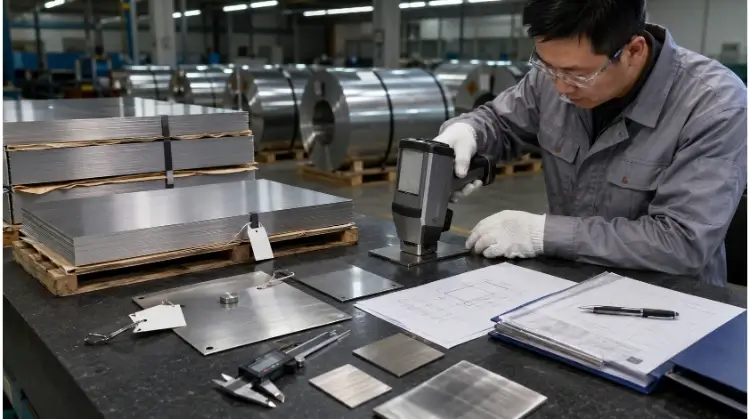
Final Selection Checklist
Before releasing a drawing for prototyping or mass production, verify the part against its harshest expected condition, not just its average environment. For example, a part might sit indoors 99% of the time, but if it is washed down daily with a chlorine-based cleaner, you cannot specify grade 430 based solely on its “indoor” status.
Review this checklist before finalizing the design:
- Will the part be exposed to standing water or frequent condensation?
- Are there salts, acids, or chlorine-based cleaning chemicals present?
- Does the manufacturing process require deep drawing or complex forming?
- Are there extensive structural welds?
- Is a magnetic response a functional requirement or a strict limitation?
- Will the part undergo thermal cycling or sustained high temperatures?
- Is a pristine cosmetic finish required over a long service life?
- Do the upfront material savings of 430 outweigh the increased manufacturing and field-failure risks?
If the application hits multiple high-risk factors (like heavy welding combined with moisture), grade 304 is usually the minimum baseline.
Drawing and Purchase Requirements
A drawing note that simply says “Material: Stainless Steel” is a liability. It forces the manufacturer to guess, usually resulting in the procurement of whatever grade is cheapest or currently sitting on the rack.
Engineering drawings and Purchase Orders (POs) must explicitly define:
- Material grade and standard (e.g., ASTM, EN)
- Thickness and acceptable tolerances
- Material state (e.g., annealed)
- Surface finish grade (e.g., 2B, No. 4 brushed)
- Grain direction (critical for preventing cracks during severe bends and ensuring consistent cosmetic blending across multi-part assemblies)
- Requirement for protective laser film
- Requirement for Mill Test Certificates (MTCs)
Clear Callout Examples:
Stainless Steel 304, ASTM A240, 1.5 mm thick, No. 4 brushed finish, grain direction as shown, protective film required.
Stainless Steel 430, ASTM A240, 1.2 mm thick, 2B finish, mill certificate required.
When dealing with international supply chains, it is helpful to cross-reference common regional designations:
| AISI (US) | UNS | EN (Europe) |
| 304 | S30400 | 1.4301 |
| 430 | S43000 | 1.4016 |
(Note: If your project follows European standards, specify the material and surface conditions according to the EN 10088 series).
Certificates, PMI, and Traceability
Even with perfect drawings, material mix-ups happen if a factory lacks strict inventory controls. Because 304 and 430 look identical, raw sheet isolation and lot traceability are mandatory.
Incoming material should always be verified against the Mill Test Certificate to confirm the heat number, mechanical properties, and chemical composition. For critical applications, factories utilize Positive Material Identification (PMI).
Technical Note: X-Ray Fluorescence (XRF) analyzers can easily distinguish 304 from 430 by detecting their respective nickel and chromium contents. However, confirming low-carbon variants, such as 304L, may require supporting material certificates or Optical Emission Spectrometry (OES), as standard handheld XRF cannot accurately measure carbon levels.
Conclusion
Choose grade 304 when the part faces moisture, frequent cleaning, complex forming, or extensive welding. Choose grade 430 when the part stays dry, has a simple geometry, benefits from a magnetic response, and material cost is the primary concern.
Keep in mind that both materials have their limits. For marine exposure, heavy chloride contact, highly demanding welded structures, or extreme high-temperature service, compare alternatives such as 304L, 316, 439, or 441 before releasing the drawing.
Choosing the right stainless steel grade early in the design phase prevents costly manufacturing delays and field failures.
Send TZR your 2D/3D drawings along with your expected production volume, service environment, chemical exposure, and finish requirements. Our engineering team will review the geometry for manufacturability (DFM) and compare 304, 430, or mixed-material options to ensure you get the right performance at the right price—from rapid prototyping through mass manufacturing.