 English
  Spanish
  German
  Russian
  Italian
  French
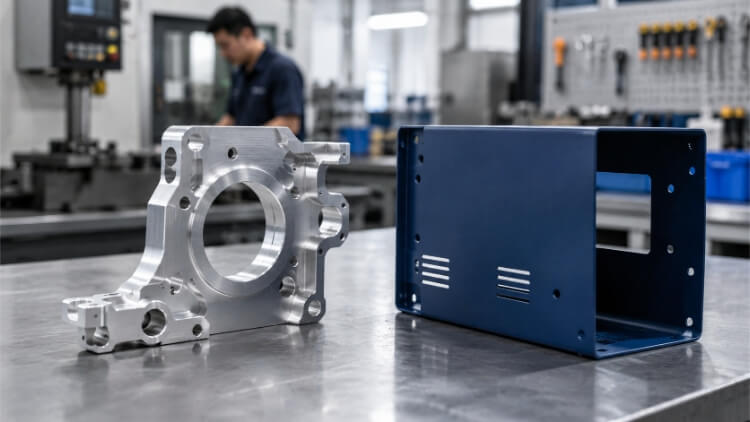
In sheet metal fabrication and CNC machining, choosing between anodizing and powder coating is rarely just a matter of picking a color or finding the lowest unit price. Both finishes protect metal surfaces, but they interact with the substrate in entirely different ways.
Anodizing is an electrochemical process that forms a hard oxide layer on aluminum. It keeps a thin metallic finish and works well for precision parts, wear resistance, and tight assembly needs. Powder coating adds a cured coating layer on the metal surface. It offers wider color and texture options, better surface coverage, and is often used for sheet metal enclosures, brackets, and outdoor parts.
Below is a direct breakdown of how these two surface treatments function and how to determine the optimal choice for your manufacturing project.
Quick Comparison Table
| Feature | Anodizing | Powder Coating |
| Process Type | Electrochemical oxidation | Electrostatic spray + thermal curing |
| Material Suitability | Primarily Aluminum (also Titanium/Magnesium) | Almost all metals (Steel, Aluminum, Stainless, etc.) |
| Dimensional Impact | Very low (grows into the metal) | Moderate to high (adds a physical layer on top) |
| Primary Advantage | High wear resistance, retains metallic look | Excellent corrosion protection, vast color options |
| Primary Shop-Floor Risk | Color matching across batches / Material alloy variations | Thread clogging / Edge build-up / Faraday cage effect |
Anodized vs Powder Coat: Main Difference
To make an informed engineering decision, it is necessary to understand that these are not just different types of standard paint. The fundamental difference lies in how the protective layer is actually formed on the metal.
Process difference
Anodizing is an electrochemical process. The metal part is submerged in an acid electrolyte bath and an electric current is passed through it. This controlled environment forces the natural oxide layer on the surface to thicken rapidly.
Powder coating is a dry finishing process. Electrostatically charged pigment and resin particles are sprayed onto an electrically grounded metal part. The part is then placed in a curing oven, where the heat causes the powder to melt, flow, and chemically cross-link into a solid film.
Surface structure
Because anodizing is an oxidation process, the finish is fully integrated with the underlying metal. It cannot peel, flake, or chip off because it is essentially a modified layer of the aluminum itself.
Powder coating, by contrast, acts as a physical shell wrapping around the part. It bonds tightly to the surface but remains a distinct, separate layer of polymer sitting on top of the base metal.
Thickness range
Anodizing produces extremely thin layers. A standard anodize adds roughly 0.0002″ to 0.0008″ (5 to 20 microns) of thickness. Powder coating is significantly thicker, typically depositing a layer between 0.0015″ and 0.005″ (38 to 127 microns) depending on the specific powder chemistry and application method.
This difference dictates shop-floor execution: while 5 microns of anodizing will rarely fail a standard dowel pin hole fit, 127 microns of powder coat will require immediate design compensation, re-tapping, or heavy masking.
Suitable metals
Anodizing is highly material-specific. In industrial manufacturing, it is almost exclusively used on aluminum alloys. Note that die-cast aluminum does not anodize well due to its high silicon content, often resulting in an ugly, mottled gray appearance; making powder coating the strictly better choice for cast parts.
Powder coating is far more versatile and can be applied to carbon steel, stainless steel, aluminum, and brass—provided the metal can withstand the 350°F to 400°F (175°C to 200°C) oven curing temperatures without deforming.
How Each Finish Affects the Part?
Beyond basic protection, the chemical and physical nature of the finish alters the mechanical properties of the machined or fabricated part.
Anodized oxide layer
When an aluminum part is anodized, the oxide layer grows according to a “50/50 rule”—half of the layer penetrates inward into the base metal, and half builds outward. This creates an extremely hard, porous surface that is later sealed.
For standard protective and cosmetic needs, Type II (Sulfuric Acid Anodizing) is the industry standard. For components subjected to heavy friction, engineers specify Type III (Hardcoat Anodizing). Type III is processed at lower temperatures and higher voltages, resulting in a dense layer that rivals hardened steel in surface hardness.
Powder coat film
The thermoset polymer film created by powder coating provides a continuous, non-porous barrier against the environment. During the curing cycle, the powder particles melt and form molecular chains, resulting in a finish that is highly resistant to impact and moisture.
Because the coating cures into a flexible film, it handles physical impacts well. However, achieving uniform thickness on complex parts can be challenging. During application, electrostatic repulsion often prevents the powder from penetrating sharp internal corners or deep recesses—a phenomenon known as the Faraday cage effect.
Surface thickness and texture
Anodizing preserves the exact surface texture of the raw metal. If a CNC machined part has visible tool marks, or a sheet metal part has grain directions from brushing, the anodized finish will show those marks clearly. It feels metallic and cold to the touch.
Powder coating, due to its thickness, actively masks surface imperfections. It easily covers minor machining marks, light scratches, and perfectly blends ground weld seams on sheet metal enclosures. The final texture depends on the powder type. It can be smooth and glossy, or it can have a heavy texture.
Tolerance and Assembly Risks
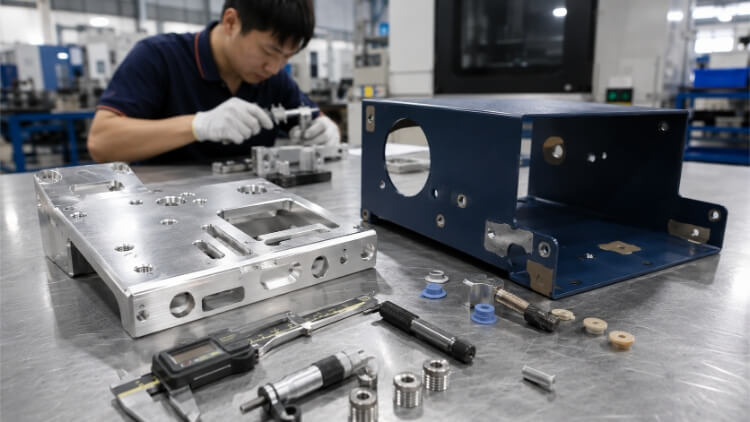
Dimensional non-compliance is the number one reason coated parts fail quality control. Engineers must account for how a finish alters the physical geometry of the part before issuing the final drawing.
Coating buildup and dimensional shift
As established, standard anodizing only adds a negligible amount of material (around 0.0002″ to 0.0008″ per surface), which rarely interferes with standard machining tolerances (e.g., ±0.005″).
Powder coating, however, adds a physical shell of 0.0015″ to 0.005″ (38–127 microns) per surface. If a machined slot is designed to tightly fit a 0.500″ mating plate, powder coating the internal walls of the slot will shrink its total width by up to 0.010″, guaranteeing an assembly failure unless the slot is machined oversized or specifically masked.
Hole, slot, and thread fit
Internal features require careful planning. Anodizing flows seamlessly into tapped holes and standard bores. Unless you are dealing with ultra-tight aerospace tolerances or thick hardcoat on very small threads (M3 or smaller), you can usually machine and tap holes to standard sizes before anodizing.
Powder coating will completely destroy the functionality of a threaded hole by melting and clogging the threads during the baking process. Forgetting to mask threaded holes before powder coating means the machine shop must manually re-tap every single hole—a secondary operation that can instantly ruin a project’s profit margin and lead time.
Masking and contact areas
Masking is a manual, labor-intensive process that directly inflates the piece price. If a sheet metal chassis requires bare metal contact areas for electrical grounding, those areas must be masked.
Masking for powder coat is generally more expensive and difficult than for anodizing. It requires high-temperature tapes and custom silicone caps that can survive the 400°F curing oven without melting or leaving adhesive residue. Anodize masking is done at room temperature but requires specialized chemical-resistant tapes to survive the acid baths.
Welded areas
If your assembly involves welding, powder coating is usually the superior choice. Powder coating easily spans and hides the cosmetic irregularities of a sanded weld seam.
Anodizing welded aluminum is highly problematic and often results in scrapped parts. The filler rod used in TIG or MIG welding reacts differently to the anodizing bath than the base metal, resulting in obvious, ugly color mismatches at the joint. Furthermore, microscopic pores in the weld can trap sulfuric acid from the anodizing bath. Over time, this trapped acid bleeds out, ruining the finish and causing localized corrosion.
Tolerance and Masking Risk Table
| Feature / Requirement | Anodizing Impact & Risk | Powder Coating Impact & Risk |
| Machined Threads | Low risk. Usually requires no masking unless applying thick Type III. | High risk. Threads will clog. Missing masking causes severe rework costs. |
| Tight Tolerance Bores | Low risk. Predictable dimensional growth (half in, half out). | High risk. Edges may build up heavily. Masking is mandatory. |
| Welded Joints | High risk. Filler metal changes color; acid bleed-out risk. | Low risk. Excellent at hiding blended welds. |
| Electrical Grounding | Requires masking (anodized layer is an electrical insulator). | Requires masking (polymer layer is an electrical insulator). |
Performance in Real Use
“Durable” is an empty term in engineering. A finish must be evaluated against the specific failure modes it will encounter in the field: abrasion, chemical exposure, thermal loads, or ultraviolet radiation.
Wear and scratch resistance
For pure wear resistance against friction and point loads, hardcoat anodizing—often specified under the MIL-A-8625 Type III standard—is the undisputed winner. It boasts a Rockwell hardness that approaches hardened steel, making it ideal for sliding mechanisms, gears, and wear plates.
Powder coating is resilient and highly impact-resistant due to its elasticity, meaning it won’t shatter if a dropped tool hits an enclosure. However, it is a softer polymer. Dragging a sharp metal object across a powder-coated panel will carve a deep scratch into the finish and expose bare metal, whereas the same action on a hard-anodized surface would likely only dull the blade.
Corrosion and UV exposure
For outdoor steel and sheet metal enclosures, a dual-layer powder coat (a zinc-rich primer base with a polyester topcoat) provides unmatched rust prevention. Properly applied exterior powder coatings can easily withstand 1,000+ hours of ASTM B117 salt spray testing, sealing the base metal entirely from moisture.
When it comes to sun exposure, UV stability depends heavily on the chemistry. Standard dyed anodizing (especially red, blue, and green) will noticeably fade, bleach, and turn pinkish under prolonged UV exposure. If anodized aluminum must sit outdoors, black or clear (undyed) finishes are required. Conversely, exterior-grade polyester powder coatings are specifically formulated to resist UV degradation and maintain their gloss and color for years.
Heat transfer and insulation
Thermal management is a critical factor for electronic enclosures and heat sinks. Anodizing actually increases the thermal emissivity of aluminum. An anodized heat sink will dissipate heat into the air more efficiently than a bare aluminum one.
Powder coating acts as a thermal blanket. Wrapping an aluminum chassis in a 3-mil layer of plastic polymer traps heat inside the enclosure. If the metal part is designed to act as a heat sink for internal electronics, powder coating is a fundamentally flawed choice.
Cleaning and service environment
Engineers must consider the chemical environment. The anodized oxide layer is highly sensitive to extreme pH levels. Harsh alkaline industrial degreasers or acidic washdown chemicals will literally dissolve the anodized layer, leaving the aluminum bare, chalky, and unprotected.
Powder coating offers vastly superior chemical resistance. High-quality epoxy or polyurethane powders can withstand routine washdowns with industrial solvents, aggressive detergents, and standard CNC machine coolants without degrading or losing their finish.
Appearance and Surface Preparation
When engineers and buyers discuss appearance, the conversation must go beyond aesthetics. On the shop floor, visual requirements dictate the necessary surface pretreatment, which directly impacts lead times and reject rates.
Color and texture options
Powder coating provides virtually unlimited cosmetic flexibility. It is available in the full RAL color spectrum and can be formulated in various gloss levels and textures (such as matte, fine sand, or heavy wrinkle).
Anodizing is restricted to a much narrower color palette (typically black, clear, red, blue, green, and gold). Because the dye is absorbed into the porous oxide layer rather than painted on top, the final color retains a deep, metallic luster that powder coating cannot replicate.
Visible machining marks
Anodizing is a translucent finish. It does not cover anything; it telegraphs the exact condition of the raw metal. If a CNC part has visible tool step-overs, or a sheet metal bracket has grain lines from the rolling mill, the anodized finish will clearly highlight those marks.
Powder coating, depending on its mil-thickness and texture, acts as a visual equalizer. A heavy textured powder coat will completely obscure minor machining chatter, light sanding lines, and surface scuffs.
Defect coverage and pretreatment
It is a common misconception that powder coating will hide poor workmanship. While it covers minor scratches, powder coating will not fill deep gouges, sharp burrs, or porous, unblended welds.
For anodizing, achieving a uniform matte cosmetic finish requires secondary mechanical pretreatment. The parts must be heavily bead-blasted or directionally brushed before entering the anodizing line to ensure an even surface texture, which adds a distinct step to the manufacturing routing.
Batch color control
Color consistency is a major shop-floor challenge for anodizing. The final shade depends on the specific aluminum alloy, the bath temperature, the current density, and the exact time spent in the dye tank. Achieving a perfect color match across different production batches—or across parts machined from different aluminum alloys (e.g., 6061 vs. 7075)—is extremely difficult.
Powder coating offers excellent batch-to-batch color stability. As long as the powder is sourced from the same manufacturer and cured at the correct temperature, the color will remain consistent whether you run 50 parts today or 5,000 parts next year.
Cost and Production Control
For purchasing managers evaluating quotes, the unit price of a finish is only a fraction of the actual cost. True procurement costs are driven by batch setup, masking labor, and rework risks.
Batch size and setup cost
Powder coating is highly scalable. Once the spray guns and ovens are up to temperature, running 1,000 sheet metal enclosures is highly cost-effective, with the unit price dropping sharply as volume increases. Engineers should also consider powder color when moving from prototype to mass production. Custom powder colors often require a large minimum order from the powder supplier. Standard RAL colors usually have shorter lead times and lower costs.
Anodizing costs are dictated by tank volume and racking. Every individual part must be manually clamped to a titanium or aluminum rack to ensure electrical contact. These “rack marks” are unavoidable and must be planned for in the engineering drawing. Small batches of custom-colored anodizing carry steep minimum lot charges because an entire dye tank must be dedicated to that specific run.
Masking and color matching
As noted in the tolerance section, masking is pure manual labor. If a complex chassis requires multiple masked grounding points, the labor to apply and remove high-temperature tape can easily cost more than the powder coating itself.
Rework and field repair
If a powder-coated panel gets scratched during final assembly or shipping, it can often be touched up in the field using a color-matched liquid paint pen.
Anodizing cannot be locally touched up. If an anodized part is heavily scratched or fails visual inspection, the only rework method is to place the part in a caustic strip tank to dissolve the anodic layer entirely, and then re-anodize it. This stripping process removes a microscopic layer of the base aluminum, altering the part’s critical dimensions and often rendering tight-tolerance parts completely out of spec.
Packaging and final inspection
Hidden costs often emerge in final packaging. Anodized surfaces, while hard, can be scratched by metal-on-metal contact during transit. Powder-coated parts, especially those with high-gloss finishes, are prone to scuffing during long-distance transit or ocean freight. They require individual poly-bagging or foam interleaving to survive continuous vibration, adding to the final bill of materials.
Anodized vs Powder Coat: How to Choose Before Production?
Specifying the right surface treatment early prevents costly engineering revisions during the pilot run. Use the mechanical and environmental constraints of your project to drive the decision.
Best parts for anodizing
Anodizing should be specified when dimensional stability, heat dissipation, and wear resistance are prioritized over color consistency.
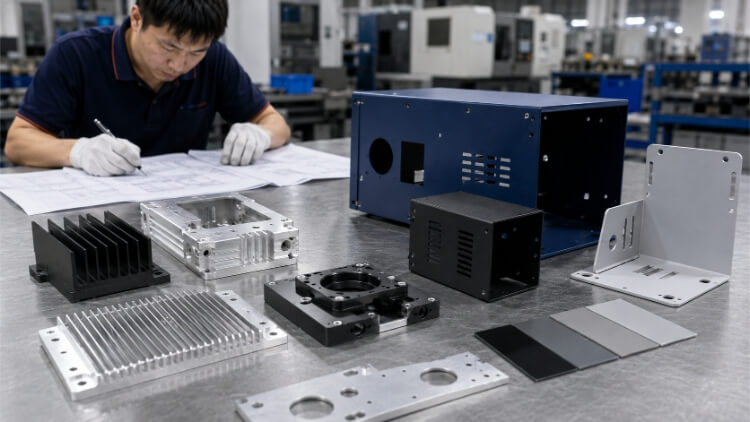
- Precision CNC Aluminum Parts: Housings, optical mounts, and internal mechanical components where adding a 0.003″ thick paint layer would ruin the assembly.
- Heat Sinks and Cooling Fins: Where thermal emissivity must be maximized.
- Sliding Components: Pneumatic cylinders, gears, and rails that require the extreme surface hardness of Type III Hardcoat.
Best parts for powder coating
Powder coating is the optimal choice when environmental protection, cosmetic uniformity, and cost-efficiency at scale are required.
- Sheet Metal Enclosures: Industrial control boxes and telecom cabinets where hiding weld marks and providing electrical insulation are benefits.
- Outdoor Infrastructure: Carbon steel brackets and heavy-duty fabricated frames that require massive salt-spray resistance and UV stability.
- Cast Metals: Cast aluminum or iron parts that contain too much silicon or carbon to be effectively anodized.
Engineering Decision Matrix
| Project Requirement | Recommended Finish | Key Shop-Floor Consideration |
| Material is Carbon Steel | Powder Coating | Anodizing is physically impossible on steel. |
| Tolerance < 0.001″ (25 microns) | Anodizing | Powder coating will violate tight machining tolerances. |
| Part is Welded Aluminum | Powder Coating | Anodizing welds causes severe color mismatch and acid bleed-out. |
| High Wear / Friction Surface | Type III Hardcoat Anodize | Powder coat will gall, scratch, and peel under friction. |
| Requires Outdoor UV Stability | UV-Resistant Powder Coat | Standard dyed anodize will bleach and fade in direct sunlight. |
| Needs to Hide Surface Scratches | Textured Powder Coat | Anodizing will clearly show all existing scratches and tool marks. |
Conclusion
Anodizing and powder coating solve different surface finishing problems. Anodizing is usually better for aluminum parts that need a thin metallic finish, wear resistance, and lower impact on fit. It is a strong choice for CNC aluminum parts, precision panels, and components with tight assembly requirements.
Powder coating is often better for sheet metal parts that need color, surface coverage, and corrosion protection. It works well for enclosures, brackets, cabinets, frames, and outdoor metal parts.
Need help choosing between anodizing and powder coating for your metal parts? Send us your drawings, material requirements, quantity, and surface finish target. Our engineering team can review the design, check tolerance and masking risks, and suggest a practical finishing plan before production.