 English
  Spanish
  German
  Russian
  Italian
  French
Aluminum is one of the most widely used materials in manufacturing. It’s light, strong for its weight, and naturally resists corrosion. These traits make it ideal for industries like aerospace, automotive, electronics, and general fabrication.
However, bending aluminum can be tricky. Unlike steel, it hardens quickly under stress. If handled incorrectly, it can crack or spring back. To achieve a good bend, engineers must understand how the metal behaves, select the appropriate method, and control key factors such as bend radius and temperature.
Understanding Aluminum’s Behavior in Bending
Before shaping aluminum, it’s vital to understand how alloy and temper affect flexibility and strength. Knowing this behavior helps prevent cracks and achieve consistent, high-quality bends.
Material Composition and Temper Designations
Two main factors affect how aluminum bends: its alloy type and temper condition. Each alloy family — such as 1xxx, 3xxx, 5xxx, and 6xxx — reacts differently when subjected to force.
- 3003 and 5052 are the most flexible and easiest to form. They allow tight bends without cracking.
- 6061-T6 is strong and common, but it often cracks when bent cold because it’s a hardened temper.
As a general rule:
- The higher the temper (like T6 or H34), the harder and less flexible the metal.
- Softer states, such as O (annealed) or T4 (solution heat-treated), are easier to bend because they stretch more before breaking.
Before selecting an alloy, think about the final strength you need and the shape of the bend. Using the wrong temper can cause fractures, uneven springback, or tool damage.
Ductility and Elongation
Ductility is the extent to which a material can be stretched before breaking. It’s measured as percent elongation. Higher elongation means the metal can bend more sharply without cracking.
Typical elongation values:
- 3003-H14 → 22–25%
- 5052-H32 → 15–20%
- 6061-T6 → 8–12%
A small difference in elongation can have a big impact. For instance, an alloy with 20% elongation can take a much tighter bend than one with 10%.
Engineers often check these values using tensile tests or forming limit data. In parts such as electronic housings or brackets, ductility helps achieve consistent, crack-free bends.
Minimum Bend Radius Guidelines
The minimum bend radius (MBR) is the smallest inside curve you can make without breaking the outer surface. It depends on material thickness (T), temper, and grain direction.
| Alloy & Temper | Recommended Inside Radius | Notes |
| 3003-H14 | 1.0×T | Great for general forming |
| 5052-H32 | 1.5×T | Good strength and flexibility balance |
| 6061-T6 | 2.5–3.0×T | Needs larger radius or local heating |
Bending across the grain evenly distributes strain and lowers the risk of cracking. Bending along the grain increases the likelihood of cracking, especially in hard tempers.
Example: Adjusting Radius to Prevent Cracking
Say you’re bending a 2 mm-thick 6061-T6 sheet with a 2 mm radius. Because the metal is hard and not very ductile, it will likely crack.
If you increase the radius to 5–6 mm or slightly heat the bend line, the metal bends smoothly with no fractures. This small change improves part quality and avoids rework.
Choosing the Right Bending Method
Every bending method offers different precision, surface quality, and cost. Selecting the right one ensures efficiency while maintaining dimensional control throughout production.
Press Brake Bending
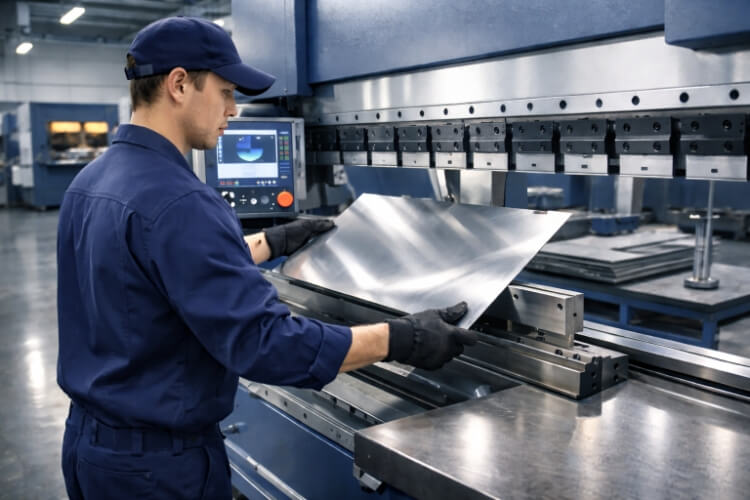
The press brake is the most common tool for bending aluminum sheets. A punch pushes the material into a die to form the angle.
- Air bending uses partial contact and offers flexibility for different angles. It’s accurate and reduces tool wear.
- Bottom bending presses the material fully into the die, creating consistent angles but increasing the risk of surface marks.
Tooling tips:
- Use polished or coated dies to protect visible surfaces.
- Choose a die opening 8–10× the material thickness for balanced force.
Roll and Rotary Draw Bending
When you need large curves or circular shapes, roll bending works best. It passes the sheet through three rollers that gradually shape it.
For tubes or profiles, rotary draw bending provides tight control and maintains accurate dimensions. Tools like mandrels can support the inside of hollow parts to prevent deformation.
Hand and Prototype Bending
For small jobs or prototypes, manual bending is still useful. Using vises or bars, operators can form simple bends with steady pressure. Sudden force should be avoided since it can cause cracks.
Always check the bend direction against the grain and test on scrap material first. These small checks can reveal how the metal behaves in real conditions and help fine-tune production settings.
How to Bend Aluminum: Step-by-Step Process
Accurate bending depends on preparation and consistency. These step-by-step practices help engineers achieve repeatable angles and surface finishes without compromising material integrity.
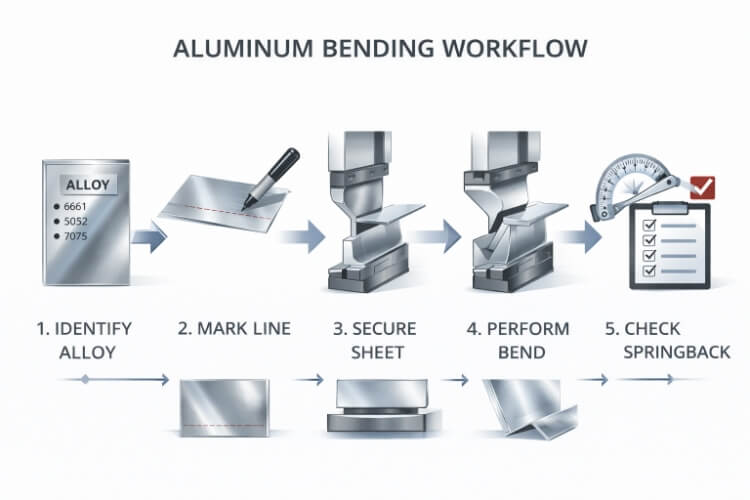
Step 1 – Identify Alloy and Temper
Every bend starts with knowing the alloy and temper. These factors show how much force the metal can handle before cracking.
- Soft alloys like 3003-O or 5052-H32 bend easily at room temperature.
- Hard alloys like 6061-T6 are stronger but need pre-heating or annealing.
Always check the material data sheet for tensile strength and elongation. If the elongation is above 15%, cold bending is usually safe. Below that, pre-heating helps prevent cracks.
Step 2 – Mark and Prepare the Bend Line
Accurate marking ensures that bends fit correctly during assembly. Use a fine-tip marker or scribe, but avoid deep scratches, which can cause cracks during bending.
Next, calculate bend allowance (BA) and setback (SB). These values adjust the flat pattern size so the final part matches your drawing after bending.
Step 3 – Secure and Support the Workpiece
Clamping the part correctly helps maintain consistent angles. Make sure the sheet is aligned evenly in the press brake or vise.
Use back gauges or side supports for longer sheets to prevent sagging. Even a small deflection can change the bend angle. Soft pads, such as foam or rubber, can protect the surface from clamp marks.
Step 4 – Perform the Bend
Apply steady pressure using the press brake or hand tool. A slow, controlled motion helps the aluminum adjust without cracking.
- Air bending gives flexible angle control and reduces tool wear.
- Bottom bending provides high accuracy but needs a perfect punch and die fit.
If bending by hand, use a lever or a pipe to apply a smooth force. Avoid sudden hits — they cause tensile stress and surface damage.
Step 5 – Check and Adjust for Springback
Aluminum tends to return slightly toward its original shape after bending. This is called springback.
Typical springback values:
- 3003-H14: 1–2°
- 5052-H32: 2–3°
- 6061-T6: 4–6°
To correct this, over-bend slightly by the expected amount. CNC press brakes can store this data and adjust automatically.
Heat and Annealing in Aluminum Bending: When and How to Use It
When cold bending isn’t enough, heat can make aluminum more workable. Proper temperature control prevents cracking and maintains strength after forming.
Why Heating Helps?
Heating makes aluminum easier to form by softening its structure. Controlled heat releases internal stress, allowing the atoms to move and stretch without breaking.
For 6061-T6, annealing changes the temper closer to T4 or O, making tight bends possible without surface cracks. This method is useful for precision parts like frames, panels, and enclosures.
Heating Techniques and Temperature Control
Most aluminum alloys soften at 340–400°F (170–205°C). Within this range, the metal becomes flexible but stays solid.
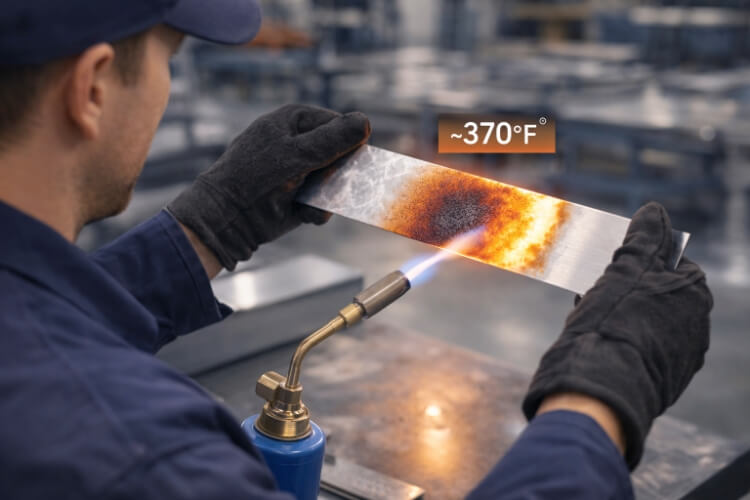
A simple field method is the soap test:
- Spread normal hand soap on the bend area.
- Heat gently with a propane torch.
- When the soap turns light brown, the temperature is around 370°F (190°C) — perfect for bending.
Cooling and Post-Heat Treatment
After heating, let the part cool naturally in the air. Do not quench it in water or oil, as that creates internal stress and distortion.
Once cooled, the metal can be aged at about 320°F (160°C) for several hours to restore its original strength partially.
Preventing Cracks, Marks, and Deformation
Surface defects can turn good parts into rejects. These preventive techniques keep aluminum components clean, strong, and ready for finishing.
Optimize Bend Radius and Die Selection
The bend radius directly affects how much strain the material’s outer surface takes.
- For 3003-H14 or 5052-H32, use a radius of about 1×T to 1.5×T.
- For 6061-T6, use at least 2.5×T to 3×T or heat the bend area first.
Choose a die width about 8–10 times the sheet thickness. This spreads the pressure evenly and prevents wrinkles on the inner curve.
Align Grain Direction Correctly
Aluminum sheets have a rolling direction, which defines grain orientation.
- Bending across the grain provides greater flexibility and reduces the risk of cracking.
- Bending along the grain increases the likelihood of cracks and shortens fatigue life.
Use Lubricants and Protective Films
Friction can cause surface scratches and heat buildup. A thin layer of forming lubricant — such as mineral oil, PTFE paste, or wax — helps the sheet slide smoothly across the die.
For polished or brushed panels, apply a protective film before bending. It prevents marks and fingerprints. Many automated press brakes now include film-feeding systems to keep surfaces clean during production.
Control Bending Speed and Pressure
Aluminum bends best under moderate and steady pressure. Moving too fast concentrates stress and may cause micro-cracks.
Servo-driven or CNC-controlled presses automatically adjust the ram speed, gradually applying force. This keeps grain flow even and produces a cleaner bend surface.

Controlling Springback in Aluminum Bending
Springback challenges even experienced fabricators. Understanding why it happens and how to compensate for it ensures precision and repeatability at every bend.
Why Springback Happens?
Aluminum has a high elastic-to-yield ratio, meaning it flexes more before yielding. When the bending force is removed, stored energy causes the bend to relax slightly.
Main factors affecting springback include:
- Yield strength — higher strength causes more rebound.
- Bend radius — tighter bends create higher recovery.
- Thickness — Thicker sheets resist deformation and spring back more.
For example, a 90° bend in 3003-H14 may open by 1–2°, while 6061-T6 can rebound by 4–6°. Uncorrected, this causes assembly misalignment or a poor fit.
Over-Bending and Tool Adjustment
The simplest way to fix springback is over-bending — forming a few degrees beyond the target. For instance, to achieve a 90° bend in 6061-T6, bend to about 94–95°.
Another option is bottom bending, or coining, in which the punch fully presses the sheet into the die. This removes most springback but requires higher tonnage. It’s ideal for high-precision parts, such as chassis frames or enclosures.
CNC Angle Correction and Feedback
Modern press brakes often use angle sensors or lasers to monitor the bend in real time. The system adjusts the punch stroke to reach the exact angle.
This automation compensates for variations in material thickness and hardness between batches. It maintains accuracy within ±0.2° across thousands of cycles.
Best Practices for Bending Aluminum
Consistent results come from disciplined routines. These best practices help maintain accuracy, extend tool life, and reduce rework.
Select the Right Alloy for Each Job
For parts that need good looks and tight corners, use 3003 or 5052. For strong structural parts, choose 6061, but use larger radii or heat to prevent cracking. Matching alloy to design purpose avoids costly production errors.
Perform Test Bends and Record Results
Always make a test bend before production. Measure angles, springback, and any surface change. Record tool settings and results. Over time, these records form a reliable reference library for future jobs.
Keep Tooling Clean and Smooth
Oxide buildup from aluminum can scratch the next workpiece. Clean the punch and die daily with a soft cloth and mild solvent. Smooth surfaces improve accuracy and extend tool life.
Inspect Visually and with Instruments
Use both digital angle gauges and visual checks. Even a 1° angle error or 0.2 mm offset can cause assembly problems. Early inspection avoids delays and rework.
Handle Parts with Care
Aluminum dents easily. Wear soft gloves and use rubber mats or plastic spacers during stacking and transport. Protecting surfaces during handling preserves all the precision achieved in forming.
Conclusion
Bending aluminum isn’t just a simple workshop task — it’s a precise engineering process. Every choice, from selecting the right alloy to setting the bend radius, shapes how the metal responds under pressure. When fabricators understand aluminum’s internal structure and behavior, they can control results instead of fixing problems afterward.
At TZR, we focus on precision sheet metal fabrication — including laser cutting, CNC bending, welding, and surface finishing. Our engineers combine technical knowledge with practical experience to produce accurate, clean, and repeatable aluminum parts.
If your next project requires tight tolerances, smooth surfaces, or complex bends, we’re ready to help. Contact us at sales@goodsheetmetal.com to discuss your design or request a free project evaluation.
FAQs
Which aluminum alloy is easiest to bend?
Alloys from the 3000 and 5000 series, like 3003-H14 and 5052-H32, are the most flexible. They have higher elongation, allowing tighter bends with a lower risk of cracking.
Can 6061-T6 aluminum be bent cold?
Yes, but it needs care. 6061-T6 is heat-treated and relatively hard. It can be bent cold for large radii, but sharper bends may crack. Heating it to 350–400°F (175–205°C) softens the metal, making it safer to form. After bending, it can be re-aged to recover its strength partially.
What’s the difference between cold bending and hot bending?
Cold bending is performed at room temperature and works best with soft or thin materials. Hot bending, also called annealing, uses controlled heat to increase flexibility. It’s better for thicker sheets or tight-radius bends that would otherwise fracture.
What tools are best for small-scale bending?
For prototypes or short runs, use manual brakes, soft-jaw vises, or roller benders. For production work that needs high precision and repeatability, CNC press brakes or servo-controlled machines provide consistent results and smooth surface finishes.