
 English
  Spanish
  German
  Russian
  Italian
  French
Cutting titanium isn’t just about dealing with a “hard” metal. For machine shops, it’s a constant battle against rapid tool wear, runaway heat, and blown profit margins. When you lose control of the thermal load in a titanium cut, your tool life drops from hours to minutes, taking your dimensional tolerances and surface finish down with it.
This guide focuses on the real factors behind titanium cutting performance in production. It explains how titanium grade, tool geometry, heat control, and process stability affect cost, tool life, and machining consistency.
Why is Titanium Difficult to Cut?
The difficulty in cutting titanium comes down to a perfect storm of physical properties that actively fight the machining process. It is rarely just one issue that destroys a tool; it is a chain reaction.
Heat buildup
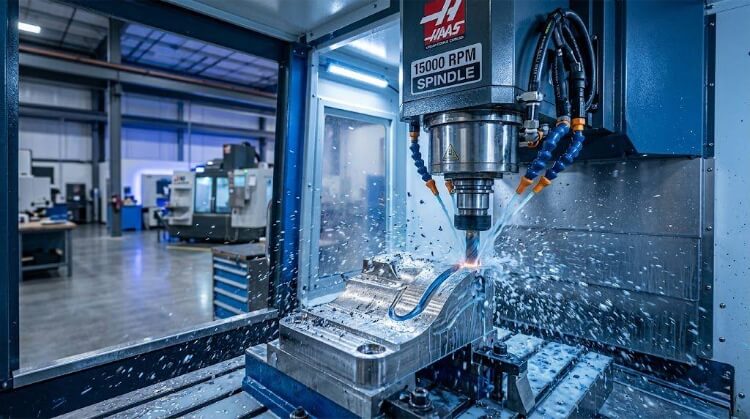
Titanium has exceptionally low thermal conductivity—often less than one-sixth that of steel. In standard aluminum or steel machining, the evacuated chips carry away up to 75% of the heat. When cutting titanium, the exact opposite happens: the heat concentrates directly at the cutting tool.
This localized thermal shock can cause cutting-edge temperatures to spike instantly. If this thermal load is not actively managed—typically through high-pressure through-tool coolant (1,000 PSI or higher) and precise feed rates—heat-resistant coatings will fail, and tool life will evaporate rapidly.
Tool wear
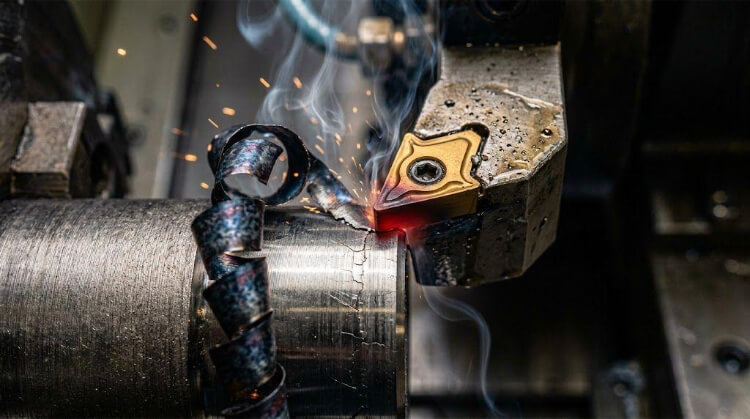
Beyond just heat, titanium is highly chemically reactive at elevated temperatures. The material tends to weld itself to the cutting edge, creating a Built-Up Edge (BUE).
As these welded bits of titanium are ripped away during the continuous cut, they take microscopic pieces of your carbide tool with them. You aren’t just wearing the tool down; you are microfracturing it.
The countermeasure: This requires advanced, heat-resistant coatings such as TiAlN or TiCN, combined with parameters that prevent the chip from welding to the rake face.
Chip evacuation
Titanium chips tend to be continuous, stringy, and incredibly tough. If your tool geometry lacks proper chip breakers or your feed rate is too light, these razor-sharp ribbons will wrap around the spindle, block coolant nozzles, or get pulled back into the cutting zone.
Re-cutting a work-hardened titanium chip is a guaranteed way to snap an end mill or shatter an insert instantly. Managing chip evacuation is a critical part of maintaining an uninterrupted machining cycle in automated production.
Process stability
Titanium possesses a relatively low modulus of elasticity—meaning it is “springy.” Instead of taking a clean cut, the material yields under cutting pressure and springs back behind the tool (deflection).
This constant pushing and rubbing leads to aggressive vibration and chatter.
The fix: Absolute rigidity. To achieve a good surface finish and maintain tool integrity, you cannot rely on standard clamping; volume production often requires custom hydraulic fixtures and the use of the machine spindle’s structural stiffness to its full extent.
Why do Titanium Grades Cut Differently?
Treating all titanium as the same material on the shop floor is a fast way to ruin parts and blow through tooling budgets. The machining behavior varies significantly with the specific alloy composition.
Commercially pure titanium
Commercially Pure (CP) titanium, such as Grade 2, is significantly softer than its alloyed counterparts. However, in machining, ‘softer’ does not mean ‘easier’.
CP titanium is highly ductile and behaves almost like a “gummy” material under the cutter. Instead of shearing cleanly, it tends to tear, smear, and weld itself to the tool. To machine CP grades successfully, standard rigid tools will fail. You must use tools with high positive rake angles and razor-sharp, uncoated (or highly polished) edges to slice cleanly through the material and prevent adhesion.
Titanium alloys
Titanium alloys, most notably Ti-6Al-4V (Grade 5), are significantly harder and stronger. While material adhesion (gumminess) is less of an issue, the primary threats shift to extreme heat generation and rapid work-hardening.
If a tool rubs against Grade 5 instead of taking a firm bite, the part’s surface instantly hardens. The subsequent pass will then hit that hardened layer, immediately destroying the cutting edge.
The strategy: You need tougher carbide grades, a slightly honed edge prep (to withstand the cutting force), and absolute discipline with your feed rates—never let the tool dwell or rub.
Grade differences in production
Applying the same tooling setup across different titanium grades will destroy your process economics.
Using a honed-edge tool designed for Grade 5 on a Grade 2 part will push and smear the metal, ruining the surface finish. Conversely, running a fragile, razor-sharp Grade 2 tool on a Grade 5 forging will result in immediate edge chipping. Selecting the correct tool geometry, coating, and cutting parameters must be strictly tied to the specific alloy being machined.
Cutting Methods for Titanium Parts
Selecting the right cutting method for titanium is rarely just about what machine is available on the floor. It is a strict calculation of production volume, dimensional tolerance, and the amount of secondary processing you are willing to pay for.
Saw cutting
- Best for: Preparing raw billets, bars, and heavy blocks before CNC machining.
- Limitations: Slow cutting speeds and low dimensional accuracy.
- The Main Risk: If the feed rate drops and the blade rubs instead of cuts, the titanium will instantly work-harden. This ruins the saw blade and guarantees your first CNC milling pass will crash.
- When to choose: It is the most cost-effective way to blank raw material. For volume production, always use carbide-tipped band saw blades with heavy flood coolant.
Waterjet cutting
- Best for: Cutting thick plates, 2D profiles, and near-net-shape blanks.
- Limitations: Slower than thermal cutting, and it can leave a slight edge taper on very thick plates.
- The Main Risk: Abrasive particles can occasionally embed in the cut edge, which might require a light finishing pass depending on the application.
- When to choose: Waterjet is the ultimate “cold cutting” method, producing zero Heat-Affected Zone (HAZ). If your blank will proceed directly to complex sheet metal bending—where maintaining the material’s original structural integrity is non-negotiable—waterjet is the safest choice.
Laser and plasma cutting
- Best for: High-speed processing of thin sheet metal and rough profiling.
- Limitations: These are thermal processes. The extreme heat drastically alters the edge chemistry of the titanium.
- The Main Risk: The localized heat reacts with oxygen and nitrogen to create an Alpha Case—a brittle, rock-hard oxidized layer along the cut edge. If you try to bend a laser-cut titanium sheet, that brittle edge will crack. If you try to CNC mill it, the hard layer will instantly destroy your end mills.
- When to choose: Use these methods for high-speed blanking, but you must design a machining allowance into your CAD model. You will have to mechanically remove the entire Alpha Case (typically 0.010″ to 0.030″) via milling or grinding before the part is functional. Always use inert assist gases (like Argon or Nitrogen) to minimize this damage.
CNC milling and turning
- Best for: Complex 3D geometries, tight tolerances, and high surface finish requirements.
- Limitations: High tooling consumption and relatively slow material removal rates (MRR) compared to cutting aluminum or steel.
- The Main Risk: Sudden tool failure and severe chatter if the setup lacks rigidity or if the tool dwells in the cut.
- When to choose: This step is necessary in the final part of production. However, machining a solid titanium block with an end mill to remove most of the material is rarely cost-effective. In volume production, a better approach is to combine processes. Waterjet or laser cutting can produce a near-net blank first, while CNC machining is reserved for finishing critical features and surfaces.
Wire EDM
- Best for: Extremely intricate shapes, sharp internal corners, and tight tolerances that traditional end mills physically cannot reach.
- Limitations: It is incredibly slow, resulting in a very high machine-hour cost per part.
- The Main Risk: EDM leaves a microscopic recast layer (a minor heat-affected zone, often under 0.0005″) that may need to be chemically or mechanically removed for high-stress aerospace applications.
- When to choose: When mechanical cutting is impossible due to part fragility, massive thickness, or extreme geometric complexity.
What Makes Titanium Cutting More Stable?
Process stability in titanium is not achieved by finding one “magic” RPM. Stability is a system. If your tool, your speeds, your coolant, and your fixture are not working together, the process will fail.
Tool material and edge sharpness
Standard high-speed steel (HSS) or generic carbide will not survive titanium. You need premium micro-grain carbide, but the edge preparation must match the specific grade you are cutting.
As mentioned earlier, gummy pure titanium needs razor-sharp, uncoated (or highly polished) edges to slice the metal and prevent material from sticking. High-strength alloys (like Grade 5) require a slightly honed or radiused edge (often with a 0.001″ to 0.002″ edge prep).
A very sharp edge can chip when cutting Grade 5 due to the high cutting force. A honed edge is stronger and more stable under this load. Heat-resistant coatings, such as TiAlN, also help the tool better handle cutting heat.
Cutting speed and feed rate
The golden rule of titanium is: Drop your speed, but maintain your feed. Surface speeds (SFM) typically need to be reduced to 20%–30% of those used for standard steel to prevent catastrophic heat buildup. However, if you drop your feed rate (chip load) too low, the tool will rub instead of cut, causing immediate work-hardening.
To maximize stability and ROI, modern CAM programmers rely on Dynamic Milling (also known as Trochoidal Milling). Instead of burying the tool in a deep, wide cut, this strategy uses a very small radial engagement (stepover) and a massive axial depth of cut. By maintaining a constant, thin chip load, an end mill that typically burns out in 45 minutes can often run stably for over 2 hours, drastically lowering your tooling cost per part.
Coolant delivery
Standard 50-PSI “flood coolant” from a generic nozzle is practically useless for aggressive titanium milling. At the cutting edge, the extreme heat instantly boils the coolant, creating a Steam Vapor Barrier that physically blocks the liquid from ever touching the tool.
To achieve true stability, you need High-Pressure Coolant (HPC)—typically running at 1,000 PSI or higher—delivered directly through the tool (Through-Spindle Coolant). This extreme pressure blasts through the vapor barrier, instantly cools the cutting edge, and forcibly evacuates the tough titanium chips before they can be re-cut.
Machine rigidity and workholding
Titanium constantly resists the cutter. If there is any “play” or weakness in your setup, the material will cause the tool to bounce, creating severe chatter.
Here is the commercial reality: Titanium is a costly material. If chatter ruins a part during the final finishing pass, the loss is serious. You lose the tool, the machine time, and the titanium block. Standard vises often do not provide enough clamping force for stable volume production. For this reason, many titanium jobs need stronger workholding from the start. Custom hydraulic fixtures can improve part stability.
Common Problems During Titanium Cutting
When machining titanium, problems rarely solve themselves. On the shop floor, troubleshooting titanium requires looking past the obvious symptom to find the mechanical root cause.
Fast tool failure
- The Phenomenon: The cutting edge burns out, chips, or completely snaps in a fraction of its expected lifespan.
- Probable Cause: This is almost always a thermal or chip-evacuation issue. Either the surface speed (SFM) is too high, creating excessive heat, or the tool is re-cutting work-hardened chips that weren’t flushed out of the cutting zone.
- Corrective Action: First, check your coolant. If you are using standard flood coolant, it is likely to vaporize before it reaches the cut. Upgrade to high-pressure through-spindle coolant. Second, visually inspect the chips—if they are turning dark blue or purple, you are generating too much heat. Reduce your RPM immediately while maintaining the feed rate.
Burrs and damaged edges
- The Phenomenon: Heavy, rolled burrs form at the tool exit, or the machined surface appears torn and smeared rather than cleanly sheared.
- Probable Cause: The cutting tool is rubbing rather than biting. This happens when the cutting edge is too dull or the feed rate (chip load) drops too low, causing the titanium to push and smear.
- Corrective Action: Ensure you use a climb-milling strategy rather than conventional milling, which allows the chip to start thick and end thin. For gummy titanium, switch to a sharper, highly polished insert. For harder alloys, slightly increase your feed per tooth to force the tool to shear the material cleanly before it work-hardens.
Chatter and part movement
- The Phenomenon: A high-pitched squealing noise during the cut, visible vibration marks (chatter) on the finished surface, or the part physically shifting in the vise.
- Probable Cause: Titanium’s low modulus of elasticity causes it to resist the cut and push back. If there is any flex in the system, this push-back creates severe vibration.
- Corrective Action: Do not just slow down the machine—that often makes chatter worse. Instead, attack the rigidity. For volume production, you must strictly enforce the 3:1 Length-to-Diameter (L/D) ratio rule for tool overhang. Exceeding this ratio ensures that even solid carbide will deflect under the pressure of titanium. Swap standard collets for shrink-fit or hydraulic tool holders to eliminate runout.
Heat damage and fire risk
- The Phenomenon: Sparks during a cut, smoke, or in the worst-case scenario, fine titanium dust or thin chips igniting into a blinding white fire.
- Probable Cause: Extremely aggressive finishing passes (taking too little material at too high a speed) without adequate coolant. Titanium powder and fine chips are highly flammable and easily ignited by tool friction.
- Corrective Action: Never run dry when taking fine cuts on titanium. Ensure the machine enclosure is regularly cleaned of accumulated titanium dust. Most importantly, standard water or CO2 fire extinguishers will cause a titanium fire to explode. Every machine cutting titanium must be equipped with a Class D (dry powder) fire extinguisher.
What Changes from Prototype to Production?
Machining one successful titanium prototype proves you have the technical capability. Scaling that process to 1,000 or 10,000 parts demonstrates commercial viability. The engineering logic must shift entirely from “getting it done” to “controlling the cost per part.”
Process choice
- In Prototyping: Time is the priority. It is common to take a solid block of titanium and let a CNC mill hog out 80% of the material. Material waste is acceptable because it saves time setting up multiple machines.
- In Production: Titanium raw material is too expensive to turn into chips. The process must pivot to near-net-shape manufacturing. High-volume runs should start with waterjet blanking, custom extrusions, or forgings. The CNC machine should be used only for high-precision finishing, drastically reducing cycle times and raw material costs.
Tooling cost
- In Prototyping: Burning through three $150 solid carbide end mills to finish five parts is an acceptable R&D expense to prove a concept.
- In Production: Unpredictable tooling consumption will destroy your profit margin. The strategy must shift to indexable milling cutters with specialized titanium-grade inserts where possible. For solid tools, CAM paths must be rigorously optimized (using Dynamic Milling) to guarantee predictable tool life. You aren’t just buying tools; you are calculating and locking in the exact tooling cost per part.
Fixture strategy
- In Prototyping: Operators use standard machinist vises, soft jaws, and spend 15 to 20 minutes manually indicating each part to ensure it is flat and secure.
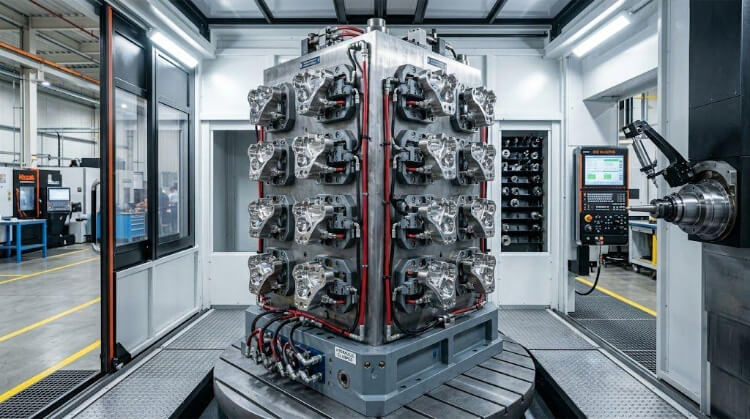
- In Production: Manual loading is often too slow for stable production. It can also increase setup variation, which raises the risk of chatter and scrap. For volume production, shops often use custom hydraulic tombstones and zero-point clamping systems. These fixtures require an upfront NRE investment, but they can shorten loading times and improve setup consistency.
Scrap and repeatability
- In Prototyping: If a tool breaks and destroys a part, you pull another block of material from the rack and start over.
- In Production: A titanium forging or near-net blank can already cost hundreds of dollars before machining begins. If a nearly finished part is scrapped during the final finishing pass, the loss can wipe out the profit on many good parts. Stable production needs tool life control. The machine should monitor tool wear and switch to a backup sister tool before the first tool fails.
Conclusion
Successful titanium cutting does not depend only on having an expensive machine. What matters more is whether the shop can control heat, cutting force, and process stability at the tool edge. A setup that works well for a Grade 2 prototype may not work for a Grade 5 production job.
If your titanium project is experiencing unstable tool life, dimensional problems, or rising cycle time, the process should be reviewed before those issues become more costly. Send us your 3D files and production requirements. Our engineering team can review the titanium grade, part geometry, and production goals, then develop a more stable, cost-effective plan from raw materials to final inspection.