 English
  Spanish
  German
  Russian
  Italian
  French
Laser cutting aluminum is widely used in sheet metal production, but it is rarely a simple process choice. Aluminum can be cut successfully, yet stable results depend on much more than machine capability alone. Material grade, feature design, assist gas, edge expectations, and downstream processing all affect whether the part is easy to produce or expensive to control.
For that reason, the real question is not only whether aluminum can be laser cut. The better question is whether laser cutting is the right choice for the part, the drawing, and the quality target. This article looks at that decision from a production view, with focus on cut stability, material choice, design risk, cost control, and final part quality.
Can You Laser Cut Aluminum?
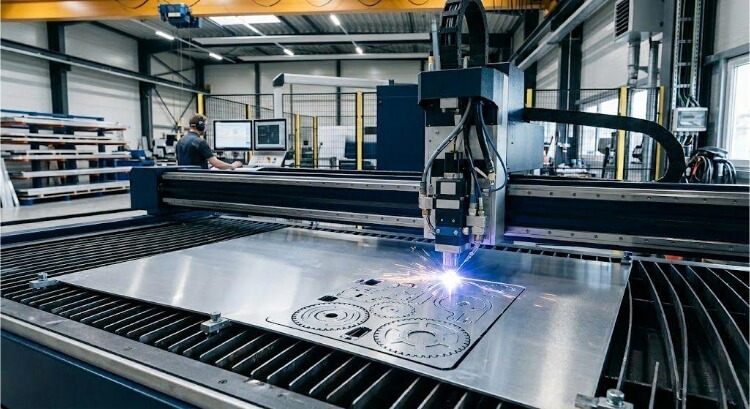
Laser cutting aluminum is possible, but stable production is where the real difficulty begins. The challenge is not only whether the beam can cut through the sheet. The real challenge is whether the process can hold edge quality, low burr, and repeatable results once the job moves beyond a single sample.
Aluminum is usually less forgiving than many steel parts. It reflects more energy and transfers heat quickly, so the cut is more sensitive to setup, gas flow, and feature geometry. A trial part may look fine, but the same job can still become expensive if edge roughness, dross, or cleanup time increases in production.
Why is aluminum harder to laser cut than steel or stainless steel?
Aluminum gives less room for process error. When settings drift slightly, the problem often shows up first at the edge. Burr may get heavier, dross may attach to the bottom edge, and small features may lose consistency before the job fully fails.
This is why aluminum cutting should be judged by consistency, not by one good sample. A hidden bracket may still work with a rougher edge. A visible panel, a coated part, or an assembly surface usually requires much tighter control.
What reflectivity and heat conductivity do during cutting?
Reflectivity affects how much beam energy actually enters the sheet. Heat conductivity affects how fast the energy moves away from the cut zone. Together, they decide how stable the kerf stays and how clean the edge looks.
In practical terms, aluminum cutting is not only about machine power. It is about keeping energy concentrated long enough to form a stable cut while clearing molten material from the kerf. A thin sheet may cut fast, but poor settings can still leave burr or visible edge marks. As thickness rises, the process usually becomes less forgiving.
Why does cuttable material not always mean stable production?
A material being cuttable is only the starting point. Stable production asks harder questions. Can the edge stay consistent across the sheet? Can burr stay low enough to avoid hand cleanup? Can the part move into bending, welding, coating, or assembly without extra work?
This is where many projects end up costing more than expected. A part may look simple, but if it needs a clean visible edge, many pierce points, or very low post-processing time, the real cost often appears after the cut, not during it.
Is Laser Cutting Aluminum the Right Choice for Your Part?
Laser cutting is usually the better choice when design flexibility matters more than the speed advantage of dedicated tooling. The better question is whether it matches the part’s thickness, quantity, feature density, edge requirement, and next process.
When does laser cutting work well for aluminum parts?
Laser cutting usually works best when the part has changing outlines, multiple cut features, or low to medium volume. In these cases, the main advantage is flexibility. Design changes can be implemented in production quickly without waiting for new tooling.
It also works well when the part value is driven by profile complexity rather than by very high repeat volume. If the geometry changes often or the project is still in development, laser cutting is often the more practical route.
Waterjet, punching, or routing may be a better option.
Laser cutting is not always the best fit. Waterjet may be a better choice when heat effects need to stay very low or when section thickness makes thermal cutting less attractive. Punching may be better for simple repeat parts at higher volume. Routing can also make sense for less demanding aluminum parts with simpler geometry.
The right process should match the real part requirement, not just the material name. A process that looks fast on paper may still be the wrong choice once edge quality, cleanup, and downstream processing are factored in.
How do thickness, quantity, and part geometry affect process choice?
Thickness changes the decision quickly. As aluminum gets thicker, edge quality and process stability become harder to maintain, and costs usually rise. Quantity matters too. Laser cutting is strongest where flexibility matters. Once the part becomes stable and the volume gets high, other methods may become more economical.
Geometry is the third filter. Small holes, dense feature patterns, many pierce points, and visible edges can all make the job slower and more sensitive. In real production, the best process is usually the one that balances feature complexity, edge quality, and total manufacturing cost.
What Aluminum Grades Can Be Laser Cut?
Most common aluminum sheet grades can be laser cut, but they should not be treated as if they behave the same way. Grade choice affects not only cutability, but also edge condition, forming margin, and how well the part moves into later processes.
For many projects, the real question is not only whether a grade can be cut, but also whether it should be. The real question is whether it still makes sense after the full manufacturing route is considered.
How do 5052, 6061, and other common grades behave differently?
In aluminum sheet metal work, the best cutting result does not always come from the grade that looks strongest on paper. 5052 is often a practical choice for sheet metal parts because it offers good corrosion resistance and good formability. That is why it is common in brackets, covers, and enclosures. 6061 can also be laser cut, but it is more often chosen when strength matters more than bending ease.
A part may cut well in either grade, but the better material can change once forming or assembly is added to the job. The cutting step should support the full part function, not determine the material on its own.
Why can the alloy type affect edge finish and cut stability?
Different aluminum grades do not respond to heat in the same way. Even when the setup is similar, one grade may show a cleaner edge while another becomes more sensitive to small features or visible edges.
This is why “aluminum” is too broad as a material choice in production planning. A hidden functional part may accept a wider process window. A visible part or a part that needs cleaner edges before finishing usually needs a narrower one.
How does sheet condition and flatness influence final results?
Grade is only part of the picture. Sheet condition also affects cut stability. If the sheet does not stay flat, nozzle distance becomes less stable, and edge quality can change across the nest.
Surface condition matters too. Protective film, scratches, contamination, and inconsistent sheet quality can all affect piercing and final edge appearance. These issues may not stop the cut, but they often reduce repeatability.
What Is the Best Way to Laser Cut Aluminum?
Good aluminum cutting depends more on process control than on machine name alone. In aluminum cutting, process stability usually matters more than chasing the fastest possible setting.
Why is the fiber laser usually the preferred option?
A fiber laser is usually preferred for aluminum because it handles reflective sheet material better in many production applications. It is often the more practical choice when both cutting efficiency and process stability matter.
That does not mean every aluminum job is easy. Aluminum still requires tighter control than many carbon-steel parts. The advantage is that a fiber laser usually gives a better starting point for stable sheet metal production.
Nitrogen vs oxygen for aluminum laser cutting
Assist gas has a direct effect on the edge condition. Nitrogen is often used when the goal is a cleaner edge with less oxidation. This is usually the better fit when appearance matters or when the part will move into finishing or assembly later.
Oxygen can support cutting in some cases, but it can also change the edge condition. That is why gas choice should follow the real part requirement, not only cutting speed. A visible finished edge and a hidden functional edge may need different targets.
How do speed, focus, nozzle condition, and gas pressure affect quality?
These settings work as one system. Focus affects where the energy is concentrated. Speed affects how stable the kerf stays. Gas pressure affects how well molten material is pushed out of the cut. Nozzle condition affects gas flow right at the cutting zone.
In production, the first signs of a mismatch usually show at the edge. Burr gets heavier, dross starts to attach, or the cut face loses consistency. The best way to laser-cut aluminum is not simply to increase power or slow the job down. It is to keep the whole process stable from piercing to the final edge finish.
Common Problems in Laser Cutting Aluminum
Most aluminum cutting problems are not isolated machine problems. They usually come from the interaction of material behavior, feature geometry, and process stability.
Why do burrs, dross, and rough edges happen?
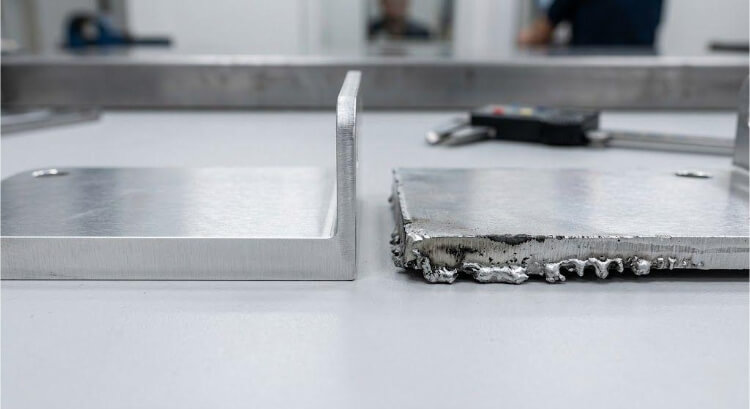
Burrs and dross usually appear when molten material is not removed cleanly from the kerf. This can happen when the speed is poorly matched, gas flow is unstable, focus is off, or the nozzle condition is poor. In aluminum work, these problems often appear quickly because the process window is narrower.
Rough edges are often an early warning sign. The part may still separate from the sheet, but the cut is no longer fully stable. In a thin sheet, that may show as a light burr or visible edge marks. In a thicker sheet, it often becomes attached dross, a heavier taper, or a less uniform cut face.
Why can thin features and small holes create cutting risk?
Small holes, narrow slots, and fine details make aluminum harder to control because they reduce the room for stable heat flow and melt ejection. The part may still be cut, but the edge quality around these features usually becomes more sensitive than on open outer profiles.
This is why a drawing that looks simple can still become difficult in production. A part with many fine features, close-cut paths, or dense pierce points often needs slower cutting, closer monitoring, or more cleanup time.
How can heat buildup and reflection reduce consistency?
Aluminum conducts heat quickly, but local heat buildup can still occur when features are dense or when cut paths are close together. Once that happens, the edge condition may start to vary from one area of the part to another.
Reflection adds another layer of sensitivity. When the process is already near its limit, reflective behavior can make piercing and edge consistency less stable. The result is often uneven quality across the nest rather than one obvious failure point.
Aluminum Laser Cutting Design Guidelines
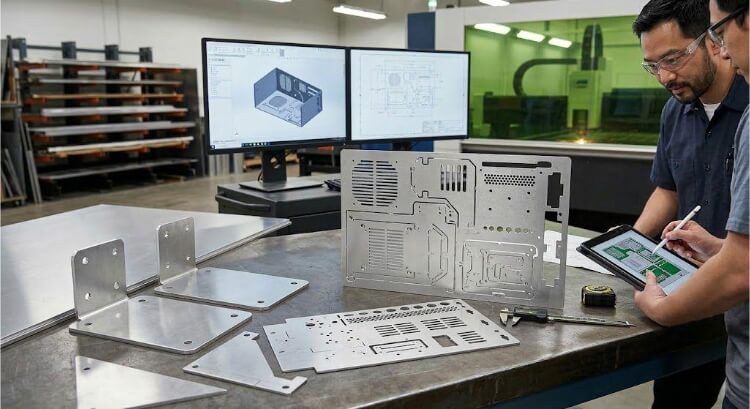
Drawing decisions often shape aluminum cutting results before machine settings do. Part design has a direct effect on cut quality, cycle time, and total cost.
Minimum holes, slots, and fine details to review before production
Very small holes, narrow slots, and sharp, fine features are common sources of risk in aluminum cutting. These details are harder to pierce cleanly and harder to keep consistent across the full sheet. As the feature size approaches the sheet thickness, the cut is usually more sensitive to burr, taper, and local roughness.
This does not mean small features should always be avoided. It means they should be reviewed early. A slight increase in hole size or slot width can make the job easier to cut and easier to repeat without changing the part function.
Safe spacing near edges, bends, and joining areas
Feature spacing matters just as much as feature size. Holes, slots, and cutouts placed too close to the outer edge can weaken the area and make edge quality less stable. Features placed too close to a future bend line can also create forming problems later.
The same issue applies to welding and assembly areas. If the cut edge is rough, crowded, or inconsistent, the next process becomes harder to control. Many downstream problems begin with a flat pattern that looks acceptable on screen but leaves too little room for stable cutting and forming.
How can better design reduce rework and improve cut quality?
Simple design changes often make a real difference. Slightly larger holes, wider slots, smoother internal transitions, and better spacing can all improve cut stability. These changes can also reduce manual deburring and help the part move more smoothly into bending, coating, or assembly.
Good aluminum design is not only about what can be drawn. It is about what can be cut cleanly, repeated consistently, and processed efficiently through the full manufacturing route.
Laser Cutting Aluminum Cost Factors
In aluminum cutting, cost often rises at the edge before it rises in machine time. Thickness, feature density, assist gas, edge requirements, and cleanup work can all change the final price.
What affects cost beyond machine time?
Thickness is one of the first cost drivers. As aluminum becomes thicker, maintaining stability during cutting becomes more difficult, and the job usually requires greater process control. Geometry matters as much. More internal features, more pierce points, and denser cut patterns usually mean more time and more chances for cleanup work.
A part can also become expensive even when the outer shape looks simple. Fine features, crowded cut paths, and tighter visible-edge requirements often slow the job down because the process has to stay more controlled.
When assist gas, tight tolerances, and cosmetic edges increase the price?
Assist gas can cost more than many teams expect. Nitrogen is often used to achieve cleaner edges and lower oxidation, but that usually raises running costs compared with a less demanding process target.
Tight tolerances and cosmetic edges raise cost for the same reason. They reduce the usable process window and leave less room for burr, dross, taper, or edge variation. A hidden functional part may accept a wider range of edge conditions. A visible finished edge usually will not.
How to balance part quality, speed, and manufacturing cost?
The best cost result usually comes from balance, not from chasing the lowest cut rate. A slightly larger hole, wider slot, or more practical edge standard can make the job easier to cut and easier to repeat.
This is why aluminum cost control is really an engineering decision. The goal is not only to cut the part. The goal is to cut it cleanly enough for the next process, without paying for unnecessary edge quality, unnecessary cleanup, or avoidable feature difficulty.
How to Check the Quality of a Laser Cut Aluminum Part?
A laser-cut edge is only good if it supports the next process without extra work. Cutting quality is not only a visual result. It affects fit, handling safety, finishing, and how easily the part moves into bending, welding, coating, or assembly.
What to inspect in edge finish, taper, and cut consistency?
The first check is the cut edge itself. Look at burr level, dross attachment, roughness, and overall edge uniformity. A good edge should remain consistent throughout the entire part, not just in one easy area.
Taper also matters. If the cut width changes too much from top to bottom, the part may still look acceptable at first glance, but fit, appearance, and assembly can all become less predictable. Consistency from part to part matters just as much as one good sample.
When deburring or secondary finishing is still needed?
Some aluminum parts can move forward with very little cleanup. Others still need deburring, edge breaking, or surface preparation after cutting. This depends on how the part will be used.
A hidden functional part may accept a sharper edge. A part that will be handled often, coated, anodized, or left visible usually needs tighter control or extra finishing.
How does cut quality affect bending, welding, coating, and assembly?
Cut quality has a direct effect on later production. Burrs and rough edges can interfere with fit-up, create more prep work before welding, and make handling less safe.
The same idea applies to forming and assembly. Sharp or inconsistent edges may look acceptable on paper, but they can still slow down the job later. A laser-cut aluminum part is successful only when it supports the full manufacturing process.
Conclusion
Laser cutting aluminum is a practical process, but it should be judged by production stability rather than just cut capability. Material grade, sheet condition, feature design, assist gas, edge standard, and downstream processing all shape the outcome.
This is why the best aluminum cutting decisions are usually made at the part level. A process that works well for a hidden bracket may not be the right choice for a visible panel, a coated enclosure, or a part that needs a clean fit-up for welding and assembly.
Need Help Reviewing an Aluminum Laser Cut Part?
A part may look easy to cut on the drawing, but real production risk often appears in edge quality, small features, bend areas, or later finishing steps. Early review usually saves more time and cost than correcting the process after cutting starts.
If you are working on an aluminum bracket, cover, panel, enclosure, or custom sheet metal part, a drawing review before production can help confirm whether laser cutting is the right process, what edge quality is realistic, and where the main cost risks may appear.