 English
  Spanish
  German
  Russian
  Italian
  French
Is your finish the weak link in your product design? In custom manufacturing, the finish is never just an aesthetic afterthought—it is a functional component. Choosing the wrong surface treatment can lead to assembly failures due to thickness buildup, premature corrosion in the field, or ballooning costs during mass production.
At TZR, we see this dilemma daily. A client designs a precision chassis for a medical device but specifies a heavy industrial powder coat that throws off the tolerances. Another specifies liquid paint for an outdoor enclosure, only to see it degrade under UV exposure within a year.
The choice between Powder Coating and Traditional Wet Paint is a critical engineering decision. This guide moves beyond the basics to compare durability, tolerance implications, cost dynamics, and failure modes, helping you make the data-backed choice for your project.
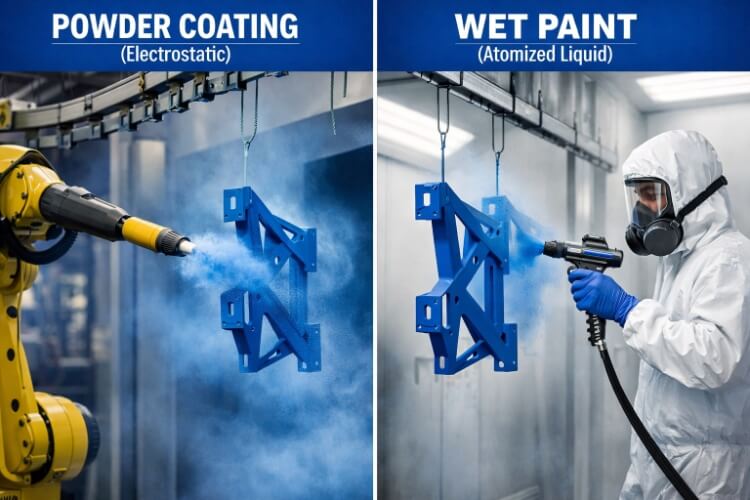
What is Powder Coating?
Powder coating is a dry finishing process that has become the industry standard for durability. Unlike paint, which requires a solvent to keep binders in suspension, powder coating uses a free-flowing, dry mix of plastic resins, pigments, and curatives.
The Engineering Process
- Electrostatic Deposition: A specialized spray gun applies an electrostatic charge to the powder particles. These charged particles are sprayed onto a grounded metal part, adhering magnetically. This ensures the powder wraps around edges and penetrates deep corners (Faraday cage areas) better than liquid spray.
- Thermal Curing: The coated part enters an industrial oven, typically heated to 350°F – 400°F (175°C – 200°C). The powder melts, flows, and chemically cross-links to form a continuous, high-density polymer skin.
Material Types: A Quick Selection Guide
- Thermoset (Most Common): Forms an irreversible chemical bond during curing. It will not melt if reheated.
- Best for: Electronics chassis, automotive parts, and appliances where heat and chemical resistance are paramount.
- Thermoplastic: Does not chemically cross-link; it just melts and sets. It is softer and more ductile.
- Best for: Thick coatings on playground equipment or wire goods that need impact absorption.
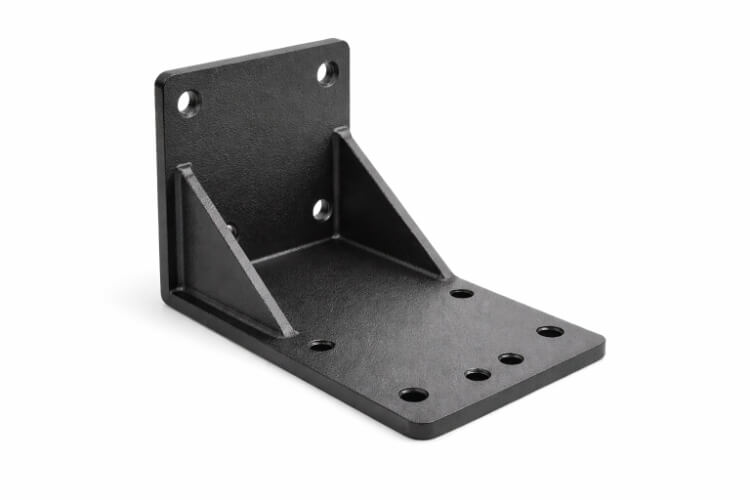
What is Traditional Wet Paint?
Wet paint (liquid spraying) is the conventional method of suspending pigment in a solvent. While it may seem “low-tech” compared to electrostatic powder, it remains indispensable for specific engineering challenges.
The Mechanics
Liquid paint relies on atomization. Compressed air breaks the fluid into a fine mist. As the solvent evaporates, the resin adheres to the surface. It does not require the high heat of powder curing, making it the universal solution for mixed materials.
Why It Still Matters?
While powder coating is tougher, wet paint is thinner and more controllable.
- Film Thickness: Wet paint can be applied as thin as 15–20 microns (0.5 – 1 mil).
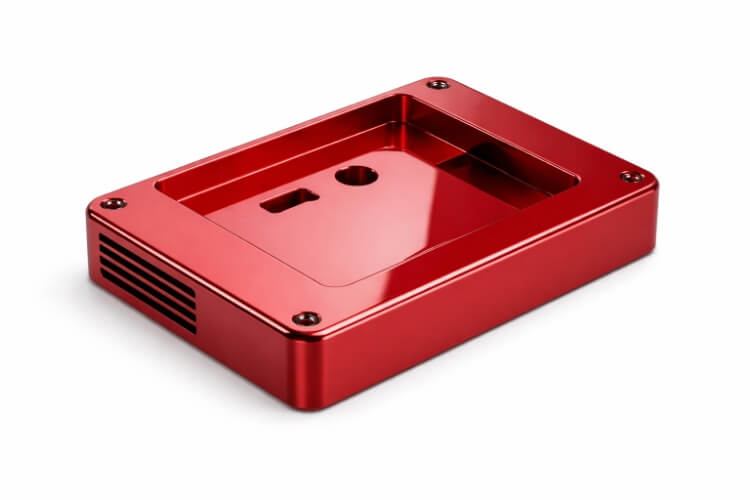
- Leveling: High-quality wet paint can achieve a “Class A” glass-smooth finish that powder coating—with its inherent “orange peel” texture—struggles to match.
Insider Insight:
Many engineers assume powder coating is always better because it’s “newer.” However, for rapid prototyping, wet paint is often superior. It allows us to mask complex features easily, requires no oven time, and avoids the heavy edge buildup that interferes with fit-checks on first-article prototypes.
Powder Coating vs. Paint: Key Differences
For sourcing managers and engineers, the choice usually boils down to four factors: How long will it last? How does it look? How much does it cost? And is it sustainable?
Here is how the two heavyweights compare when put to the test.
1. Durability
If your primary KPI is physical toughness, powder coating is the undisputed leader.
- Impact Resistance: The thermal bonding process creates a dense, flexible “skin.” Industry impact tests (ASTM D2794) consistently show that powder coating can withstand significant deflection without cracking. This makes it ideal for parts exposed to vibration or flying debris.
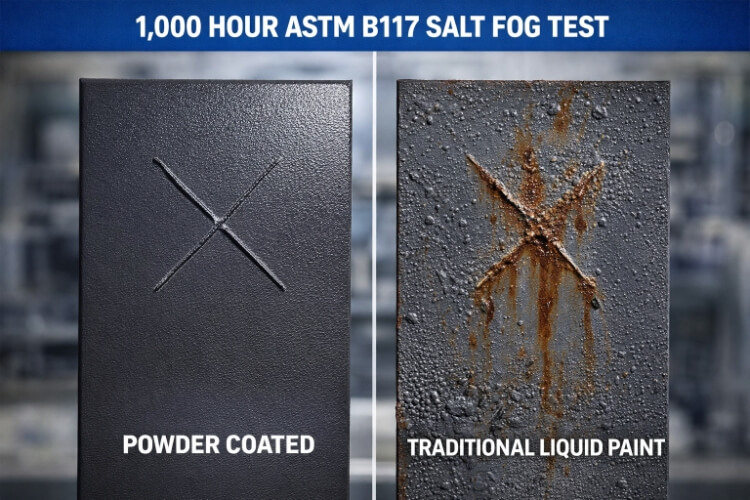
- Corrosion Resistance: Under standard ASTM B117 Salt Spray tests, a high-quality powder coat over properly pre-treated steel can often withstand 1,000+ hours before showing significant red rust. Standard industrial liquid paints often fail between 200 and 500 hours unless high-grade, expensive epoxy primers are used.
Insider Insight: ” The Coating is Only as Good as the Cleaning.” Many clients blame the powder when a part rusts, but the culprit is usually the pre-treatment. At TZR, we emphasize that without proper sandblasting or phosphate washing to remove oil and scale, even the best powder coat will peel off like a sticker. We treat the substrate preparation as 70% of the job.
2. Aesthetics
While powder wins on toughness, wet paint wins on precision and visual versatility.
- Texture (The “Orange Peel” Effect): Because powder particles must melt and flow together, the final finish often has a subtle, bumpy texture resembling the skin of an orange. While we can tune this, achieving a “Class A” mirror-like gloss (common in automotive exteriors) is incredibly difficult with powder. Wet paint levels out significantly better for high-gloss applications.
- Color Consistency & Branding: Wet paint can be mixed on-site to match any Pantone color instantly. Powder coating relies on factory-manufactured batches.
- The Risk: If you order a powder-coated run today, and another run six months later, slight “batch-to-batch” color variations can occur. For strict consumer branding, wet paint offers better repeatability across different production lots.
3. Cost Dynamics
Cost is not linear; it depends entirely on your volume.
- Prototyping (1–50 Units): Wet paint is generally cheaper. It requires minimal setup—just a spray gun and a booth. There is no need to heat up a massive industrial oven for a single prototype bracket.
- Mass Production (50+ Units): The scales tip heavily toward powder coating.
- Efficiency: Powder coating is automated and fast. Parts hang on a conveyor, get sprayed, and cure in minutes.
- Material Utilization: This is the hidden cost saver. With liquid paint, the “Transfer Efficiency” is low—roughly 30-35% of the paint lands on the part; the rest is wasted overspray. With powder, we collect overspray and reuse it, achieving up to 95% material utilization.
4. Environmental Impact
Sustainability is increasingly a requirement in RFQs (Request for Quotes).
- VOCs (Volatile Organic Compounds): Liquid paints are solvent-based and emit VOCs as they dry, requiring expensive air filtration systems and posing health risks to workers.
- The Green Alternative: Powder coating contains zero VOCs. It is solvent-free and inert. If your company has strict ISO 14001 environmental targets, powder coating is the compliant choice.
Engineering Design Guide: Tolerances, Thickness, and Masking
While durability and cost are usually the headline comparisons, experienced engineers know that the success of a part often comes down to the sub-millimeter details.
The chemical differences between powder and paint create vastly different physical constraints. Failing to account for these in your CAD model can lead to costly rework on the assembly floor.
The Tolerance Trap
One of the most common issues we see at TZR is interference fits caused by coating buildup.
- The Thickness Gap:
- Wet Paint: Adds a negligible layer, typically 0.5 to 1 mil (12–25 microns). It rarely affects general tolerances.
- Powder Coating: Adds a significant skin, typically 2.5 to 6 mils (60–150 microns) per side.
- The Assembly Consequence: If you have a tab-and-slot design or a precise sliding fit, adding 150 microns to both surfaces effectively reduces your clearance by 0.3mm. This is often enough to make parts impossible to assemble without grinding.
Engineering Tip: Design for the Finish.
If you choose powder coating, do not design to “zero” tolerance. We recommend effectively opening up your clearances in the CAD file. For clearance holes, increase the diameter by 0.15mm – 0.25mm to compensate for the powder wrap-around. It is much cheaper to adjust the digital file than to ream out 1,000 holes by hand.
Thread Protection and Masking
Protecting threaded holes is straightforward with wet paint, but powder coating presents a unique challenge due to the high curing temperatures (400°F).
- The Challenge: Standard masking tape melts. We must use specialized high-temperature silicone plugs and caps.
- The “Re-Tap” Strategy: Sometimes, for very small threads (under M6), masking is labor-intensive and unreliable.
- Best Practice: In many cases, it is more cost-effective to let the powder coat cover the threads and then re-tap (chase the threads) after curing. However, this exposes bare metal inside the thread, so it requires a corrosion inhibitor if used outdoors.
Failure Modes: “Corrosion Creep” vs. Spot Rusting
How a finish fails is just as important as how it looks when new.
- Wet Paint Failure: When painted metal is scratched, it typically rusts locally at the exposure point. The surrounding paint remains chemically bonded to the substrate.
- Powder Coat Failure (The “Shrink Wrap” Risk): Powder coating forms a mechanical shell. If the pretreatment was imperfect and the coating gets chipped, moisture can penetrate underneath the coating layer.
- The Result: This leads to Corrosion Creep. The rust travels underneath the intact coating, lifting it off the metal in large sheets like failing shrink wrap. This can hide significant structural damage until the coating falls off entirely.
Substrate Limitations and Repairability
- Field Repair: This is a major win for wet paint. If a painted heavy machine is scratched during shipping, it can be sanded and touched up with a matching liquid paint pen. Powder coating cannot be “touched up” with powder in the field (you cannot put a whole bulldozer in an oven).
- Heat Sensitivity: Remember, if it can’t survive 400°F, it can’t be powder coated. This rules out pre-assembled parts containing rubber seals, plastic bushings, or electronics. These must be masked or assembled after coating, which impacts your assembly line sequence.
| Feature | Powder Coating | Traditional Wet Paint |
| Durability | Extremely High. Impact-resistant “shell”; resists chipping and scratching. | Moderate. Good protection, but can chip or scratch more easily. |
| Corrosion Resistance | Excellent (1,000+ hrs salt spray). Susceptible to “corrosion creep” if chipped. | Good. Fails locally (spot rust) rather than peeling in sheets. |
| Coating Thickness | Thick (2.5 – 6.0 mils). Can interfere with tight tolerances/threads. | Thin (0.5 – 2.0 mils). Ideal for precision fits and fine details. |
| Aesthetics & Texture | Slight “Orange Peel” texture. Difficult to achieve mirror-smoothness. | Can achieve Class A High Gloss (mirror finish) and smooth leveling. |
| Color Matching | Limited to batch availability. Custom colors require high MOQs. | Unlimited. Can be mixed on-site to match any Pantone/RAL instantly. |
| Cost Efficiency | Cheaper for Mass Production (50+ units) due to material recycling. | Cheaper for Prototypes (1–50 units) due to low setup costs. |
| Heat Resistance | High (cured at 400°F). | Variable. Standard paints degrade in high heat unless specialized. |
| Substrate Compatibility | Mostly Metal (conductive & heat resistant). | Universal. Metal, Plastic, Wood, Carbon Fiber, Rubber, etc. |
| Environmental | Eco-Friendly. Zero VOCs, recyclable overspray. | High VOCs (solvents), requires strict air filtration. |
| Field Repair | Difficult. Cannot touch up with powder; requires liquid paint patch or full recoat. | Easy. Can be sanded and touched up on-site. |
| Best Use Case | Heavy machinery, outdoor enclosures, automotive chassis, large batches. | Prototypes, cosmetic consumer electronics, complex assemblies, plastics. |
When to Choose Powder Coating vs. Wet Paint?
Ultimately, the choice between powder coating and paint isn’t about which is “better” in the abstract—it is about which aligns with your specific constraints. We often see projects fail not because the coating was bad, but because it was the wrong application for the design.
To simplify your decision, use this “If-Then” Decision Matrix based on thousands of projects we have managed at TZR.
Choose POWDER COATING If:
- Volume: You are running mass production (50+ units). The speed and material efficiency will significantly lower your per-unit cost.
- Environment: The product is for outdoor use, heavy machinery, or transportation (e.g., truck beds, agricultural equipment) where impact and corrosion resistance are non-negotiable.
- Geometry: Your design includes wire goods, fencing, or complex tubing. Powder wraps around these shapes naturally, whereas paint would require expensive manual labor to avoid runs and drips.
- Sustainability: Your company has strict Zero-VOC mandates or environmental compliance targets.
Choose WET PAINT If:
- Volume: You are in the Prototyping phase (1–10 units). It is faster, cheaper to set up, and allows for easier modifications.
- Tolerances: You have precision mating surfaces or intricate assembly points where a 6-mil (150-micron) coating buildup would cause interference.
- Substrate: Your assembly contains mixed materials (plastics, carbon fiber, rubber) that cannot survive a 400°F (200°C) oven.
- Field Maintenance: The product is large and likely to need cosmetic touch-ups in the field (e.g., heavy structural steel).
Conclusion
The battle between powder coating and paint has no single winner. Powder coating is the industrial workhorse—an armored shell built for efficiency and toughness. Wet paint is the precision instrument—versatile, thin, and infinitely customizable.
The success of your metal fabrication project relies on making this decision during the design phase, not after the parts are cut.
At TZR, we don’t just follow instructions; we optimize them. We have seen too many great designs stalled by tolerance issues or unexpected corrosion failures.
Send us your CAD files today. Our engineering team will perform a complimentary DFM (Design for Manufacturing) review. We will check your tolerances against coating thickness, recommend the optimal pretreatment, and ensure your product performs as beautifully as it looks.
FAQs
Can you apply powder coating over wet paint?
Generally, no. The high heat required to cure the powder (400°F) will burn, bubble, or gas out the underlying liquid paint, ruining the finish. The surface must be sandblasted to bare metal first.
Is powder coating completely waterproof?
It creates a hydrophobic, non-porous seal, making it highly water-resistant. However, it is not “waterproof” in a submerged sense if there are any pinholes or if the coating chips. Once the seal is broken, moisture can travel underneath (corrosion creep).
Can I get a custom color match for powder coating?
Yes, but with caveats. While we can order custom powder to match any RAL or Pantone color, manufacturers typically require a high Minimum Order Quantity (MOQ) (e.g., 25kg of powder). For small batches, sticking to stock colors is much more economical.
Which is better for hiding surface defects?
Powder coating is superior here. Because it is thicker and has a natural texture, it can hide minor grinding marks or steel imperfections that a high-gloss wet paint would magnify.