 English
  Spanish
  German
  Russian
  Italian
  French
Progressive die stamping is widely used for metal parts that need stable quality, repeat output, and lower unit cost in long production runs. It is a common choice for brackets, clips, terminals, shields, and other parts that are produced in volume from coil stock.
The process can be very efficient, but it is not the right fit for every part. A part may look simple on the drawing, but still be difficult to run in a progressive die if the strip cannot remain stable at each station. That is why part shape, production volume, tooling cost, and strip flow all need to be judged together.
For buyers and engineers, the real question is not only how the process works, but also why. The more useful question is whether it makes sense for the part, the program, and the expected production demand.
How Progressive Die Stamping Works?
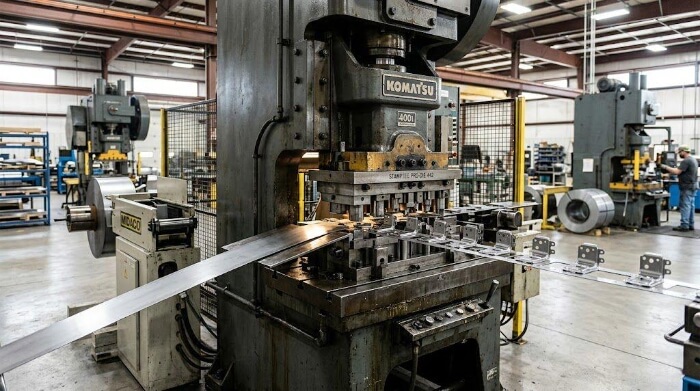
Progressive die stamping builds a part step by step as the metal strip moves through a series of stations within a single die. Each press stroke completes one stage of the work until the finished part is cut free at the final station.
Strip feeding
The process usually starts with a coil-fed strip. The material advances one pitch at a time, with each stroke moving it to the next station.
Stable feeding is one of the basic requirements in progressive die stamping. If the strip does not advance accurately, hole position, formed features, and overall part consistency can all shift. In this process, the strip is not only the raw material. It also carries the part through the die, so strip control directly affects whether the tool can run consistently.
Production speed can be high once the die is stable, but speed only creates value when the strip stays controlled from station to station. If strip movement becomes unstable, output, quality, and tool life can all suffer.
Multi-step forming in one die
Each station performs part of the job. One station may pierce holes, another may trim edges, and another may bend or form features. Instead of making the part in one hit, the die builds it in stages.
This is one reason the process becomes efficient in repeat production. Multiple operations are handled within a single tool, reducing handoffs between steps, and output remains consistent once the die is running well.
Die design matters just as much as press speed. Station order, strip layout, carrier strength, and feature sequence all affect whether the part can run cleanly from start to finish. A part may look simple on the drawing, but it becomes difficult to produce if the strip loses support as features are added.
Final part separation
In most setups, the part stays attached to the strip until the last station. This helps keep it located and supported while earlier operations are completed.
At the final stage, the finished part is cut free from the carrier. This supports continuous production, but it also creates a clear design limit. The part must stay stable on the strip through the full die path. If support becomes too weak or the shape becomes too difficult to carry, the process will not stay stable in production.
What Parts Are Best for Progressive Die Stamping?
Progressive die stamping usually works best when the part shape is stable, repeat demand is clear, and production volume is high enough to recover tooling cost over time. It is most effective when the part can move through the die in a controlled way and when the long-run piece cost matters more than the low upfront tooling risk.
Repeatable part shapes
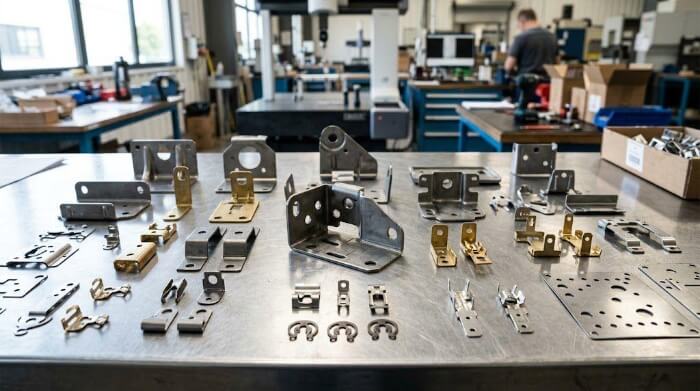
Parts with stable shapes and repeatable features are usually the best fit. This often includes brackets, clips, terminals, retainers, covers, and similar parts with pierced features, trimmed outlines, tabs, and moderate forming.
The main question is not only whether the final shape can be stamped, but also whether it can be stamped at all. It is whether the part can stay supported, located, and controlled through each station. Some parts look simple on the drawing but become difficult in production because the strip loses strength, balance, or support as features are added.
Medium to high volume production
Production volume is one of the main reasons to choose progressive die stamping. Tooling costs are usually higher at the start, so the process makes the most sense when those costs can be spread across repeat orders or long production runs.
Tooling investment can vary widely from one project to another. A smaller, simpler die may be easier to justify than a large, multi-station tool built for tighter control, more features, and a longer production life. That is why progressive die stamping is usually a demand decision as much as a process decision.
For lower-volume work, simpler stamping, laser cutting, turret punching, or press brake forming may be easier to justify. As demand becomes more stable and repeat output becomes more important, progressive die stamping becomes easier to support from both a cost and production standpoint.
Parts that need a lower unit cost
One of the main advantages of progressive die stamping is lower unit cost in repeat production. Once the die is built and running well, multiple operations can be completed in a single tool, reducing handling between steps.
That advantage is strongest when the design is stable, and demand is predictable. If the same part will run long enough, the lower piece cost can outweigh the higher upfront tool cost. If the design changes often or the annual demand is unclear, that advantage becomes much harder to realize.
For buyers and engineers, tooling costs matter only in context. It needs to be weighed against annual demand, target piece price, and how long the design is likely to stay unchanged.
When Progressive Die Stamping Is the Wrong Choice?
Progressive die stamping is not the best option for every part. It can be efficient in the right program, but if the part is hard to carry on the strip, the design changes often, or demand is too low, the tool may be difficult to justify.
Low volume or changing designs
Progressive die stamping usually makes less sense when order volume is low or the part design is still changing. A higher upfront tool cost is harder to recover when the same part does not run long enough or requires frequent revisions.
In this situation, more flexible processes are often easier to manage. Laser cutting, simpler stamping tools, or brake-formed fabrication may carry a higher piece cost, but they can reduce risk when demand is uncertain or the design is not yet stable.
Deep drawn or difficult part shapes
Some part shapes are harder to run in a progressive die because they do not remain stable on the strip throughout the entire process. Deep drawn features, large forms, weak carrier areas, and unbalanced shapes can all make strip control more difficult.
That does not mean these parts cannot be stamped. It means progressive die may not be the most practical route. In some cases, a transfer die or another forming method gives better part support and a more stable production path.
Jobs are better suited to other processes
A process should be chosen for the part, not the other way around. If the geometry is simple, the volume is low, or the design is likely to change, another process may give better overall value.
This is especially true in early-stage programs, prototype work, and mixed-volume production. In those cases, lower tooling risk and faster design adjustment matter more than the lower piece cost that a progressive die can offer later.
What Makes a Progressive Die Expensive?
Progressive die cost is not driven by size alone. Tool cost usually increases when the die requires more stations, tighter process control, a stronger carrier design, and more features completed in a single tool.
Strip layout and station count
Strip layout is one of the biggest cost drivers in progressive die design. The die has to move the part through each operation in a stable sequence, and that often determines how many stations are needed.
As station count increases, the tool becomes longer, more complex, and harder to build, tune, and maintain. A part that needs more steps is not only more expensive because it does more work. It is more expensive because the die has to complete that work in the right order without losing strip control.
Complex features and tight tolerances
Part features also directly affect the cost. Pierced holes, narrow tabs, bends, coined details, formed features, and tight edge relationships can all increase the complexity of the tool.
Tighter tolerances usually raise costs further. They often require better process control, stronger alignment, and closer attention to wear over long runs. A part can be stampable and still become expensive if the quality target demands more control than a simple die can provide.
Material behavior and burr control
Material choice also affects die cost and process difficulty. Harder materials, springback-sensitive materials, or stock with tighter surface and edge requirements may need more attention in tool design and setup.
Burr control matters for the same reason. If the part needs cleaner edges, more stable feature quality, or longer tool life between maintenance intervals, the die usually needs a higher level of control. That added control often shows up in both tooling cost and long-run maintenance demands.
Common Problems in Mass Production
A progressive die may run well in sampling but still exhibit problems in long production runs. Once output increases, strip movement, tool wear, burr growth, and dimensional drift can all start to affect part quality and production stability.
Feeding and strip movement issues
Feeding problems are one of the most common reasons a progressive die stops running consistently. If the strip does not advance accurately, hole position, feature alignment, and forming consistency can all begin to shift.
Long-run problems often start small. A slight feed shift, weak carrier support, or poor material control can turn into burr growth, size drift, or unstable forming later in the run. Once that happens, scrap risk rises, and the process becomes harder to control.
Tool wear and dimensional change
Tool wear is part of normal production, but it still directly affects part quality. As punches, cutting edges, and forming surfaces wear down, burrs may increase, and dimensions may begin to move.
This is why long-run quality cannot be judged only by first-off samples. A part that looks good at the start of the run still needs to hold size, edge condition, and feature consistency after repeated cycles. In progressive die stamping, stable output depends on how well the die holds that control over time.
Maintenance and consistency problems
Maintenance is not only about fixing a worn tool. It is part of keeping the process repeatable. A die can keep running after maintenance starts slipping, but repeatability usually drops first.
For this reason, production consistency depends on more than die design alone. It also depends on how the tool is maintained, how wear is managed, and how early small process changes are caught before they turn into larger quality problems.
How Progressive Die Compares to Other Processes?
Progressive die stamping is one of several methods for making sheet-metal parts, but it is not always the best option. The right choice depends on part shape, annual demand, design stability, tolerance needs, and the total cost of getting the part into production.
Transfer die
Transfer die is often the better choice when the part shape is harder to carry on a strip. Once the blank is separated, the part moves from station to station without remaining attached to a carrier, which can provide better support for larger forms or more complex geometries.
Compared with a progressive die, a transfer die may handle some part shapes more effectively, but it also involves a different tooling and handling approach. If strip carry is the main problem, the transfer die is often the best place to start.
Single-operation stamping
Single-operation stamping can make more sense when the part is simple or production demand does not justify a multi-station die. Tooling is usually easier to build, revise, and justify in lower-volume work.
The tradeoff is handling and process efficiency. Separate operations may require more setups, more movement, or more secondary work. For mature parts that run repeatedly at high volume, a progressive die often creates a stronger, more reliable process. For simpler or less stable programs, single-operation tooling may be the safer choice.
Laser cutting and CNC machining
Laser cutting and CNC machining are usually more flexible when volumes are low, designs are still changing, or the part does not justify dedicated stamping tooling. They are often easier to use in prototype work, pilot runs, and early-stage development.
The tradeoff is piece cost and throughput. These processes are easier to start with, but they usually do not match the long-run efficiency of progressive die stamping once volume rises and the design is stable. If tooling risk is the main concern, they are often the better starting point. If repeat demand and cost reduction drive the program, progressive die may become the stronger choice later.
| Process | Best For | Main Advantage | Main Limitation | Best Fit in Real Projects |
|---|---|---|---|---|
| Progressive Die Stamping | Parts with stable geometry and repeat demand | Low piece cost in long runs, high output, fewer handling steps | Higher upfront tooling cost, less flexible for design changes | Mature parts that run repeatedly in medium to high volume |
| Transfer Die | Larger forms or parts that are hard to carry on a strip | Better part support for difficult shapes and more complex forming paths | Tooling and handling can be more complex | Parts that are difficult to keep stable in a strip-based process |
| Single-Operation Stamping | Simple parts or lower-volume work | Simpler tooling, easier revisions, lower initial tool risk | More handling, more setups, lower long-run efficiency | Parts with simpler geometry or programs that do not justify a multi-station die |
| Laser Cutting | Flat parts, prototypes, and changing designs | High flexibility, no dedicated stamping die, fast for early-stage work | Higher piece cost in volume, limited forming capability | Prototype parts, pilot runs, and low-volume production with frequent design updates |
| CNC Machining | Parts that need machining features, tighter local control, or non-sheet-metal geometry | Strong flexibility, good for detailed features and lower-volume precision work | Slower throughput and higher piece cost for stamped-type parts | Early-stage development, lower-volume parts, or designs not suited to stamping |
Conclusion
Progressive die stamping is not just a fast way to make parts. It is a production strategy that works when the part can stay stable on the strip, the design is consistent, and demand is high enough to justify the tool.
For the right program, it can reduce handling, improve repeatability, and bring piece cost down over time. For the wrong part or unstable demand, it can create risk, higher upfront cost, and difficult production control.
If you are evaluating progressive die stamping for a project, the fastest way to decide is to review the part with real production conditions in mind. Send us your drawing, CAD file, or project details. Our team can review the part, discuss the most practical production route, and help you understand the tradeoff between tooling cost, piece price, and long-run production efficiency.