 English
  Spanish
  German
  Russian
  Italian
  French
Selecting the right steel isn’t just about reading yield strength off a datasheet. Over-engineering a part by specifying an alloy steel can triple your raw material costs and double your CNC machining time for absolutely zero functional gain.
Here is the bottom line: Carbon steel is your go-to for driving down the Cost-per-part and accelerating production. Alloy steel is your insurance policy when the component faces extreme mechanical loads, severe wear, or harsh environments where failure is not an option.
If you need to make a fast, data-driven decision to hit your target Total Cost of Ownership (TCO), start with the quick guide below.
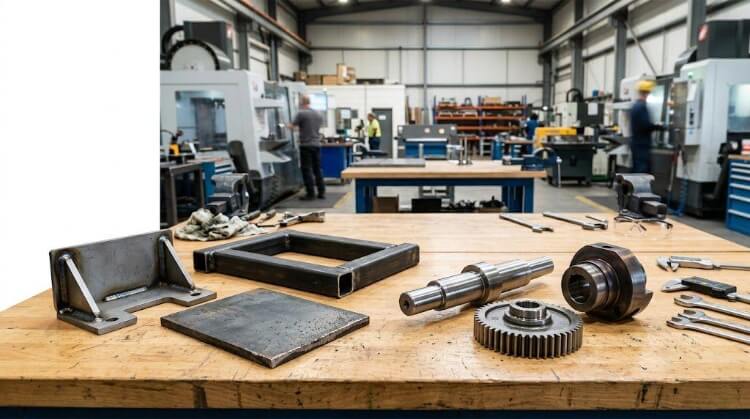
Quick Guide for Choosing Between Alloy Steel and Carbon Steel
Carbon steel is usually the practical starting point for simple parts. It is easier to source, easier to cut, easier to weld, and often cheaper to process
Alloy steel is a better choice when the part needs stronger mechanical performance. It can provide higher strength, better wear resistance, and better response to heat treatment.
Cost-Sensitive Parts
When protecting the project budget is the primary goal, carbon steel is the definitive starting point. Low carbon steel is highly ductile, making it significantly easier to cut, bend, weld, and finish than its alloy counterparts.
Because the raw material is cheaper and the manufacturing cycle is shorter, your overall cost-per-part drops dramatically. It works exceptionally well for brackets, frames, covers, and structural panels where you want to avoid expensive over-engineering.
High-Load Parts
Alloy steel is the superior option when a component must handle high stress, heavy torque, or repeated mechanical loading. Grades like 4140 and 4340 are engineered for these demanding environments, truly unlocking their potential after heat treatment.
However, always keep lead times in mind. Common carbon steels are universally in stock, while specialty alloys can delay your project by weeks. Only specify these materials for critical shafts, heavy-duty gears, and load-bearing pins where standard steel would fail.
Welded Assemblies
If your project requires extensive fabrication, low carbon steel is hands-down the easiest steel to weld. It has a much lower cracking risk in the heat-affected zone (HAZ) and generally requires no specialized process controls.
Conversely, welding alloy steel is a completely different beast. It often requires strict preheating, controlled cooling rates, or post-weld heat treatment. These extra steps add hours to the fabrication process and drive up labor costs.
Wear-Resistant Parts
For parts subjected to continuous friction, impact, or abrasive wear, alloy steel takes the lead. Properly heat-treated alloy steel achieves a deeper, more stable hardness that dramatically extends wear life.
While carbon steel can survive simple wear applications through secondary surface hardening, its TCO often ends up higher once you factor in the extra coating processes. Your ultimate choice will depend on the contact load, lubrication, and expected service life.
Material Differences That Affect Part Performance
The practical differences between alloy steel and carbon steel begin at the chemical level. Carbon steel relies almost entirely on its carbon content to dictate its mechanical properties, while alloy steel utilizes a mix of added elements to target very specific performance goals.
Carbon Steel Basics
At its core, carbon steel consists primarily of iron and carbon, occasionally containing trace amounts of manganese, silicon, sulfur, and phosphorus. Its behavior on the shop floor changes drastically as the carbon content increases.
Low carbon steel is highly ductile, making it easy to form and weld. As you move to medium and high carbon steels, the material gains strength and hardness, but simultaneously becomes much harder to bend and weld without cracking.
Key Takeaway: Carbon steel is not one single material. Grades like A36, 1018, 1045, and 1060 behave very differently in machining, welding, bending, and heat treatment.
Alloy Steel Basics
Alloy steel takes a standard iron-carbon base and adds specific elements such as chromium, nickel, molybdenum, manganese, or vanadium. These additions are engineered to improve strength, toughness, hardenability, wear resistance, or extreme heat tolerance.
Because of these complex metallurgical additions, alloy steel usually costs more and requires tighter control during machining and thermal processing.
Key Takeaway: Alloy steel is not automatically better. It is better only when the part truly needs its added performance. Specifying a high-end alloy for a simple equipment bracket is a fast way to burn your manufacturing budget.
The Procurement & Engineering Decision Matrix
To help you balance material price against manufacturing friction, use the following matrices. Note that a higher material cost is often overshadowed by the cost of extended machining time.
Carbon Steel Decision Matrix
| Grade | Common Use | Machinability (10=Easiest) | Relative Cost | Engineering Reality |
| A36 | Frames, welded structures | 6/10 | $ (Base) | Can be “gummy” and tear easily. It is tough to hold tight tolerances or achieve a fine surface finish during CNC machining. |
| 1018 | Machined parts, pins | 8/10 | $ | Excellent for turning and high-speed CNC milling. Offers highly predictable chip control. |
| 1045 | Stronger shafts, rods | 6/10 | $$ | Noticeably harder on cutting tools than 1018. Requires more rigid workholding and better coolant strategies. |
| 1060 | Wear parts, springs | 4/10 | $$ | Tough to machine. The high carbon content significantly reduces carbide insert life. |
Alloy Steel Decision Matrix
| Grade | Common Use | Machinability | Relative Cost | Engineering Reality |
| 4130 | Tubes, aerospace frames | 5/10 | $$$ | Great strength-to-weight ratio, but requires highly controlled welding procedures to avoid cracking. |
| 4140 | Heavy-duty shafts, gears | 4/10 | $$$ | Extremely tough, but increases tool wear by 30-40% compared to standard 1018. Expect slower cycle times. |
| 4340 | Extreme impact parts | 3/10 | Exceptional impact resistance, but eats cutting tools for breakfast if feeds and speeds are not perfectly dialed in. | |
| 8620 | Carburized gears, pins | 6/10 | $$$ | The best choice for case-hardening. Provides a glass-hard surface with a tough, ductile core that won’t shatter under load. |
Manufacturing Factors That Change Cost and Risk
A material might look perfect on a CAD drawing, but its true cost is exposed the moment it hits the shop floor. Every extra minute spent cutting, bending, or welding directly inflates your final invoice. The manufacturing route you choose often dictates whether an alloy is a wise investment or a critical over-engineering mistake.
Real-World Example: We recently reviewed a CAD file for a simple sensor housing spec’d in 4140 Alloy Steel. By convincing the client to downgrade to 1018 Carbon Steel with a black oxide finish, we cut their machining cycle time by 45% and reduced the cost-per-part from $42 to $18, with zero loss in field performance.
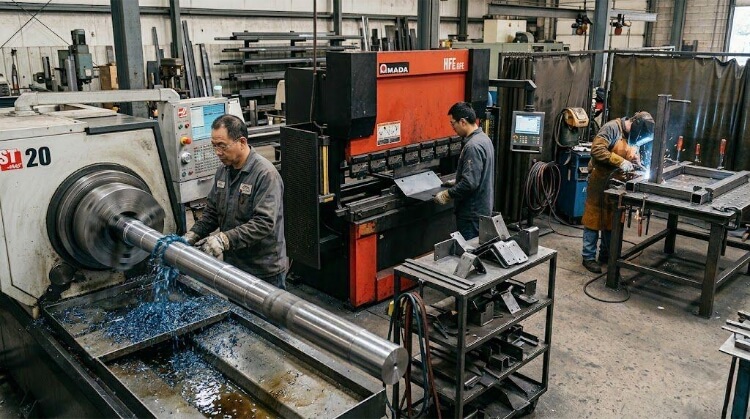
CNC Machining Cycle Times
Low carbon steel (like 1018) allows machinists to maximize spindle speeds and feed rates. It generates predictable chips, resulting in aggressive cycle times and extended tool life.
Conversely, alloy steels (like 4140 or 4340) push back against the cutter. They demand slower speeds, rigid workholding, and premium carbide inserts. If you specify a pre-hardened alloy, expect your machining costs to skyrocket as cutting tools wear out prematurely.
Engineering Reality: Material price is only a fraction of a CNC quote. Doubling your machining time will always hurt your budget more than upgrading the raw material. Always design for manufacturability (DFM) first.
Sheet Metal Formability and Springback
High tensile strength is the enemy of the press brake. Engineers often mistakenly specify high-strength alloys for sheet metal brackets, assuming stronger is better.
In reality, high carbon and alloy steels introduce severe springback—the tendency of the metal to fight the bend and return to its original shape. Furthermore, forcing a hard alloy into a tight bend radius dramatically increases the risk of micro-cracking along the edge.
Engineering Reality: For formed components, the strongest material is rarely the right material. If a hard alloy fractures along the bend line during a 90-degree fold, its extreme yield strength is entirely useless. Stick to highly ductile mild steels for formed enclosures.
Weldability and HAZ Cracking
Low carbon steel is the undisputed king of welded assemblies. It boasts incredible weldability with almost zero risk of cracking in the Heat-Affected Zone (HAZ). Welders can move quickly without complex thermal controls.
Welding alloy steel, however, is a massive labor bottleneck. The added alloying elements make the metal highly prone to embrittlement when rapidly cooled. To prevent catastrophic weld failure, fabrication shops must implement strict pre-heating and Post-Weld Heat Treatment (PWHT) procedures.
Engineering Reality: Specifying an alloy steel for a standard welded frame will drastically increase fabrication labor hours and complicate your quality inspection process.
Surface Protection vs. Built-In Resistance
Engineers often mistakenly upgrade to expensive alloy steels simply to combat environmental wear. While some alloys resist oxidation better than others, very few are truly corrosion-proof (unless you pivot entirely to Stainless Steel).
For the vast majority of industrial equipment, using an inexpensive carbon steel paired with a robust powder coating, zinc plating, or hot-dip galvanizing yields a drastically lower Total Cost of Ownership (TCO).
Engineering Reality: Do not buy expensive metallurgy just to fight surface rust. Use cheap structural steel and let the surface finish do the heavy lifting.
Heat Treatment Effects on Dimensional Accuracy
Heat treatment is the mandatory process that unlocks the true mechanical power of alloy steels. Without it, you are paying a premium for alloys but getting mediocre performance. However, thermal processing introduces significant lead time, extra supply chain logistics, and the precision engineer’s worst nightmare: dimensional distortion.
Annealing for Machinability
Sometimes, raw alloy stock arrives too hard to efficiently machine. Annealing involves heating the steel and cooling it slowly to relieve internal stresses and soften the material.
While it saves your cutting tools and speeds up the CNC process, it adds an entirely separate thermal processing step to your production timeline.
Quenching and Tempering for Peak Performance
This is where high-end alloys earn their price tag. Quenching rapidly cools the steel to lock in extreme hardness and tensile strength, while tempering slightly reheats it to remove dangerous brittleness. This process is essential for high-load shafts, gears, and wear plates.
Pro Tip for Your Drawings: Never just write “Make from 4140” on your print. If you want the strength, you must explicitly call out the final state. Specify “4140 Steel, Quench and Temper to HRC 28-32” so your machine shop knows exactly what mechanical properties to deliver.
The Hidden Cost of Distortion Control
You cannot plunge red-hot steel into a quench tank without consequences. The rapid temperature change causes the metal to warp, shrink, or expand unpredictably.
If your part features tight geometric tolerances (like bearing presses or precise concentricity), you cannot simply heat treat the finished component. To guarantee accuracy, precision parts require a costly three-step dance:
- Rough-machining (leaving extra material on critical surfaces).
- Heat treatment (allowing the part to warp safely).
- Finish-machining or grinding (cutting away the hardened material to hit the final tolerance).
Engineering Reality: Managing heat distortion effectively doubles your CNC setup time. For precision components, heat treatment must be factored into the CAD model and machining budget from day one; it cannot be treated as an afterthought.
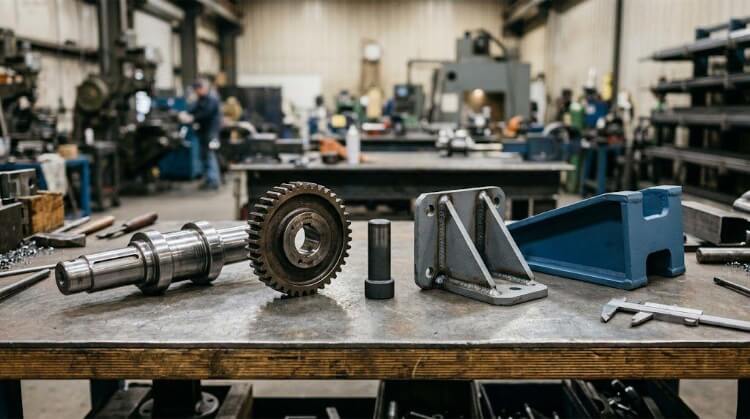
Calculating Total Cost Beyond Raw Material Price
The cheapest raw material quote on your desk does not guarantee the cheapest finished part. The real cost of a component is a combination of raw material, machining spindle time, consumable tooling, secondary thermal processes, and the risk of scrap.
Spindle Time is More Expensive Than Steel
In modern manufacturing, machine hourly rates dwarf raw material costs. Easier-to-machine materials like 1018 carbon steel allow programmers to optimize feed rates and minimize cycle times.
Tough alloy steels force machinists to slow down the spindle to prevent chatter and tool breakage. A material that saves you $2 in raw steel might easily cost you an extra $15 in extended machining time.
The Hidden Tax of Tool Wear at Scale
Tool wear is the invisible line item on your manufacturing quote. Harder and tougher alloy steels (especially when pre-hardened) aggressively wear down premium carbide inserts.
In a rapid prototyping phase, replacing a tool once or twice is a minor inconvenience. But when you transition to mass production, this “hidden tax” explodes. When a CNC operator has to stop the machine to index cutting tools every ten parts during a 5,000-piece run, you are paying for massive downtime. For high-volume manufacturing, optimizing material machinability is the fastest way to protect your profit margins.
Post-Processing and Logistics
A good material decision must include the entire supply chain route. Carbon steel typically moves from the laser cutter or CNC mill straight to a local plating facility and then ships to you.
Alloy steel often requires a highly fragmented supply chain: rough machining, shipping to a specialized heat-treater, waiting for quench and temper, shipping back for finish grinding, and final inspection. Each extra step adds lead time, logistical markup, and the risk of vendors blaming each other for delays.
Engineering Reality: Stop optimizing for the cheapest raw material. Optimize for the fastest, most reliable manufacturing route. A slightly more expensive, free-machining steel will almost always yield a lower final Cost-per-part.
The Engineer’s Cheat Sheet: Steel Selection by Part Type
To translate all these metallurgical differences into an actionable DFM strategy, here is the executive summary on how to spec materials based on the actual geometry and function of your part.
Low-Cost Structural Parts & Enclosures
- The Strategy: Avoid over-engineering. Do not pay for yield strength you don’t need.
- The Material: Low carbon steel (A36, 1018) paired with a protective finish like powder coating or galvanizing.
- Why it works: It provides the ultimate balance of low cost and high ductility. Whether it is undergoing rapid laser cutting, CNC machining, or high-volume sheet metal stamping, low carbon steel delivers flawless bends and clean cuts without fracturing. It is the undisputed champion for standard equipment panels, general enclosures, and internal support brackets.
High-Torque Shafts & Load-Bearing Pins
- The Strategy: Match the alloy to the load.
- The Material: * Medium-duty: 1045 Carbon Steel (provides decent strength without the alloy price tag).
- Heavy-duty: 4140 Alloy Steel (Quenched and Tempered).
- Why it works: 4140 will handle extreme torsional stress and shear forces without permanently deforming or shearing off inside the assembly.
Severe Wear & High-Friction Components
- The Strategy: You need a glass-hard surface to resist friction, but a ductile core to absorb impact without shattering.
- The Material: 8620 Alloy Steel (Carburized / Case-Hardened).
- Why it works: Standard through-hardened steels can be too brittle for impact wear. Case-hardening an alloy like 8620 gives you wear resistance exactly where the contact happens, while the core remains tough.
Complex Welded Assemblies & Frames
- The Strategy: Prioritize weldability to eliminate the risk of Heat-Affected Zone (HAZ) cracking and avoid expensive Post-Weld Heat Treatment (PWHT).
- The Material: Strictly low carbon steels.
- Why it works: You can lay down fast, structurally sound welds without pre-heating the material, keeping fabrication labor costs highly competitive.
Conclusion
Choosing between alloy steel and carbon steel should never be based entirely on price, nor should it be driven by a blind desire for maximum strength. The smartest engineering teams make material decisions by analyzing the exact mechanical load, the specific manufacturing route, and the long-term TCO.
Carbon steel remains the definitive choice for low-cost, highly fabricable sheet metal parts, stamped panels, and everyday components. Alloy steel is your heavy-duty insurance policy—reserved exclusively for high-stress, high-wear, and mechanically demanding applications where failure is not an option.
Still unsure which material is right for your next project? Or tired of managing a fragmented supply chain for fabrication, heat treatment, and finishing? Do not let poor material selection inflate your manufacturing budget or delay your product launch. Upload your CAD files today for a free Design for Manufacturability (DFM) review.