 English
  Spanish
  German
  Russian
  Italian
  French
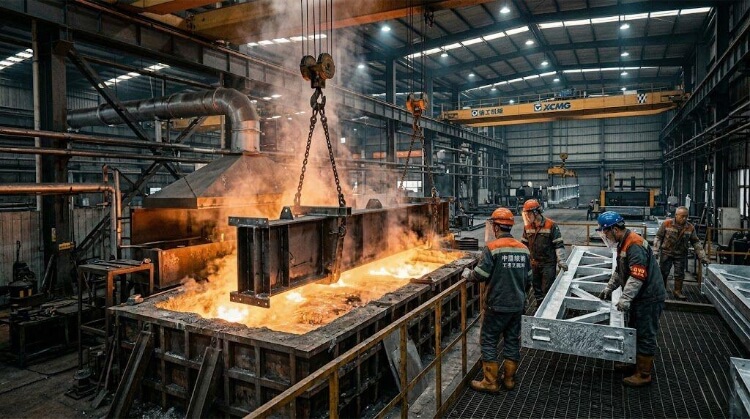
Hot-dip galvanizing (HDG) is a heavy-duty industrial coating process that protects iron and steel from corrosion by immersing the metal in molten zinc at approximately 450°C (842°F). Unlike superficial surface coatings, HDG creates a metallurgically bonded zinc-iron alloy layer.
This rigorous finishing method is widely specified in manufacturing and construction because it delivers 50 to 100+ years of maintenance-free protection against rust and environmental wear.
Here is the engineering breakdown of how the process works, where to specify it, and the critical design rules you need to follow before sending parts to the bath.
What the Zinc Layer Actually Does?
Most finishes simply adhere to the surface of the metal. HDG alters the surface chemistry to provide a dual-action defense. Here is the mechanical logic behind its corrosion resistance:
Zinc-Iron Alloy Bonding and Hardness
During the high-temperature immersion, zinc reacts with iron to form a series of dense alloy layers. The innermost layers are actually harder than the underlying base steel, making the coating highly resistant to physical impact and abrasion.
The Metallurgical Layers (Outward from Base Steel):
- Gamma & Delta Layers (Zinc-Iron Alloy): Hardness ~250 DPN. (Harder than standard base steel at ~159 DPN). Provides extreme impact resistance.
- Zeta Layer (Zinc-Iron Alloy): Hardness ~179 DPN. Transitional alloy layer.
- Eta Layer (Pure Zinc): Hardness ~70 DPN. The softer, ductile outer layer that absorbs the initial impact.
Sacrificial Cathodic Protection
Zinc is highly anodic compared to steel. If the coating is mechanically gouged or scratched, exposing the raw steel underneath, the surrounding zinc acts as a sacrificial anode. It will preferentially corrode to protect the exposed steel, effectively “self-healing” the breach and preventing rust creep.
Coating Thickness and Service Life Specifications
Standard HDG processes adhere to strict specifications like ASTM A123 (for structural parts) or ISO 1461. Depending on the steel gauge and silicon content, coating thickness typically ranges from 50 to 85+ µm.
According to ISO 14713 corrosion data, an 85 µm coating in a standard C3 environment (urban/industrial atmosphere) guarantees 70 to 100+ years of Time-to-First-Maintenance (TFM).
Where Hot-Dip Galvanizing Works Best?
Specifying HDG makes engineering sense when the cost of future maintenance or component failure outweighs the initial processing cost. It is the optimal choice for the following applications, driven by specific material behaviors:
Structural Steel Frameworks
Structural beams, columns, and chassis frames are often inaccessible once erected. HDG provides decades of zero-maintenance protection, ensuring the load-bearing capacity remains uncompromised by oxidation over the asset’s entire lifecycle.
Outdoor and Heavy-Duty Equipment
Assets exposed to outdoor environments face continuous physical wear from gravel, debris, and UV exposure. Unlike epoxy or polymer paints, which suffer from “under-creep” (where rust spreads beneath the paint film once scratched), HDG’s sacrificial action isolates the damage. Even if a gravel strike exposes 2mm of bare steel, the surrounding zinc will corrode first, halting structural degradation.
Complex Welded Fabrications
Welded assemblies contain dead corners, sharp edges, and internal geometries that standard spray systems cannot reach. Total liquid immersion ensures 100% surface coverage, completely sealing moisture out of vulnerable weld seams and hollow sections.
High-Corrosion Environments
In environments heavily loaded with moisture, salt, or industrial chemicals, standard paints fail rapidly. The thick zinc barrier and its predictable, slow depletion rate make it a highly cost-effective baseline defense for chemical plant grating, agricultural machinery, and coastal infrastructure.
💡 Procurement Tip: Do not evaluate HDG costs merely by price-per-pound. Factor in the Life-Cycle Cost (LCC). A painted structure may require 2 to 3 maintenance repaints over a 50-year span, making HDG significantly cheaper long-term despite a potentially higher initial processing fee.
Design Rules Before Galvanizing
Engineering for hot-dip galvanizing (HDG) must happen at the CAD stage, not on the fabrication floor. Failure to design for the bath leads to warped assemblies, uncoated pockets, or explosive hazards.
Vent and Drain Holes
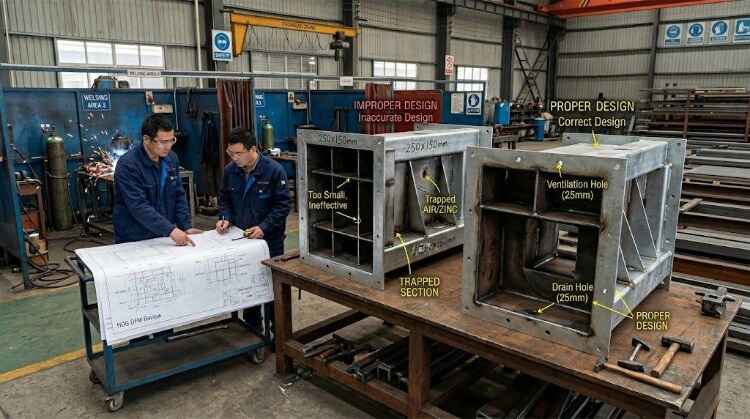
Molten zinc is dense—over seven times heavier than water. For a part to be successfully coated, zinc must flow rapidly into and out of the structure, and air must escape. Any dead corners or unvented pockets will trap air or liquid zinc.
- DFM Rule: Place vent and drain holes at the absolute highest and lowest points of the assembly based on its orientation during dipping. Size drainage holes to at least 25% of the cross-sectional area of the profile.
- ⚠️ Cost Impact: Trapped zinc adds massive dead weight (which you are charged for by the pound), while trapped air leaves bare steel, requiring manual touch-ups or total part rejection.
Hollow Section Safety
If a hollow section (like a welded tube frame) is completely sealed, any trapped moisture inside will rapidly vaporize when submerged in 450°C zinc. The resulting steam expansion can cause the part to literally explode in the galvanizing kettle.
- DFM Rule: Every closed hollow section must be vented. There are no exceptions. If structural integrity prohibits permanent holes, specify temporary holes that can be plugged post-galvanizing.
- ⚠️ Safety & Cost Impact: An exploded part destroys the component, halts the galvanizer’s production line, and poses severe safety risks to operators.
Sheet Metal Warping
At galvanizing temperatures, steel experiences a temporary reduction in yield strength. Simultaneously, the heat relieves any residual stresses introduced during rolling or welding. For thin sheet metal (generally under 3mm or 11-gauge), this stress relief manifests as severe, unpredictable warping and buckling.
- DFM Rule: Avoid HDG for large, flat, thin panels. For structural sheet metal, utilize symmetrical welding techniques or incorporate stiffening ribs into the bend profile.
- 🔄 Alternative Process: If a thin cosmetic panel requires corrosion resistance without thermal distortion, switch the specification to Electro-galvanizing (Zinc Plating) or Cold Galvanizing (Zinc-rich paint).
Thread Tolerance Allowance
Zinc will coat every exposed surface, adding between 50 to 100+ µm of thickness per side. If you machine a standard thread and send it to the galvanizer, the mating fastener will no longer fit.
- DFM Rule: For external threads (bolts/studs), machine the threads undersized prior to galvanizing. For internal threads, standard practice is to tap the threads after the part has been galvanized.
- ⚠️ Labor Impact: Failure to undercut external threads before galvanizing requires manual re-threading of every single bolt, stripping the protective zinc layer and increasing assembly labor time by up to 300%.
Silicon Content and the Sandelin Effect
The metallurgical reaction between steel and zinc is heavily driven by the steel’s chemical composition. Steel chemistries falling into the “Sandelin Curve” (0.04% to 0.15% Silicon) cause the zinc-iron alloy layers to grow uncontrollably.
- DFM Rule: Always verify mill certificates before procurement. Specify steel with a Silicon content of either <0.04% or between 0.15% and 0.25% to ensure a predictable coating.
- ⚠️ Quality Impact: Sandelin steel produces a coating that is excessively thick, dark grey, brittle, and highly prone to flaking off under mechanical stress.
Manufacturing Changes After Galvanizing
Parts returning from the galvanizer will not possess the same geometric tolerances or surface profiles as the raw fabricated steel. Your downstream assembly processes must be adapted to account for the physical realities of the zinc layer.
Zinc Thickness Buildup and Assembly Fit
Liquid zinc pools due to surface tension (the meniscus effect), meaning the zinc layer is often thicker at the edges of holes than on flat surfaces.
- Raw Steel Design: A standard clearance hole for an M10 bolt is 11mm.
- Post-HDG Reality: Zinc meniscus pooling will shrink the hole diameter.
- Assembly Rule: Oversize CAD clearance holes by 1.5mm to 2.0mm (e.g., use 12.5mm or 13mm for an M10 bolt) to guarantee drop-in assembly without secondary drilling.
Surface Roughness and Drainage Spikes
Hot-dip galvanizing is an industrial corrosion barrier, not a cosmetic architectural finish. As the part is lifted from the bath, gravity causes liquid zinc to run downward, often freezing into sharp “zinc drips” or “spikes” at the lowest edges.
- Raw Steel Design: Flat mating surfaces sit perfectly flush.
- Post-HDG Reality: Drainage spikes interfere with flush mounting and present cut hazards to assembly workers.
- Assembly Rule: Explicitly instruct your internal QA or assembly team to grind drainage spikes flat on critical mating faces prior to final assembly.
Re-Tapping Threaded Holes
Following the DFM rules, internal threads are typically cleared or tapped post-galvanizing. This means the internal threads will be exposed bare steel.
- The Corrosion Reality: This is not a failure point. Once a galvanized bolt is threaded into the bare hole, the zinc on the bolt’s threads provides cathodic protection to the bare steel inside, preventing rust from forming within the joint.
Distortion in Thin-to-Medium Parts
Even with optimal design, some parts will distort slightly. Tight flatness tolerances (e.g., <2mm per meter) specified for raw steel plates are generally voided once the part undergoes HDG.
- Raw Steel Design: Laser-cut plate with strict planar tolerances.
- Post-HDG Reality: Minor thermal warping across the span.
- Assembly Rule: If tight flatness is mandatory for your assembly, factor in the time and cost of secondary mechanical straightening operations (using hydraulic presses or rollers) after the parts return from the galvanizer. Do not assume HDG parts will remain perfectly flat.
Surface Appearance and Coating Defects
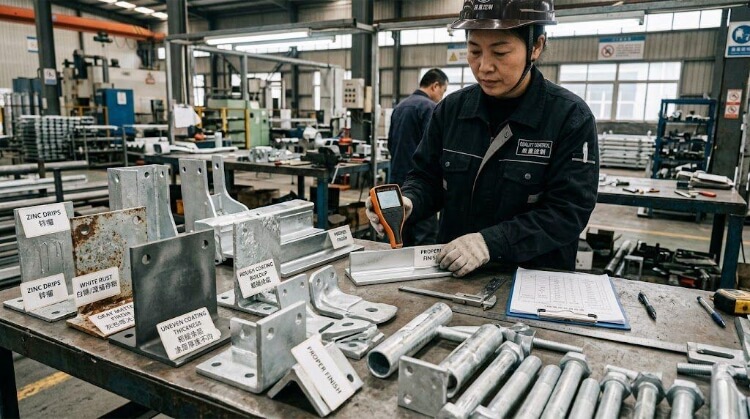
Hot-dip galvanizing is an industrial corrosion barrier, not an architectural finish. Variations in appearance are natural, but procurement teams and QA inspectors must know how to distinguish between a cosmetic anomaly and a functional coating failure.
White Rust (Wet Storage Stain)
- Visual: A powdery, white, chalky substance on the surface.
- The Cause: Newly galvanized parts packed tightly together in damp, poorly ventilated environments. The zinc reacts with water without enough carbon dioxide to form its stable protective patina.
- QA Verdict: ACCEPTABLE (Usually). In most cases, it is purely cosmetic and can be removed with a stiff nylon brush.
- ⚠️ Cost/Time Impact: If the parts are slated for secondary painting, white rust must be chemically removed or sweep-blasted first, otherwise, the paint will immediately peel.
Matte Gray Finish
- Visual: A dull, dark gray surface lacking the typical shiny “spangle.”
- The Cause: As discussed in the DFM section, this is caused by steel with high silicon/phosphorus content (Sandelin Effect), where the zinc-iron alloy grows rapidly to the surface.
- QA Verdict: ACCEPTABLE. This is not a defect. In fact, matte gray coatings are often thicker and provide longer corrosion protection than shiny coatings. Do not reject a part just because it lacks a shiny finish.
Bare Spots
- Visual: Uncoated areas where raw steel is visible.
- The Cause: Inadequate surface cleaning (residual grease/paint), trapped welding slag, or trapped air pockets during the dip.
- QA Verdict: REJECT & REPAIR. Bare steel will rust. Under ASTM A780, small bare spots can be touched up using high-zinc dust paint (cold galvanizing compound) with a minimum of 65% zinc in the dry film. Large bare areas require stripping and re-dipping.
Zinc Drips and Skimmings
- Visual: Sharp spikes, lumps, or thick tear-drops of zinc at the edges.
- The Cause: Gravity pulling liquid zinc down as the part is withdrawn from the bath.
- QA Verdict: CONDITIONALLY ACCEPTABLE.
- Assembly Rule: If the drips are on non-mating surfaces, leave them alone (more zinc means more protection). If they interfere with assembly tolerances or pose cut hazards, they must be manually ground flat.
Uneven Coating Thickness
- Visual: Calipers measure 60µm in one spot and 120µm in another.
- QA Verdict: ACCEPTABLE. HDG is a metallurgical reaction, not a precision machine pass. Thickness will vary based on local steel chemistry and thermal mass. As long as the minimum local thickness meets the specified ISO/ASTM standard, the part is compliant.
Hot-Dip Galvanizing vs. Other Finishes
Choosing the right finish is an exercise in balancing tolerance limits, environmental exposure, and lifecycle costs. Here is the decision logic for when to choose HDG versus alternatives.
Zinc Plating (Electro-galvanizing)
- The Mechanism: Zinc is deposited onto the steel via an electrical current in a chemical bath.
- The Reality: The coating is extremely thin (typically 5 to 15 µm) but perfectly uniform.
- When to Choose: Select zinc plating for small, precision fasteners (where HDG would clog the threads) or for indoor cosmetic parts. Never specify zinc plating for outdoor structural applications; it will rust within a few years.
Powder Coating
- The Mechanism: Dry plastic powder is electrostatically applied and baked into a solid film.
- The Reality: Excellent color options and a smooth finish, but it acts only as a barrier. If powder coating is scratched, moisture creeps underneath, causing the paint to blister and rust to spread uncontrollably.
- When to Choose: Use for aesthetic enclosures, indoor equipment, or consumer-facing parts where color branding is mandatory and impact risks are low.
Duplex Coating Systems (HDG + Paint/Powder)
- The Mechanism: Applying powder coating or wet paint over a hot-dip galvanized base.
- The Reality: This creates a synergistic effect. The paint protects the zinc from early depletion, and the zinc prevents under-film rust creep if the paint is scratched. The combined lifespan is typically 1.5 to 2.5 times longer than the sum of the two coatings individually.
- When to Choose: Specify for extreme environments (offshore, chemical plants) or high-visibility infrastructure where you need both a 50-year lifespan and a specific brand color.
Post-Processing After Galvanizing
Manufacturing often doesn’t stop once the parts return from the galvanizer. However, cutting, welding, or painting over a 450°C metallurgical alloy requires strict procedural shifts.
Welding Galvanized Steel
- The Reality: Welding vaporizes the zinc coating, creating toxic zinc oxide fumes (“Metal Fume Fever”). The vaporized zinc also causes severe porosity and cracking in the weld pool.
- Manufacturing Rule: Avoid welding after galvanizing whenever possible. If unavoidable, the zinc layer must be ground off completely (at least 1 to 2 inches back from the weld zone) prior to striking an arc. Post-weld, the area must be recoated with zinc-rich paint.
Laser Cutting Galvanized Parts
- The Reality: The zinc layer is highly reflective to certain laser wavelengths and creates a heavy, stubborn dross on the underside of the cut. More importantly, it generates hazardous fumes.
- Manufacturing Rule: Perform all laser cutting, punching, and heavy fabrication on raw steel before sending the flat patterns or formed parts to be galvanized.
Machining Coated Surfaces
- The Reality: Milling or drilling a galvanized part strips away the protective zinc-iron alloy layers, exposing raw steel to the environment.
- Manufacturing Rule: If tight-tolerance features (like bearing press-fits) must be machined post-HDG, explicitly mandate that those specific machined surfaces are thoroughly coated with a heavy-duty corrosion inhibitor or cold zinc compound immediately after machining.
Paint Adhesion Preparation
- The Reality: Paint will not stick to a fresh, smooth zinc surface. Without proper preparation, it will peel off in large sheets within months.
- Manufacturing Rule: The HDG surface must be chemically etched using a “T-Wash” (a phosphoric acid-based solution) or mechanically profiled using a very light, low-pressure sweep blast. Do not use standard aggressive sandblasting, as it will strip the zinc entirely.
Conclusion
Specifying Hot-Dip Galvanizing is a highly effective way to guarantee decades of maintenance-free performance for steel structures and heavy sheet metal assemblies. However, as this guide outlines, it cannot be treated as an afterthought. From proper venting and draining to managing silicon content and thread tolerances, successful galvanizing requires strict Design for Manufacturing (DFM) discipline at the earliest stages of a project.
At TZR, we understand the realities of the shop floor. With over 10 years of experience in sheet metal fabrication, CNC machining, and rapid prototyping, our engineering team works directly with you to optimize your designs before production begins. Ready to optimize your next steel project? Contact TZR today for a technical design review and production quote.