 English
  Spanish
  German
  Russian
  Italian
  French
Bare steel parts rust quickly when exposed to moisture. To prevent this, zinc plating remains the most common surface finish applied to carbon steel and low-alloy steel components, providing reliable corrosion resistance at a low cost.
Zinc plating is an electrochemical process that applies a protective zinc coating to iron or steel. Acting as a sacrificial barrier, it offers cost-effective corrosion resistance, enhances durability, and improves appearance for industrial components.
This guide explains the technical mechanisms of zinc plating and how to select the right specifications for your parts. It also covers how to align your requirements with industry standards like ASTM B633 or ISO 2081 to avoid costly manufacturing delays.
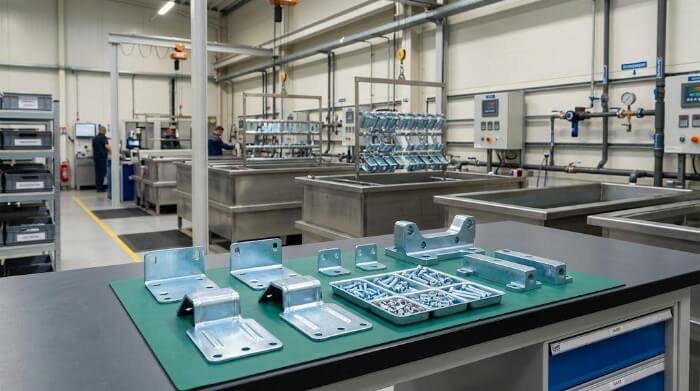
Why Zinc Plating Is Used Instead of Bare Steel?
Applying a zinc coating changes how steel interacts with its environment. It protects the base metal through two distinct mechanisms, which work together to extend the service life of the part.
Sacrificial Protection
Zinc is more electrochemically active than steel. When a zinc-plated part is scratched and the underlying steel is exposed, the zinc acts as a sacrificial anode.
It oxidizes first, protecting the steel underneath from rusting. This galvanic protection ensures that minor surface damage during assembly or transport does not immediately result in structural corrosion of the base metal.
Barrier Protection
Before sacrificial protection is needed, the zinc layer acts as a physical barrier. It prevents oxygen and moisture from reaching the steel substrate.
As long as this barrier remains intact and uniform, the steel underneath will not oxidize.
Service Life
The service life of a zinc-plated part depends directly on the thickness of the coating and the operating environment. For example, a standard 8-micron coating with a clear trivalent chromate typically withstands 96 to 120 hours of neutral salt spray (NSS) testing before white rust appears.
In dry, controlled indoor environments, this translates to decades of protection. In outdoor or high-humidity environments, the zinc layer is consumed much faster, meaning thicker coatings or alternative methods like hot-dip galvanizing become necessary.
Key Benefits
Beyond corrosion resistance, zinc plating is highly cost-effective, especially for high-volume sheet metal and CNC machined parts. It improves the cosmetic appearance of raw steel, offering a clean, uniform finish.
Additionally, because the typical coating is relatively thin (usually 5 to 12 microns), it allows for standard machining tolerances to be maintained on most features. This eliminates the need for secondary rework on precision fits.
What Happens During the Zinc Plating Process?
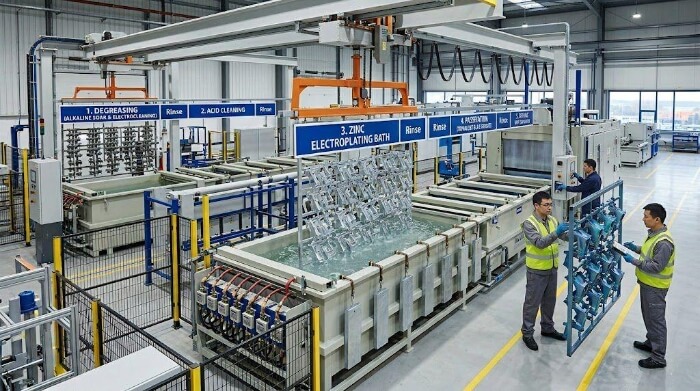
Understanding the plating process helps engineers and procurement managers diagnose quality issues like poor adhesion or uneven thickness. The process involves several sequential chemical and electrical stages.
Surface Preparation
A coating will only adhere to a perfectly clean surface. Parts are first submerged in alkaline cleaning tanks to remove oils, stamping lubricants, and machining coolants, followed by an acid pickling process to remove scale, rust, and surface oxides.
If the surface preparation is incomplete or rushed, the final zinc coating will likely blister, peel, or exhibit poor adhesion under mechanical stress.
Electroplating
The cleaned parts are placed into an electrolyte bath containing dissolved zinc ions. A direct electrical current is introduced, making the parts the cathode, which causes the zinc ions to deposit onto the surface of the steel.
It is important to note that plating does not apply perfectly evenly. Due to the Faraday effect, areas closer to the anodes or sharp outside corners typically receive a slightly thicker coating. Conversely, deep recesses and blind holes suffer from poor “throwing power” and may remain bare unless specific drainage holes are designed.
Passivation
Zinc itself will oxidize and form a white powder (often called white rust) when exposed to air and moisture. To prevent this, a passivation layer—usually a chromate conversion coating—is applied immediately after electroplating. This chemical bath seals the zinc and dictates the final color of the part (such as clear/blue, yellow, or black).
Today, trivalent chromium (Cr3+) is the industry standard to ensure RoHS compliance. This has fully replaced the toxic hexavalent (Cr6+) formulations used in the past, making it safe for global shipping and handling.
Inspection
The final step involves quality control checks. Plating thickness is usually measured using non-destructive methods like X-ray fluorescence (XRF) or magnetic induction gauges to ensure it meets the drawing specifications.
Adhesion is also tested using standard tape tests or bend tests to verify that the zinc layer remains securely bonded to the steel substrate.
How to Choose the Right Zinc Coating Specification?
Selecting a zinc plating specification requires balancing several interrelated factors. The thickness of the zinc layer, the type of passivation used, and the expected salt spray performance must all align with the final service environment of the part.
Coating Thickness
Standard zinc plating thickness typically ranges from 5 to 12 microns (ASTM B633 Fe/Zn 5 to Fe/Zn 12). A thicker zinc deposit provides a longer service life because there is more sacrificial material available.
However, specifying a thicker coating just to be safe can cause significant dimensional issues on precision CNC parts and fine threads.
Zinc Coating Colors
The color of a zinc-plated part comes entirely from the passivation layer applied after the zinc. Clear (often called blue-bright) is the standard for most indoor components.
Yellow passivation generally offers slightly better corrosion resistance because the chromate film itself is thicker. Black zinc is often chosen for cosmetic reasons or to reduce light reflection, but it usually requires an additional topcoat sealer to maintain its durability.
Trivalent Chromate
When defining the passivation layer, modern drawings must specify trivalent chromium (Cr3+). This ensures compliance with global environmental directives like RoHS and REACH.
Properly formulated and sealed trivalent chromates now perform just as well as the older, toxic hexavalent (Cr6+) coatings that are banned in many industries.
Salt Spray Performance
Procurement teams often use Neutral Salt Spray (NSS) testing to verify coating quality. The specification should define the minimum hours required before white rust (oxidation of the zinc) and red rust (oxidation of the steel) appear.
It is important to note that NSS hours are a standardized comparative metric, not a direct predictor of real-world lifespan. 96 hours in a salt spray cabinet can equal many years in a normal indoor environment.
Service Environment
The final choice depends on where the part will operate. Indoor electronics enclosures usually only need a 5-micron clear zinc coating.
For mild outdoor exposure or automotive under-hood components, an 8 to 12-micron yellow or heavy-build clear coating is more appropriate. If the part faces continuous exposure to harsh weather or marine conditions, standard electroplated zinc is no longer sufficient.
Common Risks and Limitations of Zinc Plating
While zinc plating works well for general corrosion protection, it is not a universal solution. It has physical and chemical limitations that engineers must consider during the design phase.
Hydrogen Embrittlement
High-strength steels, particularly those with a hardness above 32 HRC or grade 10.9 fasteners, absorb hydrogen gas during the acid pickling and electroplating stages. If this trapped hydrogen is not addressed, the part may suffer a sudden, brittle fracture under load.
To prevent this, susceptible parts must undergo a hydrogen embrittlement relief bake (typically at 190-220°C) within 4 hours after plating, in accordance with standards like ISO 9588.
Wear Resistance
Zinc is a relatively soft metal. It is not intended for moving parts, sliding mechanisms, or surfaces subject to heavy continuous friction.
If a zinc-plated part is subjected to abrasion, the coating will quickly wear off. This exposes the bare steel underneath, leading to rapid localized corrosion.
High-Temperature Exposure
Zinc plating is generally not recommended for parts that will operate at temperatures above 200°C (392°F).
Prolonged exposure to high heat causes the protective chromate conversion layer to dehydrate and crack. Even though the zinc is still on the part, the loss of the chromate layer significantly reduces the overall corrosion resistance.
Chemical Exposure
Zinc reacts poorly to both strong acids and strong alkalis. It will rapidly dissolve if exposed to these harsh chemicals.
For equipment used in chemical processing plants, food processing (where caustic washdowns are common), or direct saltwater immersion, materials like 304 or 316 stainless steel are usually a much safer choice than zinc-plated carbon steel.
Design and Manufacturing Factors That Affect Coating Quality
The final quality of a plated part depends heavily on its geometry and how it was fabricated in the shop. Designers must plan for the plating process to avoid assembly failures later.
Threads and Tight Tolerances
Plating adds material to all surfaces. On a threaded hole, an 8-micron plating thickness actually reduces the pitch diameter by up to 32 microns (due to the thread geometry).
Engineers must account for this buildup by specifying pre-plate dimensions or using over-tapped holes. This is especially critical for small internal threads like M3 or M4, which will easily bind during assembly if not properly sized.
Laser-Cut and Bent Features
Sheet metal manufacturing leaves specific signatures on the material. Laser cutting with oxygen, for example, leaves a hard black oxide scale on the edges.
If this scale is not completely removed via mechanical tumbling or aggressive pickling (which can alter overall part dimensions), the zinc coating will simply flake off these edges. Bending also creates microscopic stress on the outside radius, which requires proper pre-treatment.
Welded Assemblies
Spot welds, overlapping joints, and incomplete seam welds create tight crevices. During the plating process, alkaline cleaners and plating acids get trapped in these gaps.
Over time, these trapped liquids bleed out, causing localized corrosion known as “acid bleed-out” or “weeping.” If an assembly must be plated after welding, seal welding or adding specific drainage holes is usually required.
Material Surface Condition
Electroplating is a thin conformal coating; it does not fill in scratches, gouges, or deep tool marks.
If a CNC machined part has heavy chatter marks, or if hot-rolled steel (SPHC) has pitting after the mill scale is removed, those defects will still be highly visible after plating. A consistent, smooth starting surface is necessary to achieve a clean cosmetic finish.
Cost, Lead Time, and Production Considerations
The cost and lead time of zinc plating depend heavily on the production method and the physical characteristics of the parts. Understanding these variables helps procurement teams budget accurately and avoid unexpected delays in the supply chain.
Barrel vs Rack Plating
The plating method is the biggest driver of cost. In barrel plating, thousands of small parts (like screws, brackets, or small machined components) are tumbled in a rotating cylinder submerged in the plating bath. This method is highly efficient and very cost-effective for large volumes.
However, tumbling causes parts to collide. For larger sheet metal parts, cosmetically sensitive surfaces, or easily bent features, rack plating is required. In rack plating, parts are individually hung on metal fixtures. This prevents damage but requires significantly more manual labor, making the piece price higher.
Coating Thickness and Cost
Thicker zinc coatings cost more, but not just because of the raw material. Depositing a 12-micron layer takes considerably more time in the electrolyte bath than a 5-micron layer.
This increased cycle time reduces the plating line’s overall throughput. When scaling from prototyping to mass production, specifying an unnecessarily thick coating will artificially inflate the unit cost across thousands of parts.
Part Geometry
Complex shapes are more expensive to plate. Parts with deep recesses, blind holes, or intricate internal channels suffer from poor throwing power.
To achieve the minimum required thickness in these recessed areas, the plating shop may need to use auxiliary anodes or extend the plating cycle. Cupped shapes that trap plating chemicals also require specialized racking angles to allow for proper drainage, increasing setup time.
Lead Time Planning
Zinc plating is a secondary operation that typically adds 3 to 5 days to the manufacturing schedule. This includes transit to the plating line, queuing, chemical processing, and final inspection.
If the parts are made from high-strength steel, you must also factor in the mandatory hydrogen embrittlement relief bake. This bake must happen immediately after plating and can add 4 to 24 hours to the process, depending on the material grade.
When Zinc Plating Is the Right Choice?
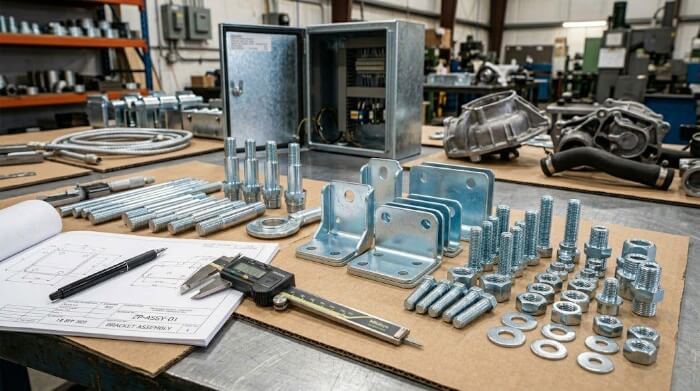
Zinc plating is highly versatile, but it is not always the optimal solution. Engineers must weigh it against other common finishes to ensure the part functions correctly in its intended environment.
Zinc vs Hot-Dip Galvanizing
Electroplated zinc is thin, precise, and cosmetically clean, making it ideal for machined parts and internal sheet metal enclosures.
Hot-dip galvanizing (HDG) involves submerging the steel in molten zinc. It creates a much thicker (often 50 to 100+ microns), rougher coating. HDG provides superior outdoor corrosion resistance for structural steel but will completely ruin the tolerances of precision CNC parts and fine threads.
Zinc vs Zinc-Nickel
Standard zinc plating works well for general indoor and mild outdoor use. However, for automotive underbody components or parts exposed to heavy road salt, standard zinc falls short.
Zinc-nickel alloy plating provides up to five times the corrosion resistance of standard zinc and handles higher operating temperatures. The tradeoff is that zinc-nickel is significantly more expensive and harder to strip and re-work if defects occur.
Zinc vs Powder Coating
Powder coating provides a durable, thick plastic-like barrier (typically 60 to 120 microns) with excellent cosmetic color options. It is highly resistant to scratches and impact.
However, powder coating covers holes and adds massive dimensional buildup. Zinc plating is a better choice when you need to maintain strict dimensional tolerances or when the budget does not allow for masking threaded holes prior to coating.
For severe outdoor environments, these two processes are often combined. A thin zinc plating layer is applied to the sheet metal as a sacrificial primer, followed by a powder coat finish for maximum barrier protection and cosmetic appeal.
Electrical Conductivity Requirements
Unlike powder coating or anodizing, zinc plating is electrically conductive.
This makes it the standard choice for internal sheet metal chassis, server racks, and electronic enclosures where components must be grounded to the frame. It provides necessary corrosion protection without acting as an insulator.
Conclusion
Specifying zinc plating correctly requires a balance between corrosion resistance, dimensional tolerances, and production costs. Understanding how the plating process affects threads, welded joints, and laser-cut edges is critical to avoiding failures on the assembly line.
At TZR, we don’t just blindly follow drawings. Our engineering team reviews your CAD files and GD&T requirements based on more than ten years of experience in sheet metal fabrication and CNC machining.
If you are moving from rapid prototyping to high-volume manufacturing, we can support that step. You can send us your project details. We will help review and improve your design for easier production, lower cost, and more stable long-term performance.
FAQs
Can you plate directly over rusty steel?
No. All rust, mill scale, and oils must be entirely removed during the surface preparation stage using alkaline cleaners and acid pickling. If the rust is severe and causes deep pitting in the steel, the plating will adhere, but the pits will still be visible on the finished part.
Does clear zinc plating look the same as blue zinc?
Yes. In the manufacturing industry, “clear zinc,” “blue zinc,” and “bright zinc” generally refer to the same finish. They all use a clear trivalent chromate passivation over the zinc layer, which naturally exhibits a slight bluish tint under certain lighting.
Will zinc plating hide scratches from CNC machining?
No. Electroplating is a very thin, conformal coating. It follows the exact surface topography of the base metal. Heavy chatter marks, scratches, or tooling lines from the CNC machine will remain fully visible after the zinc plating is applied.