
 English
  Spanish
  German
  Russian
  Italian
  French
Stainless steel fabrication is the manufacturing process of cutting, bending, and welding stainless steel alloys into custom components. Due to the material’s high yield strength and thermal conductivity, it requires specialized tooling and precise heat management to prevent work hardening and distortion.
Designing for stainless steel requires more than just understanding its corrosion resistance. On the shop floor, the reality is that stainless steel work-hardens quickly under cutting tools, requires significantly higher tonnage to form on a press brake, and is highly susceptible to severe thermal distortion during welding. These material behaviors directly dictate setup times, tooling wear, and your overall project costs.
This guide outlines how early decisions in material selection, surface finish, and part geometry impact the manufacturing process. By understanding these shop-floor realities, engineers and purchasing managers can optimize their drawings for reliable fabrication and tighter cost control.
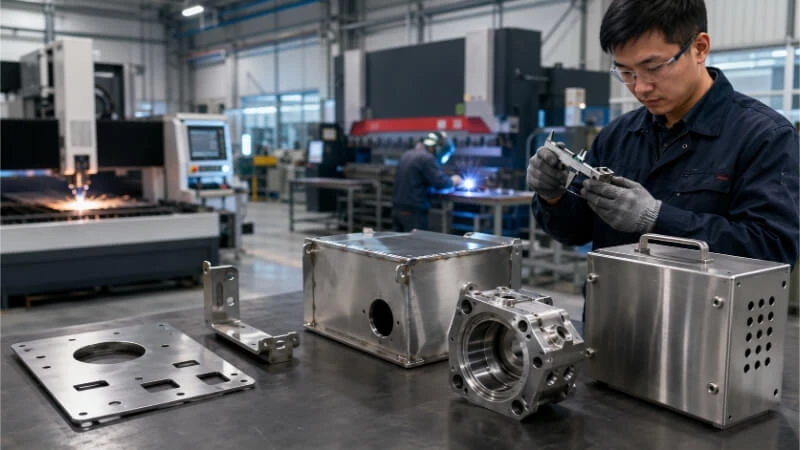
Select the Right Grade and Starting Finish
The performance and cost of a fabricated part begin with selecting the appropriate alloy and raw material finish. Specifying a higher grade than necessary increases material costs, while selecting the wrong finish can add hours of manual labor to the final assembly.
Common Grades and Their Trade-Offs
The 300-series austenitic alloys are the most common in sheet metal fabrication, but the specific chemistry dictates the manufacturing approach. Grade 304 works well for general indoor equipment or mild outdoor environments. Grade 316 contains 2% to 3% molybdenum, increasing resistance to chlorides, and is usually used for marine or chemical applications. However, specifying 316 typically carries a 20% to 30% material cost premium over 304.
When a design requires extensive welding, it is safer to specify “L” grades, such as 304L or 316L. These variants limit carbon content to a maximum of 0.03%, which prevents carbide precipitation at the weld seams. Without this limitation, the heat-affected zone (HAZ) becomes vulnerable to intergranular corrosion over time, often leading to field failures.
Corrosion, Strength and Formability
Stainless steel alloys balance yield strength against formability. Austenitic grades (304, 316) offer excellent ductility, making them suitable for deep drawing and tight bends. However, they are prone to rapid work hardening.
Because stainless work-hardens so quickly during friction, machining it requires rigid setups, slower spindle speeds, and higher feed rates compared to mild steel. When a formed sheet metal part requires precision tapped holes, tight-tolerance countersinks, or mating surfaces, combining primary laser cutting with secondary CNC milling ensures accuracy without over-stressing the material or burning through cutting inserts.
Ferritic grades, such as 430, do not work-harden as severely and are often more cost-effective. However, they have lower overall formability and limited weldability, making them better suited for simple, formed panels rather than complex, watertight enclosures.
Mill and Polished Finishes
Specifying the correct starting finish drastically reduces post-fabrication processing. A standard 2B mill finish has a smooth, dull grey appearance. It works well for functional internal components, brackets, or parts that will eventually be coated.
If the final product requires a cosmetic appearance, it becomes more cost-effective at volume to purchase pre-polished sheets, such as a No. 4 brushed finish.
Cost Control Note: Manually blending raw welds to match a No. 4 brushed finish can account for up to 30% of the total labor time on a complex enclosure. Starting with a pre-polished sheet is significantly cheaper than manually polishing a raw sheet after fabrication, provided the factory uses protective film to prevent tooling marks during bending.
Design Parts for Reliable Stainless Steel Fabrication
Design for Manufacturability (DFM) in stainless steel focuses on managing the material’s high yield strength and thermal conductivity. Small adjustments to the CAD model prevent downstream defects on the press brake and the welding table.
Bending Geometry and Springback
Stainless steel requires approximately 50% more bending force than mild steel of the same thickness. This higher tensile strength also results in greater springback after the press brake releases the part. A reliable DFM rule for stainless sheet metal is to use a minimum inner bend radius equal to 1.0 to 1.5 times the material thickness (1t – 1.5t).
Cost Control Note: Specifying an excessively tight bend radius (under 1t) places extreme stress on the outer face of the bend, which may cause micro-cracking. It also frequently requires the shop to use custom V-dies or secondary coining operations to hit the dimension, directly increasing your setup fees.
Holes, Reliefs and Weld Access
The placement of features near bend lines dictates whether a part will survive the forming process intact.
Quality Risk: Punching or laser-cutting holes too close to a bend line causes the hole to pull and become oval-shaped as the metal stretches. This inevitably requires manual re-drilling on the shop floor or results in rejected parts during final assembly.
To prevent this, the distance from the edge of a hole to the start of the bend radius should be at least 1.5 times the material thickness. Additionally, including bend reliefs—small circular or rectangular cutouts at the ends of a flange—prevents the material from tearing.
For assemblies that require welding, the geometry must provide physical clearance for the equipment. TIG welding is the standard for thin stainless steel; the joint design should allow at least a 45-degree access angle for the welding torch and shielding gas cup to ensure proper penetration.
Cosmetic Surfaces and Tolerances
Tight tolerances drive up machining, fixturing, and inspection costs. Standard sheet metal tolerances of ±0.010″ (0.25mm) are reasonable for most CNC bending and cutting operations. It is best practice to only specify tighter tolerances on critical mating surfaces or fastener locations.
When detailing cosmetic parts, the engineering drawing should clearly indicate the required grain direction.
Cost Control Note: If a part has multiple bends, requiring a continuous grain direction across all visible faces restricts how the flat pattern can be nested on the raw sheet. This restriction decreases sheet utilization and increases the scrap rate, which directly raises the per-part cost. Allow random grain direction on non-critical faces whenever possible.
Plan the Stainless Steel Fabrication Sequence
A successful stainless steel build relies on sequencing operations to manage heat, stress, and dimensional accuracy. Because the material is tough and warps easily, correcting mistakes late in the process is expensive and often impossible.
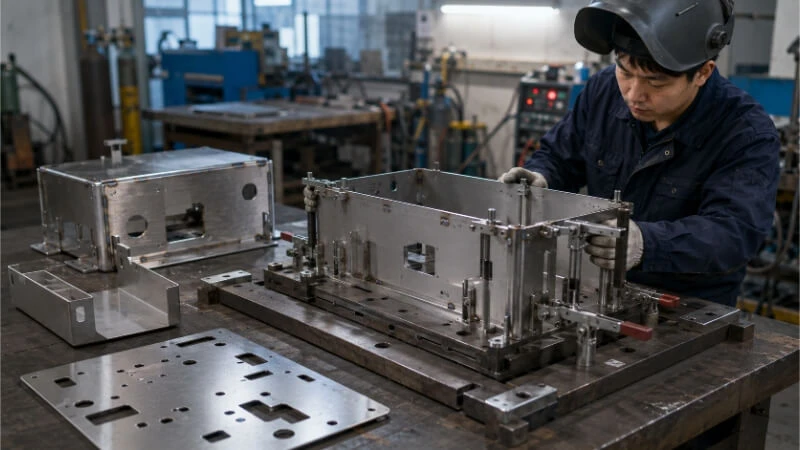
Cutting and Forming
The fabrication sequence begins with generating the flat blank. Fiber lasers using high-pressure nitrogen as an assist gas produce clean, oxide-free edges. This specific gas selection prevents the edge from oxidizing, which allows the parts to move directly to the welding station without manual edge grinding.
However, laser cutting inherently creates a localized hardened edge due to rapid heating and cooling.
Cost Control Note: If a design requires small tapped holes near the perimeter, trying to machine through a laser-hardened edge often breaks taps. It is usually more cost-effective to pilot the holes on the laser, and then utilize an in-house CNC mill to accurately drill and tap the holes prior to forming on the press brake.
Welding and Fixturing
Stainless steel expands approximately 50% more than carbon steel when heated, and its thermal conductivity is much lower. This means heat stays concentrated at the weld joint, causing severe thermal distortion.
Welding a stainless steel box or frame without proper heat management will cause the assembly to warp permanently out of tolerance. To manage this, the shop floor must utilize heavy copper fixturing and heat sinks to draw heat away from the joint.
For high-volume production, a qualified manufacturer will design and build dedicated hard welding fixtures. This upfront tooling investment locks in the geometry, reducing setup time and ensuring the 500th part meets the exact same tolerances as the first.
Post-Weld Machining and Finishing
Welding introduces stress and alters the geometry of the part. If an assembly features critical mating surfaces, O-ring grooves, or tight-tolerance bearing presses, those features should never be machined into the flat sheet.
Engineering Tip: This is where working with a facility that houses both custom sheet metal fabrication and CNC machining under one roof becomes critical. The reliable sequence is to cut, form, weld, and then perform post-weld CNC machining on the critical dimensions. This closed-loop approach guarantees accuracy without relying on multiple outsourced vendors.
Once machining is complete, the part moves to finishing. Heat tints (the rainbow discoloration around welds) must be removed to restore the protective chromium oxide layer, typically through electrochemical passivation or mechanical polishing.
Control Cost and Production Quality
Controlling costs on a stainless steel project requires clear communication between the purchasing team, the design engineer, and the factory floor. Minor ambiguities in the RFQ often translate to inflated pricing to cover assumed risks.
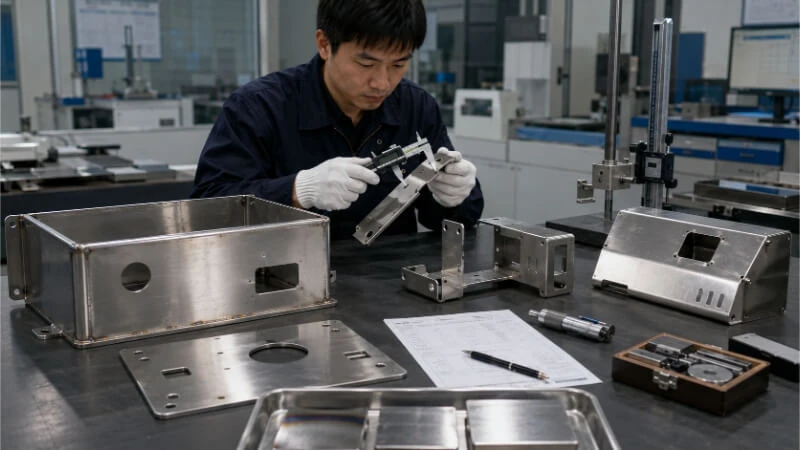
Material Selection and Sheet Utilization
Standard stainless steel sheets typically come in 48” x 96” or 60” x 120” sizes. The flat pattern of the part determines how efficiently it nests on the raw sheet.
Cost Control Note: If a part’s flat pattern measures 49 inches in one direction, it forces the shop to use an oversized sheet or suffer a massive scrap rate on a standard 48-inch sheet. Trimming a flange by just 1 inch during the DFM phase can frequently reduce raw material costs by 15% to 20% on volume orders.
Welding, Finishing and Inspection Costs
Labor drives the cost of stainless steel fabrication. Calling out continuous, watertight welds on every seam is highly labor-intensive. If the assembly does not need to hold fluid or withstand heavy structural loads, specify stitch welds (e.g., a 1-inch weld every 3 inches) to drastically reduce heat input and labor time.
Cosmetic finishing is another major cost driver. Upgrading a requirement from a standard No. 4 brushed finish to a No. 8 mirror finish requires multiple sequential sanding and buffing steps. This highly reflective surface is also susceptible to scratching during final inspection and transit, which requires expensive custom dunnage and packaging.
Distortion, Contamination and Surface Defects
One of the most easily preventable quality failures in stainless steel manufacturing is cross-contamination. If a shop processes carbon steel and stainless steel in the same area without strict isolation, iron dust will settle on the stainless parts. If a worker uses a grinding wheel on carbon steel and then touches a stainless part with the same tool, the stainless steel will develop surface rust in the field.
A reliable B2B manufacturer controls this by dedicating separate tooling, abrasives, and assembly zones strictly for stainless steel processing.
Prototype-to-Production Control
Moving from a single prototype to batch production requires locking down the manufacturing variables. During the prototype phase, the factory verifies the exact bend deductions and springback compensation for their specific press brake tooling.
Once the First Article Inspection (FAI) passes, the CNC laser programs, tool sets, and welding fixture designs are finalized. For purchasing managers managing compliance, a mature factory will support production runs by providing Material Test Reports (MTRs) for raw material traceability and comprehensive dimensional inspection reports, significantly reducing supply chain risk.
Prepare Drawings and RFQ Requirements
An RFQ (Request for Quote) is only as accurate as the engineering drawing provided. Ambiguities in material, finishing, or tolerances force estimators to add a risk premium to the quote. Clear documentation ensures you pay for the manufacturing steps you actually need, and nothing more.
Material, Finish and Cosmetic Requirements
A drawing that simply calls out “Stainless Steel” or “Polished” leaves too much room for interpretation.
Cost Control Note: If a drawing only states “polished” without specifying which surfaces actually matter, estimators must quote the entire part as a cosmetic face. Hand-blending non-visible internal corners to a cosmetic standard can easily inflate your unit price by 40% or more.
Specify the exact alloy (e.g., 304L instead of just 304) and the required surface finish standard (e.g., 2B mill finish or No. 4 brushed). If a part has both visible and hidden faces, identify the cosmetic surfaces explicitly. This allows the factory to apply protective film and handle those specific surfaces with care, while moving faster on internal faces to keep production costs down.
Welds, Critical Dimensions and Tolerances
Applying a blanket ±0.005″ (0.127mm) tolerance across a welded sheet metal frame drives costs up unnecessarily. It is more cost-effective to separate the tolerances: use standard sheet metal tolerances (±0.010″ to ±0.030″) for overall dimensions, and strictly flag the critical mating holes or bearing surfaces. This tells the shop to utilize post-weld CNC machining only where it is required.
For welding, define the joint expectations. “Weld all seams” is an expensive callout. If structural integrity allows, specify weld length and pitch (e.g., 25mm weld every 75mm). Furthermore, state whether the welds need to be ground flush and blended, or if they can be left as-welded.
Volume, Inspection and Packaging
Quote volume directly dictates the manufacturing strategy. A 10-piece run utilizes standard tooling and manual setups, while a 1,000-piece run justifies building custom hard fixtures to reduce the unit cost. Provide expected annual volumes in your RFQ, even if you are only ordering a prototype first.
Stainless steel components are often heavy but easily scratched. Define packaging requirements upfront—such as individual foam dunnage or custom crating—to prevent field rejections caused by transit damage.
The Bulletproof RFQ Checklist
- Exact alloy specified (e.g., 304L vs. 316)
- Surface finish standard defined (e.g., Ra value, 2B, or No. 4)
- Cosmetic vs. hidden faces explicitly marked
- Weld lengths and pitches defined (avoid “weld all seams”)
- Required inspection reports (FAI, MTRs) requested upfront
- Expected annual volume provided
Conclusion
Fabricating stainless steel requires more than just cutting and bending metal; it requires rigid tooling, strict contamination control, and smart process sequencing to manage work hardening and thermal distortion. By optimizing your drawings and understanding the shop-floor trade-offs in material and finishing, you can significantly reduce project costs and lead times.
When a project demands both formed sheet metal and tight-tolerance machined features, working with a facility that houses both capabilities under one roof reduces supply chain risk. We combine custom sheet metal fabrication with in-house CNC machining to deliver precise, ready-to-assemble stainless steel components.
Get a Free DFM Review with Your Quote
Send us your 3D CAD models (STEP/IGES) and PDF drawings. Before we simply attach a price tag, our engineering team will run a quick manufacturability check to highlight potential springback issues, tolerance conflicts, or cost-saving opportunities.