 English
  Spanish
  German
  Russian
  Italian
  French
When specifying steel for a manufacturing project, the choice between hot rolled and cold rolled variants impacts much more than the initial raw material invoice. The thermal history of the steel dictates how it will behave on the shop floor.
The core difference lies in processing temperatures. Hot-rolled steel is shaped at high heat, offering cost-effective deformability for structural components. Cold-rolled steel undergoes additional room-temperature reduction, yielding tighter dimensional tolerances, a superior surface finish, and increased yield strength for precision manufacturing.
This guide breaks down the engineering characteristics of both material states. It explains their performance in actual fabrication processes and how to evaluate total manufacturing costs beyond the price per pound.
How Rolling Conditions Affect Manufacturing?
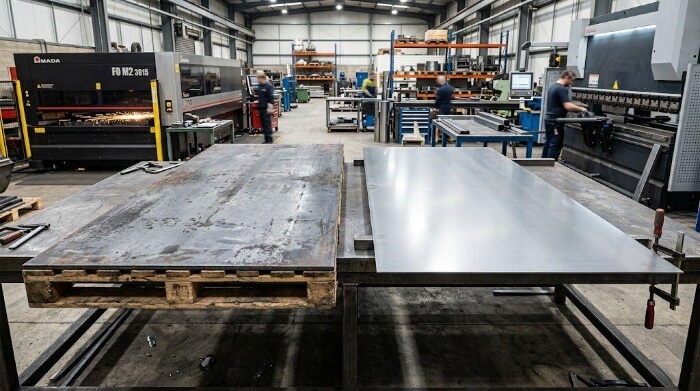
The fundamental differences between hot rolled (HR) and cold rolled (CR) steel come down to the temperature at which the metal is formed. These thermal conditions permanently alter the material’s internal grain structure.
High-Temperature Rolling
Hot rolled steel (such as A36) is milled at extremely high temperatures, typically above 1,700°F (925°C). This temperature sits above the material’s recrystallization point, allowing it to be shaped easily in large volumes.
Because the steel cools naturally at room temperature after rolling, it shrinks slightly and unevenly. This thermal contraction makes it difficult to maintain precise dimensional control and results in a somewhat looser grain structure.
Strain Hardening
Cold rolled steel (such as 1018) starts as hot rolled steel but undergoes further processing. Once the material cools to room temperature, it is passed through rollers again to reach its final dimensions.
This cold working process causes strain hardening. It increases the yield and tensile strength by approximately 20% compared to hot rolled steel, though this added strength comes at the cost of reduced material ductility.
Residual Stress
The mechanical pressure used to form cold rolled steel at room temperature introduces significant internal residual stress. When the material is subjected to heavy machining or laser cutting, this trapped stress is released, which often causes the part to warp or distort.
Conversely, because hot rolled steel cools naturally without mechanical compression, it holds very low residual stress. This makes hot rolled material more dimensionally stable during aggressive material removal.
Surface Scale
The extreme heat of the hot rolling process causes the surface of the steel to oxidize rapidly in the air. This forms a hard, dark, and scaly surface layer known as mill scale.
Cold rolling takes place at room temperature, which prevents this oxidation. As a result, cold rolled steel maintains a smooth, grey surface that is usually coated with a light oil film to prevent rusting during transit and storage.
Surface Quality and Dimensional Control
The physical state of the material upon delivery dictates how much labor is required before the part is finished. Tolerance requirements and surface finishing specifications should drive your initial material selection.
Thickness Tolerance
Cold rolled steel offers tight dimensional control, often holding thickness tolerances within ±0.005 inches depending on the gauge. This makes it highly suitable for precision sheet metal brackets and chassis where parts must fit together without interference.
Hot rolled steel has wider tolerance bands due to its unpredictable cooling shrinkage. This means the thickness can vary slightly across a single sheet or from batch to batch.
Flatness
For large equipment panels, base plates, or welding fixtures, material flatness is a critical requirement. Cold rolled sheets are generally flatter and more uniform straight from the mill.
Hot rolled plates often exhibit slight bowing or crowning across their length. If an assembly requires a strictly flat surface, using hot rolled steel usually forces the shop to add mechanical leveling or face milling operations.
Mill Scale and Tool Wear
The mill scale on hot rolled steel is highly abrasive. If it is not removed before processing, it acts like sandpaper, significantly accelerating wear on CNC cutting tools and press brake dies.
The smooth, clean finish of cold rolled steel is much easier on fabrication equipment. It requires no abrasive removal prior to machining, which extends tool life and reduces consumable costs.
Laser Cutting Stability
Laser cutting introduces localized heat into the material. When cutting long or narrow profiles from cold rolled steel, this heat can trigger the release of internal stresses, causing the parts to spring out of flat.
Hot rolled steel often works better for large laser-cut profiles where maintaining flatness post-cutting is important. However, the laser parameters must be adjusted properly to pierce and cut through the surface scale.
Paint Adhesion and Preparation
A clean substrate is an absolute requirement for paint, powder coating, or plating to adhere properly. Cold rolled steel generally only requires standard chemical degreasing before surface finishing.
Hot rolled steel requires aggressive mechanical descaling (such as sandblasting) or chemical pickling to remove the oxide layer. If a coating is applied directly over mill scale, the finish will eventually chip and flake off as the scale naturally separates from the underlying steel.
Machining and Fabrication Performance
When raw material enters the shop floor, its physical state dictates the manufacturing process. The choice between hot and cold rolled steel directly impacts how the metal behaves under cutting tools, press brakes, and welding torches.
Machining Distortion
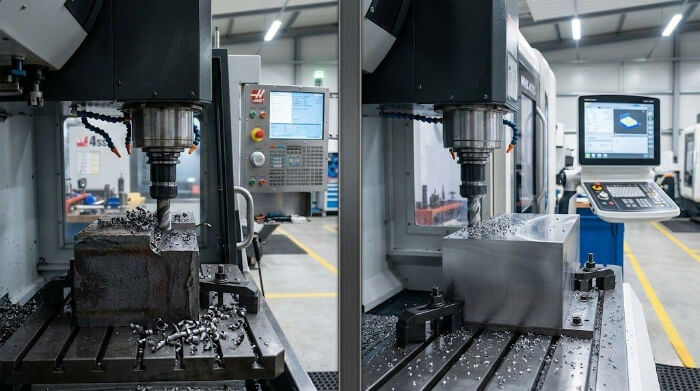
When milling cold rolled steel, removing a large amount of material from one side releases trapped internal stresses. This often causes the remaining material to bow or twist immediately after it is released from the CNC vise.
Hot rolled steel behaves much more predictably during heavy machining. Because it cools naturally and lacks internal pressure, the material stays dimensionally stable even after aggressive, asymmetrical material removal.
Springback
During sheet metal bending, materials naturally want to return to their original flat state. Because cold rolled steel has a higher yield strength from strain hardening, it exhibits significantly more springback than hot rolled sheets.
Press brake operators must compensate for this by slightly over-bending the material. If the bending parameters are not dialed in correctly, this leads to inconsistent angles across a production run.
Bend Cracking
Cold rolling reduces the natural ductility of the steel. When forming cold rolled sheet metal with tight inside radii, the material is prone to micro-cracking or fracturing, especially if the bend is parallel to the material’s grain direction.
Hot rolled steel is much more forgiving in press brake operations. Its higher ductility allows for tighter bend radii and deep drawing processes without tearing or compromising the structure of the part.
Weld Distortion
Welding introduces massive, localized heat into a part. When cold rolled steel is welded, this rapid heating releases its built-up manufacturing stresses, frequently causing severe warping in the welded assembly.
For heavy welded frames and structural supports, hot rolled steel is the standard choice. Its stress-free internal structure tolerates the intense heat of MIG or TIG welding with minimal distortion.
Tool Wear
The abrasive mill scale on hot rolled steel is notoriously hard on CNC tooling. If the scale is not mechanically removed before milling, it can reduce carbide insert life by 30% to 50%, rapidly increasing tooling replacement costs.
Cold rolled steel has a clean surface, but its higher base hardness requires specific feed and speed adjustments. However, without the unpredictable abrasive scale, tool wear on cold rolled material is generally more consistent and easier to manage during volume production.
Manufacturing Cost Beyond Material Price
Hot rolled steel usually has a lower initial material cost per pound. However, evaluating materials based solely on the raw invoice ignores the Total Cost of Ownership (TCO), which dictates the actual cost per finished part.
Surface Preparation
If a hot rolled part requires a clean powder coat or paint finish, you must factor in the cost of sandblasting or chemical pickling to remove the mill scale.
Mechanical descaling or chemical pickling can easily add 15% to 30% to the base material cost, quickly erasing any initial pricing advantage. In these cases, paying the premium for cold rolled material upfront is usually more economical.
Secondary Processing
Trying to achieve precise flatness or tight thickness tolerances with hot rolled steel requires secondary operations. Facing large plates or using leveling rolls adds significant labor hours to the project.
Cold rolled steel arrives with tight tolerances and excellent flatness straight from the supplier. This allows shops to skip preparation operations and send the material directly to the laser cutter or press brake.
Scrap and Rework
Material inconsistencies lead to rejected parts. The variable thickness of hot rolled steel can cause parts to fail quality control checks, especially when relying on automated bending cells that expect uniform material.
Conversely, using cold rolled steel for heavy welded assemblies often results in scrapped parts due to heat-induced warping. Selecting the wrong material state early in the design phase is a primary driver of costly rework.
Machining Time
Machine time is one of the most expensive factors in custom manufacturing. Milling through the tough outer scale of hot rolled steel often requires reducing feed rates by 20% or more to protect the cutting tools.
Cold rolled steel allows for more optimized and consistent CNC toolpaths. Its uniformity enables machinists to run programs reliably at higher speeds without unexpected tool failures or work stoppages.
Choosing the Right Steel for Different Parts
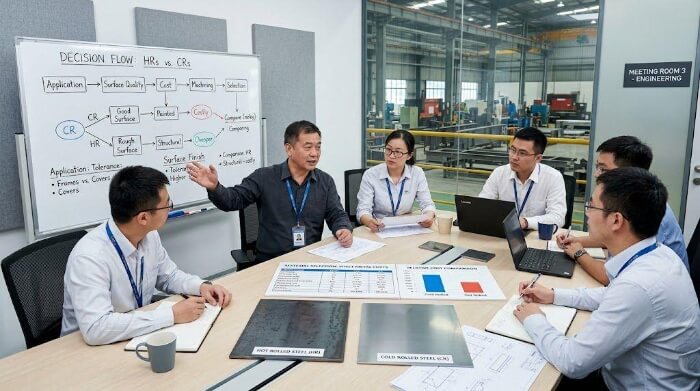
Selecting the correct steel depends entirely on the part’s function, aesthetic requirements, and required manufacturing processes. Here is how engineers typically match the material to the application.
Welded Structures
For industrial frames, structural supports, and heavy machinery bases, hot rolled steel (such as A36) is the standard. These parts prioritize strength, weldability, and cost over tight dimensional tolerances.
Since these structures are often hidden or painted with heavy industrial coatings, the surface scale and slight dimensional variations do not affect the final performance of the equipment.
Precision Sheet Metal
For electronics enclosures, server racks, and internal mounting brackets, cold rolled steel (like SPCC or 1018) is highly recommended. These applications demand tight tolerances for assembly and predictable behavior in the press brake.
The consistent thickness of cold rolled sheets ensures that complex multi-bend parts mate perfectly when assembled with rivets, screws, or hardware inserts.
Cosmetic Parts
Consumer appliances, automotive panels, and exposed hardware require flawless surface finishes. Cold rolled steel provides the necessary smooth substrate for high-gloss paint, fine powder coating, or zinc plating.
Using hot rolled steel for these applications would require excessive grinding and polishing. Cold rolled material ensures that the final aesthetic is not compromised by underlying surface pitting.
CNC Components
For machined blocks, pins, and precision mechanical components, cold rolled steel offers better machinability and a superior surface finish straight off the mill.
However, if the CNC component requires massive material removal from one side, engineers may specify hot rolled steel to prevent bowing. If cold rolled steel must be used for heavy milling, a pre-machining thermal stress relief process is often required to maintain dimensional stability.
HRPO Steel vs Hot Rolled and Cold Rolled Steel Comparison
In many manufacturing scenarios, buyers need a clean surface for painting but do not want to pay the premium for the tight tolerances of cold rolled steel. Hot Rolled Pickled and Oiled (HRPO) serves as the standard middle-ground solution.
Pickling Process
To create HRPO, standard hot rolled steel is submerged in a hydrochloric acid bath to chemically dissolve the tough mill scale. A light oil film is then applied to the bare metal to prevent flash rusting during transit and storage.
This process removes the abrasive oxide layer without changing the internal mechanical properties of the steel. It prepares the material for manufacturing without the extra rolling steps required to produce cold rolled steel.
Surface Improvement
The primary benefit of HRPO is its clean, scale-free surface. It is safe for press brake tooling and allows for direct welding and powder coating with minimal in-house preparation.
However, buyers must remember that pickling is strictly a surface treatment. HRPO does not improve the dimensional tolerances or flatness of the original hot rolled sheet.
Cost Balance
HRPO carries a slight premium over standard hot rolled steel but remains significantly cheaper than cold rolled material. As a general rule, if standard hot rolled is the baseline, HRPO typically adds a 10% to 15% premium, while cold rolled steel can cost 25% to 40% more.
By outsourcing the descaling process to the steel mill, fabrication shops eliminate the need for expensive in-house sandblasting. When factoring in the saved labor and extended tooling life, HRPO frequently offers the lowest total cost per part for painted sheet metal components.
Industrial Applications
HRPO works well for agricultural machinery, heavy shelving, and automotive chassis components. These applications require excellent paint adhesion to prevent corrosion but can easily tolerate wider dimensional variations.
If the final product will be powder-coated and does not require precision mating surfaces, HRPO is usually the most cost-effective specification.
Selection Mistakes in Manufacturing
Specifying the wrong steel state leads to budget overruns, delayed production schedules, and high defect rates. Here are the most common material selection errors made during the design and procurement phases.
Over-Specifying Tolerances
Engineers often leave default, tight CAD tolerances on non-critical parts, forcing procurement to source expensive cold rolled steel. If the part does not mate with precision components, loosening the tolerance and specifying hot rolled steel can immediately cut material costs.
Engineers should review the assembly intent before finalizing the drawing. Never pay for cold rolled precision on a part where hot rolled variation is perfectly acceptable.
Ignoring Surface Prep
Procurement teams sometimes purchase hot rolled steel to meet a strict raw material budget, forgetting that the final part requires a cosmetic powder coat finish.
The subsequent labor hours required to manually grind or blast the mill scale often exceed the price difference of the materials. Buying cold rolled or HRPO upfront would have kept the project under budget.
Tight Bend Failures
Selecting cold rolled steel for structural brackets with sharp inside radii is a common Design for Manufacturing (DFM) error. Because cold rolled steel has reduced ductility from strain hardening, it is highly prone to cracking along the bend line during press brake operations.
To prevent fracturing in cold rolled steel, engineers should specify an inside bend radius of at least 1.0x to 1.5x the material thickness. If a part requires tighter radii or aggressive deep drawing, specifying hot rolled steel prevents structural failure and keeps scrap rates low.
Choosing by Material Price Alone
Evaluating supplier quotes based only on the raw material weight per pound ignores the realities of manufacturing. The initial invoice does not reflect the cost of broken CNC end mills, extended machining cycle times, or heat-induced weld distortion.
A mature manufacturing strategy bridges the gap between engineering (who defaults to cold rolled for safety and precision) and procurement (who defaults to hot rolled for price). Ultimately, evaluating the Total Cost of Ownership—including tooling wear and secondary processing—determines the true final cost of the component.
Conclusion
The decision between hot rolled and cold rolled steel should never be based on material price alone. Hot rolled steel offers excellent ductility, low internal stress, and cost savings for heavy structural work. Cold rolled steel provides the dimensional accuracy, machinability, and clean surface finish required for precision manufacturing.
Understanding how these materials behave under cutting tools, welding torches, and press brakes is critical to controlling your project’s total manufacturing cost and ensuring consistent product quality.
Ready to optimize your next manufacturing project?
With over 10 years of experience in sheet metal fabrication and CNC machining, TZR helps clients bridge the gap between engineering design and shop-floor reality. Whether you are scaling up for mass production or evaluating materials for rapid prototyping, our engineering team ensures your parts are built with the right material, at the right price. Contact TZR today to discuss your next project.
FAQs
Is cold rolled steel stronger than hot rolled steel?
In most cases, yes. Cold rolled steel is usually stronger because the cold working process increases its hardness through strain hardening. However, this also makes it less ductile compared to hot rolled steel.
Which steel is better for CNC machining and fabrication?
It depends on the application. Cold rolled steel offers better dimensional accuracy, but it may introduce more internal stress, which can affect machining stability. Hot rolled steel is easier to machine in heavy material removal but has lower surface precision.
Why does hot rolled steel require surface treatment before coating?
Hot rolled steel has a surface layer called mill scale, which does not bond well with paint or powder coating. Processes like blasting or pickling are usually required before finishing to ensure proper coating adhesion.
What is HRPO steel and when should it be used?
HRPO (Hot Rolled Pickled and Oiled) steel is hot rolled steel that has been treated to remove scale and prevent corrosion. It offers a balance between cost and surface quality, making it suitable for parts that need better finish than hot rolled but do not require cold rolled precision.