 English
  Spanish
  German
  Russian
  Italian
  French
When engineers finalize CAD drawings for metal parts, confusing sandblasting with bead blasting on a manufacturing PO usually leads to one of two expensive outcomes: ruined precision tolerances on a machined part, or failed powder coating adhesion on a fabricated enclosure.
Sandblasting uses highly abrasive angular media to aggressively etch metal, making it ideal for rust removal and ensuring thick coating adhesion. Conversely, bead blasting uses spherical glass beads for a non-destructive peening action, providing a satin cosmetic finish that completely protects precision machining tolerances.
Choosing the wrong method often leads to assembly failures, delaminating paint, or ruined precision features. This guide breaks down the physical differences, material removal mechanics, and cost implications to help engineers and procurement teams specify the correct finish for their exact manufacturing requirements.
Sandblasting vs Bead Blasting: Core Difference
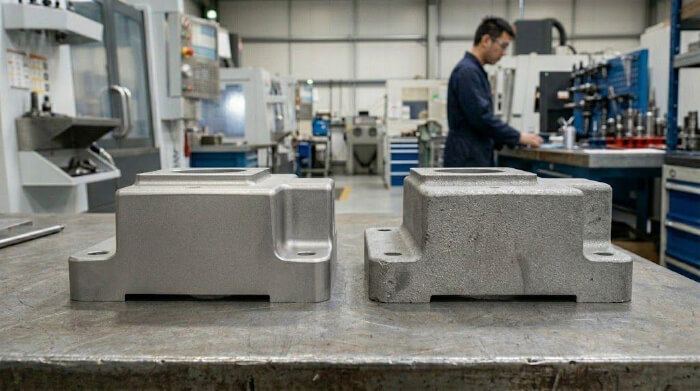
The fundamental difference between these two processes comes down to the shape and hardness of the abrasive media. This physical variance completely changes how the media interacts with the metal substrate upon impact.
Media Characteristics
Sandblasting utilizes angular, irregular abrasive materials. While traditional silica sand is restricted due to safety regulations, modern operations use highly abrasive substitutes like aluminum oxide, silicon carbide, or steel grit, which typically rate between 7 and 9 on the Mohs hardness scale.
Bead blasting uses perfectly spherical media, most commonly manufactured glass beads or ceramic beads. These are significantly softer than sandblasting abrasives—usually measuring around 5 to 6 on the Mohs scale—and contain absolutely no sharp edges.
Cutting Action
Because sandblasting media is angular and hard, it acts like a microscopic cutting tool. When propelled at high air pressures (often 60 to 120 PSI), the sharp edges aggressively gouge, etch, and cut into the metal substrate.
This mechanical action physically removes base material from the part. It efficiently strips away tough surface contaminants and heavy oxidation that softer finishing methods simply cannot break through, but it alters the original dimensions of the metal.
Peening Action
Glass beads do not cut. Instead, they impact the metal surface like tiny hammers in a process known as peening. Propelled at lower pressures (typically 30 to 80 PSI), the spherical beads strike the surface and compress the outer layer of the metal.
This action flattens microscopic peaks and pushes the material down rather than tearing it away. As a result, bead blasting has an extremely low material removal rate, allowing precision parts to retain their engineered tolerances while still achieving a clean, uniform finish.
Comparing Surface Finish and Part Quality
The mechanical differences in the blasting media directly dictate the final physical condition of the part. This impacts both how the component looks and whether it passes dimensional inspection on the shop floor.
Surface Texture
Sandblasting creates a highly textured, coarse surface. The angular media leaves deep micro-scratches across the substrate, making the metal feel noticeably rough to the touch.
Bead blasting produces a uniform, dimpled texture. Because the spherical beads compress rather than cut the material, the resulting surface feels smooth and consistent, typically described as a satin finish.
Anchor Profile
An anchor profile refers to the microscopic peaks and valleys created on a metal surface. This rough texture is essential because it allows secondary coatings to physically lock onto the part, preventing peeling or flaking under stress.
Sandblasting creates the deep, irregular anchor profile required for industrial powder coating and heavy painting. In contrast, bead blasting creates shallow, rounded dimples. Using bead blasting as a pre-treatment for thick coatings does not provide sufficient mechanical grip and frequently leads to paint delamination in the field.
Surface Roughness
Surface roughness is typically measured in Ra (Roughness Average). While exact values depend on grit size and air pressure, sandblasting with medium aluminum oxide usually yields an Ra between 3.2 µm and 12.5 µm.
Bead blasting with fine glass beads yields a much smoother surface, typically between 0.8 µm and 3.2 µm Ra. Engineers use these specific Ra ranges on CAD drawings to control exactly how much friction a mating surface will have.
Visual Appearance
Parts processed with angular sandblasting media appear flat, dull, and highly industrial. Because the surface is deeply etched and scatters light randomly, this finish is rarely specified as a final cosmetic surface for visible components.
Bead blasting, however, produces a bright, clean, and semi-matte appearance that diffuses light evenly. It is frequently specified as the final aesthetic finish for consumer electronics, exposed aluminum enclosures, and medical devices where visual consistency is required.
Dimensional Accuracy
Dimensional accuracy is a critical pass/fail factor for engineering sign-offs, especially for precision assemblies. Because sandblasting relies on a cutting action, prolonged exposure removes material and can easily push tightly toleranced features out of spec.
Bead blasting minimizes this risk by relying on plastic deformation rather than material removal. It typically removes less than 0.0001 inches of material, allowing CNC machined parts and precision sheet metal components to retain their exact specified measurements after finishing.
Evaluating Performance in Manufacturing Applications
How these processes perform on the actual shop floor determines which one is right for your project. The decision depends heavily on the specific alloy you are processing and what features you must protect.
Rust Removal
Sandblasting is the standard process for stripping heavy rust and deep corrosion from carbon steel (such as Q235 or 1018). Its aggressive cutting action quickly removes oxidation down to the bare metal, making it highly efficient for refurbishing raw structural steel.
Bead blasting is generally too gentle for heavy rust. Attempting to remove deep oxidation with spherical glass beads will take too long and often merely polishes the rust rather than removing it, wasting valuable production time.
Scale Removal
Laser cutting, hot rolling, and heavy welding often leave a tough, hardened oxide scale on sheet metal parts. Sandblasting easily breaks through this hard layer to expose the clean substrate underneath.
Bead blasting struggles with heavy scale. While it may remove light surface discoloration, it is highly inefficient against the thick, hardened edges left by high-power laser cutting operations.
Deburring
Sandblasting quickly removes heavy burrs caused by sheet metal stamping or aggressive machining operations. However, because it removes material, it may round off intended sharp edges and alter the part’s geometry.
Bead blasting is highly effective for removing light, microscopic burrs. It safely cleans the edges of CNC machined parts without altering the corner radius, making it a much safer choice for precision components.
Machining Mark Removal
Bead blasting is the industry standard for hiding tooling marks left by CNC milling and turning. For example, using #120 glass beads on 6061 aluminum parts blends the tool paths into a perfectly uniform, matte finish, elevating the cosmetic quality for final delivery.
Sandblasting will also obliterate machining marks, but it leaves a rough, raw texture. This aggressive finish is generally unsuitable if the aluminum or stainless steel part is meant to remain unpainted.
Weld Cleaning
For heavy structural welded assemblies (like low-carbon steel frames) that require powder coating, sandblasting is necessary to thoroughly clean the weld seam and prepare the surrounding area for paint adhesion.
For 304 or 316 stainless steel welded enclosures where cosmetics matter (such as medical equipment or food-grade housings), bead blasting removes heat tint and discoloration without destroying the metal’s natural finish.
Understanding the Impact on Secondary Finishes
Surface preparation is the foundation of any coating process. Specifying the wrong blasting method at the prototyping stage frequently leads to expensive coating failures during mass manufacturing.
Powder Coating
Standard powder coating (typically 60-80 microns thick) requires a deep anchor profile to adhere properly. Sandblasting with #80 aluminum oxide provides this rough surface, ensuring the powder coating mechanically locks in and resists chipping over time.
Bead blasting leaves a surface that is too smooth for industrial powder coats. If a powder coating delaminates in the field due to this improper pre-treatment, the cost to chemically strip the failed paint and re-blast the parts is often two to three times the initial surface finishing cost.
Painting
Heavy industrial liquid paints require the rough profile generated by sandblasting. The thicker the required paint layer, the deeper the underlying anchor profile needs to be to support it over years of outdoor exposure.
For thin, cosmetic wet paint applications on consumer electronics, bead blasting is sometimes used. It provides a clean, uniform surface without the deep scratches that might otherwise show through a thin coat of paint.
Anodizing
Bead blasting is widely used for preparing 6061 or 7075 aluminum parts before anodizing. It creates a smooth, non-reflective surface that results in a premium, consistent matte anodized finish, which is highly desired in high-end consumer devices.
Sandblasting before anodizing is generally avoided. The aggressive abrasives create a dark, uneven, and excessively rough surface that absorbs the anodizing dye inconsistently, resulting in a poorly manufactured appearance.
Electroplating
Sandblasting can be used prior to electroplating if a dull, matte plated finish is required. However, if the sandblasting is too aggressive, the deep micro-valleys can trap plating solutions and cause porosity or corrosion issues later.
Bead blasting provides a smooth, uniform base that allows plating layers to distribute evenly. It cleans the metal surface thoroughly while minimizing microscopic defects that could interfere with the final plating quality.
Laser Marking
Bead-blasted surfaces provide an excellent, high-contrast background for laser engraving. The uniform satin finish provides maximum contrast, ensuring industrial cameras and barcode scanners achieve a near 100% first-pass read rate for QR codes and part numbers.
Sandblasted surfaces scatter light inconsistently due to their rough texture. This often makes fine laser-marked text blurry and difficult for automated optical scanners to read, causing costly traceability issues in automated supply chains.
Protecting Tolerances and Thin-Wall Parts
When moving from rapid prototyping to mass manufacturing, protecting part integrity during surface finishing is necessary to maintain high yield rates. The abrasive media you choose directly dictates whether a batch of parts will pass final dimensional inspection or end up in the scrap bin.
Precision Features
Bead blasting removes almost zero material, typically less than 0.0001 inches. Engineers can specify bead blasting for CNC machined parts without having to adjust the CAD models to compensate for material loss, making it entirely safe for precision dowel pin holes or strict H7 bearing presses.
Sandblasting removes material rapidly. If used on precision mating surfaces, the aggressive cutting action will likely alter the dimensions by several thousandths of an inch (0.001″ – 0.003″+), causing the part to fall out of tolerance and fail final assembly.
Thread Protection
Sandblasting is highly destructive to machined threads. The angular abrasive will quickly strip the crests of internal or external threads, which frequently leads to cross-threading or bolt failure during final assembly.
While bead blasting is less aggressive, it can still alter the profile of fine threads (such as M3 or M4). Standard manufacturing practice requires manually installing silicone masking plugs into all threaded holes for both processes to ensure standard thread gauges pass inspection.
Thin-Wall Deformation
High-pressure sandblasting (80+ PSI) induces severe stress on the metal surface. When applied to thin sheet metal enclosures—such as 1.2mm (18-gauge) 5052 aluminum or Q235 steel—this localized stress frequently causes the panel to warp permanently, a defect known as “oil canning.” For mass-produced sheet metal parts, using the wrong blasting method can cause yield rates to drop below 60%, and those hidden scrap costs are ultimately factored into your unit price.
Bead blasting operates at lower pressures and induces a more uniform compressive stress across the surface. It is significantly safer for thin-wall stamped parts and electronic housings, though operators must still strictly control blasting pressure to prevent distortion.
Masking Requirements
Sandblasting requires heavy-duty masking materials because the sharp abrasives will easily eat through standard Kapton tape. Applying specialized thick rubber masking is highly labor-intensive and slows down the production cycle. Bead blasting is gentler on masking materials, but the manual labor required to apply and remove the tape remains.
To lower the unit price for high-volume production, our DFM (Design for Manufacturing) recommendation is to unify surface finish requirements across the entire part whenever possible. Alternatively, designing precision threads into blind holes can eliminate the need for manual masking entirely, significantly reducing labor hours.
Managing Cost and Production Efficiency
Surface finishing choices directly impact the final quote. When scaling up a project from prototypes to mass production, media consumption, equipment maintenance, and manual processing times dictate the true total cost of ownership (TCO).
Media Consumption
Traditional angular abrasives like sand or cheap aluminum oxide shatter upon impact. They break down rapidly into useless dust, requiring continuous purchasing and replenishment to keep the production line running.
Glass beads are manufactured as solid spheres that withstand impact much better. Because they do not fracture easily, the overall volume of media consumed per 1,000 parts is significantly lower compared to angular grit.
Media Reusability
The reusability of the abrasive is a major factor in mass manufacturing costs. Angular media typically lasts for only a few cycles before losing its cutting edges and becoming ineffective. In a properly maintained closed-loop blasting cabinet, high-quality glass beads can be recovered and reused up to 30 times.
This is why, for mass production runs of thousands of parts, a mature manufacturer with an efficient recovery system can often offer highly competitive bead blasting quotes, even though glass beads cost more upfront than raw sand.
Equipment Wear
Angular media aggressively wears down the internal components of blasting equipment. Ceramic nozzles, delivery hoses, and cabinet viewing windows must be replaced frequently when sandblasting, adding hidden maintenance costs to the factory overhead.
Spherical glass beads cause minimal wear on internal machinery. This reduces machine downtime and keeps production lines running smoothly, which is critical when adhering to strict delivery schedules for large orders.
Cleaning Requirements
Sandblasting leaves microscopic grit embedded in the substrate, along with heavy amounts of dust. These parts usually require intensive secondary cleaning, such as ultrasonic washing or high-pressure air blow-offs, before they can move to the painting line.
Bead blasting leaves a much cleaner surface because the spherical beads bounce off the metal rather than embedding into it. This reduces the time required for post-process cleaning and lowers the risk of trapped contaminants ruining a secondary coating.
Production Throughput
Sandblasting is a faster process per square inch. Its aggressive cutting action means operators spend less time stripping heavy oxidation or weld scale, increasing the overall throughput for heavy raw structural components.
Bead blasting takes slightly longer to achieve a perfectly uniform cosmetic finish. However, because it requires less post-process cleaning and drastically reduces the scrap rate of thin-wall parts, the overall production timeline usually balances out favorably for precision components.
Choosing the Right Process for Different Parts
Selecting the correct surface finish at the engineering stage prevents costly reworks during mass production. Here is how we typically route different manufactured components on the shop floor.
CNC Machined Parts
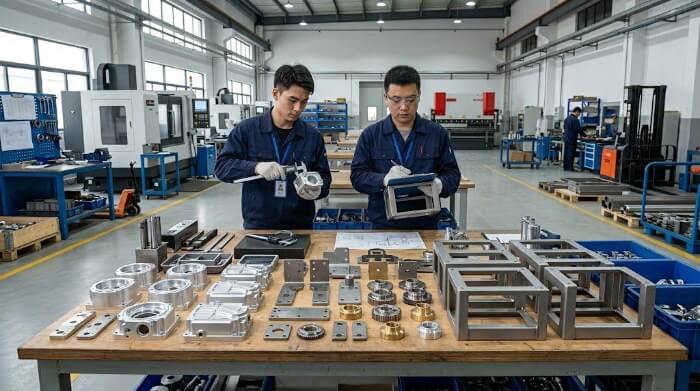
Bead blasting is typically specified for precision CNC machined parts. When processing materials like 6061-T6 aluminum or 304 stainless steel, glass beads easily remove milling marks and microscopic burrs without altering the part’s final geometry.
Sandblasting should be avoided for high-precision CNC components. The aggressive material removal will destroy tapped holes, alter tight bearing fits, and round off intended sharp edges.
Sheet Metal Enclosures
For thin-wall sheet metal enclosures (such as 1.2mm or 18-gauge aluminum), bead blasting is the safer choice. The lower operating pressure prevents the permanent warping and “oil canning” effect that plagues thin stamped parts.
Sandblasting is only recommended for sheet metal if the component is manufactured from thicker carbon steel (over 2.5mm) and requires a heavy outdoor powder coating where maximum adhesion is necessary.
Welded Assemblies
For carbon steel welded frames, sandblasting is required to thoroughly strip away weld scale, slag, and oxidation. Aggressive sandblasting also exposes sub-surface welding defects, making it an essential step for strict QC inspections before coating.
For stainless steel TIG welded assemblies—especially those used in medical or food-grade equipment—bead blasting is the standard choice. It effectively removes the heat tint (discoloration) around the weld zone while maintaining the metal’s clean, bare aesthetic.
Structural Components
Sandblasting is standard practice for heavy structural components. Thick materials like Q235 steel plates or heavy hot-rolled angle iron are not at risk of warping under high pressure.
The angular media efficiently strips heavy mill scale and rust, creating the deep anchor profile required for heavy-duty, corrosion-resistant coatings to survive in outdoor environments.
Consumer Products
Bead blasting is highly favored for consumer electronics and premium hardware. It provides the uniform, light-diffusing satin finish seen on laptop chassis, custom keyboards, and machined aluminum buttons.
More importantly, it provides the premium tactile feel and fingerprint resistance that high-end consumer brands demand. Sandblasting is rarely used for visible consumer products unless a specifically rough, high-friction grip surface is functionally required by the industrial design.
Sandblasting vs Bead Blasting: Quick Selection Guide
Use this summary to quickly determine which process aligns with your production requirements and coating specifications.
Sandblasting Applications
- Best for: Carbon steel, cast iron, and thick structural metals.
- Primary function: Heavy rust removal, mill scale stripping, and aggressive cleaning.
- Pre-treatment for: Thick powder coating, industrial liquid painting, and thermal spraying.
- Warning: Will alter precise dimensions and warp thin sheet metal.
Bead Blasting Applications
- Best for: Aluminum, stainless steel, brass, and precision CNC components.
- Primary function: Cosmetic finishing, removing machining marks, and light deburring.
- Pre-treatment for: Anodizing, clear coating, and laser marking.
- Advantage: Protects strict engineering tolerances and prevents thin-wall deformation.
Comparison Table
| Feature | Sandblasting (e.g., Aluminum Oxide) | Bead Blasting (e.g., Glass Beads) |
| Media Shape | Angular / Irregular | Spherical |
| Mechanical Action | Cutting / Etching | Peening / Compacting |
| Material Removal | High (Alters precise dimensions) | Extremely Low (Preserves tolerances) |
| Surface Finish | Rough / Matte (High Ra) | Smooth / Satin (Low Ra) |
| Coating Adhesion | Excellent for thick coatings | Poor for thick coatings |
| Sheet Metal Risk | High risk of warping | Low risk (with pressure control) |
Conclusion
Choosing between sandblasting and bead blasting is not about which process is universally better; it is about matching the mechanical action to your specific part. If your primary goal is strong coating adhesion or stripping heavy rust from structural steel, sandblasting is necessary. If you need to protect tight CNC tolerances, prevent sheet metal warping, or achieve a premium cosmetic finish on aluminum, bead blasting is the correct engineering choice.
If you are unsure which surface treatment fits your tolerance requirements and production budget, upload your CAD files today. Our engineers will provide a free DFM review and a rapid quote within 24 hours, ensuring a seamless transition from your first prototype to mass production.
FAQs
Can you bead blast carbon steel?
Yes. While commonly used for aluminum and stainless steel, bead blasting works well on carbon steel to remove light machining marks. However, glass beads will not remove heavy rust, and the bare steel will still require a secondary coating to prevent future corrosion.
Does sandblasting weaken the metal?
On thick structural steel, sandblasting does not weaken the material. However, on thin sheet metal parts (under 1.5mm), the aggressive impact introduces localized stress that can permanently warp the panel, ruining the structural geometry of the part.
Is bead blasting cheaper than sandblasting for mass production?
For one-off prototypes, the costs are similar. In mass manufacturing, bead blasting often becomes more cost-effective because glass beads can be recycled up to 30 times in a closed-loop system, lowering consumable costs.