 English
  Spanish
  German
  Russian
  Italian
  French
In the world of industrial electrical design, protection is not a variable you can afford to get wrong. A miscalculation in enclosure ratings doesn’t just mean a wet circuit breaker; it means downtime, safety hazards and expensive equipment replacement.
When specifying NEMA enclosures for harsh environments, one rating seems to appear more than any other: NEMA 4X.
Whether you are an electrical engineer designing a control panel for a wastewater treatment plant or a procurement manager sourcing cabinets for a food processing facility, understanding the nuances of NEMA 4X is critical. Many professionals ask, What is a NEMA 4X enclosure exactly? It is the gold standard for durability as it combines rigorous protection against the ingress of water with the ability to withstand corrosive agents, safeguarding critical electrical components inside.
This guide takes a deep dive into the NEMA 4X standard, how it compares to other common ratings, and why the method of manufacturing, standard versus custom, is just as important as the rating itself.

What is NEMA 4X? Understanding the Standard
The National Electrical Manufacturers Association (NEMA) defines NEMA 250 as the governing standard for electrical enclosures in North America. Within this standard, the official NEMA 4X enclosure definition outlines a high degree of protection designed for extreme environmental conditions.
To really grasp the NEMA 4X meaning, we have to break down the designation into its two parts: the “4” and the “X.”
The “4” Designation: Watertight and Dust-tight
First and foremost, a NEMA 4 enclosure offers a watertight seal. This is more than just rain protection. To attain a Type 4 rating, an enclosure must not allow water to enter even when exposed to a stream from a hose. Specifically, according to strict NEMA 4X specifications, it must be able to withstand water projected from a 1-inch nozzle at a rate of 65 gallons per minute from a distance of 10 feet.
If your equipment is exposed to washdown procedures, common in industrial cleaning, or heavy windblown dust and rain, the Type 4 rating ensures that the internal components of the equipment stay dry. At the same time, it is dust-tight, which prevents the ingress of airborne particulates that can cause short circuits or overheating.
The “X” Factor: Corrosion Resistance
The “X” is the critical differentiator. It means that the enclosure has undergone strict testing of corrosion resistance. While a standard NEMA 4 steel box may rust when the paint is scratched, a NEMA 4X enclosure offers an inherent resistance to corrosive elements.
In order to receive this NEMA 4X rating, the material must resist prolonged exposure to salt spray (usually a 200-hour salt spray test) without exhibiting significant signs of corrosion that would compromise the structure. This makes NEMA 4X the mandatory choice for environments that contain:
- Saltwater or sea spray.
- Corrosive chemicals and caustic cleaners.
- Acidic atmospheres are prevalent in petrochemical plants.
Furthermore, NEMA 4X enclosures are also rated to protect against the formation of ice from the outside, ensuring that mechanisms such as door latches are improved even in freezing conditions.
NEMA 4X vs. Other Ratings: What are the Differences?
Confusion often occurs when choosing between NEMA ratings. Is NEMA 12 enough? Is NEMA 4 the same as 4X? Understanding these distinctions is critical for compliance and budget management.
NEMA 4 vs. NEMA 4X
This is the most common comparison. Both ratings provide the same protection from solid foreign objects (dirt, dust) and water penetration (rain, sleet, snow and hose-directed water).
The difference is all in the corrosion. A standard painted carbon steel enclosure can achieve NEMA 4, but cannot achieve NEMA 4X. If the paint is on a NEMA 4 enclosure chips, the steel underneath will rust. NEMA 4X enclosures are made with materials that are naturally resistant to corrosion, such as stainless steel, aluminum or fiberglass.
Think of NEMA 4 as a heavy-duty raincoat, and NEMA 4X is a hazmat suit. Both keep you dry, but only one lets you walk through a chemical spill unharmed.
NEMA 12 vs. NEMA 4X
NEMA 12 is an indoor rating. It is designed to provide protection from dust, falling dirt, and dripping non-corrosive liquids (such as oil or hydraulic fluid leaks). It is the standard for indoor manufacturing floors.
NEMA 4X is far superior in protection. NEMA 12 enclosures are not water tight against pressurized streams and provide no standardized corrosion protection. Using a NEMA 12 enclosure in an outdoor or washdown zone will cause rapid failure.
NEMA 3R vs. NEMA 4X
NEMA 3R is the minimum rating for outdoor electrical boxes. It is protective from falling rain and ice formation. However, NEMA 3R is not airtight or watertight to pressurized flow. It often relies on a “shedding” design where water can get in but is drained out without hitting components.
NEMA 4X, on the other hand, is gasket-sealed. It keeps water out completely, even under pressure, and provides the corrosion protection that 3R does not. If you are near the coast, 3R will rust; 4X will not.
IP66 vs. NEMA 4X
The IP (Ingress Protection) system is used mainly in Europe and increasingly worldwide. IP66 is the closest thing to NEMA 4X in terms of ingress.
- IP6: Dust-tight (First digit).
- IP6: Protected against powerful water jets (Second digit).
However, the NEMA standard is more complete regarding the overall degree of protection of the equipment. NEMA 4X implies IP66, but IP66 does not ensure NEMA 4X. This is because the IP system only tests for ingress (solids and liquids). It does not test for corrosion resistance or operation under ice forming. Therefore, for North American industrial applications, specifying NEMA 4X is a safer, more rigorous requirement than specifying IP66.
Common Materials Used in NEMA 4X Enclosures
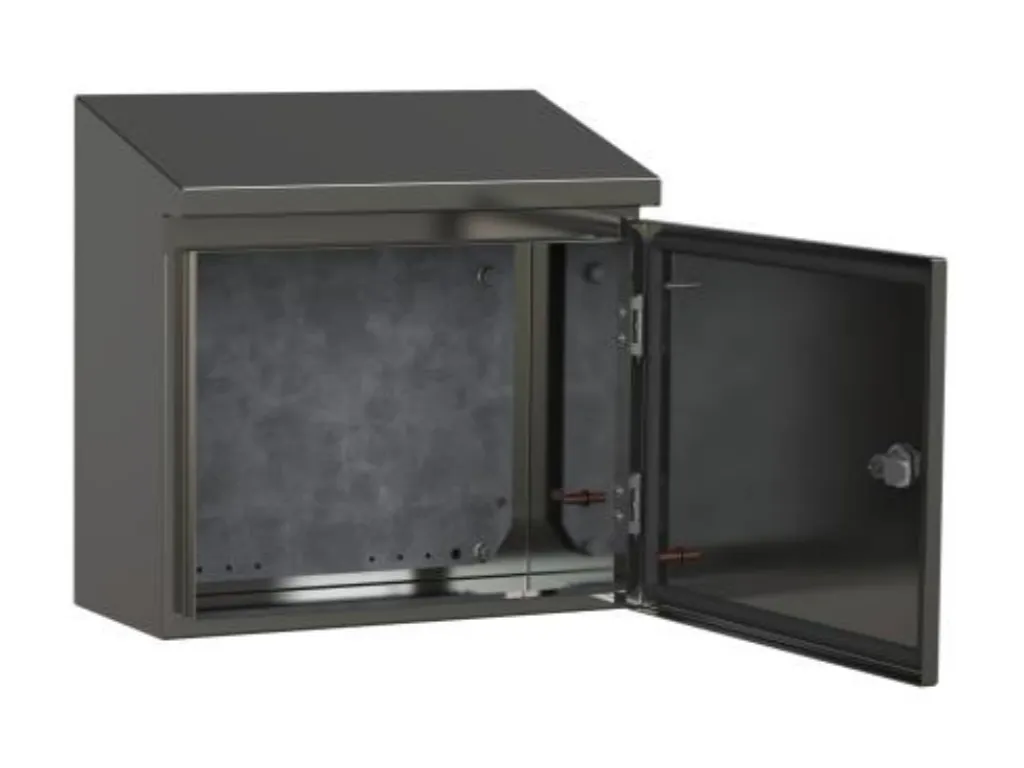
Selecting the right NEMA 4X enclosure material is not only aesthetic but functional because the X determines the corrosion resistance. The substance has to be resistant to the environment.
Stainless Steel (Type 304 and 316).This is the best material used in industrial NEMA 4X enclosures.
- Type 304: Provides great corrosion protection in normal washdown and outdoor applications.
- Type 316: It has molybdenum, which offers better resistance to acids and chlorides. This is the obligatory option in marine conditions and pharmaceutical use. Stainless steel has a high impact strength, carrying capacity and durability which cannot be matched by polymers.
Aluminum (usually 5052-H32) is light and creates a natural oxide coating, which is resistant to rust. It is a good option in solar power applications or telecommunications where weight is an issue. It is, however, not as resistant to strong alkalis as stainless steel.
The non-metallic types of polycarbonate and Fiberglass are used in smaller junction boxes since they are not susceptible to rust and are relatively cheap. Nevertheless, they are greatly limited in structure. They may crack in the UV over time, they are prone to cracking when hit, and they cannot hold heavy internal parts without bending.
Common NEMA 4X Enclosure Categories and Typical Dimensions
NEMA 4X enclosures are usually sorted by size and use when browsing catalogs or planning a project. Although these are the so-called standard sizes, they are not a strict rule but general market averages.
| Enclosure Category | Typical Dimensions (H x W x D) | Primary Applications |
| Small Junction Boxes | 4″ x 4″ x 3″ to 12″ x 12″ x 6″ | Terminal blocks, push buttons, and wiring junctions. |
| Wall-Mount Enclosures | 16″ x 12″ x 8″ to 48″ x 36″ x 16″ | PLCs, VFDs, and machine control panels. |
| Freestanding / Floor-Mount Enclosures | 60″ x 36″ x 18″ to 90″ x 72″ x 24″+ | Power distribution systems, large motor drives, and multi-door automation cabinets. |
Note: Although these ranges are common with off-the-shelf products, industrial requirements are usually in between these particular integers, which causes the problems mentioned below.
Key Industries and Applications Requiring NEMA 4X
The NEMA 4X rating is not a luxury; in most industries, it is a regulatory or operational requirement.
- Food and Beverage Processing: This is the greatest consumer of NEMA 4X enclosures. The equipment should be cleaned with high-pressure and high-temperature water containing caustic cleaning agents on a daily basis. This “washdown” cycle can only be withstood by NEMA 4X stainless steel which does not corrode or leak.
- The Enemy of metal is marine and offshore salt. Oil rigs, docks, and ships need enclosures that are able to withstand salt spray at all times. Here, type 316 stainless steel NEMA 4X enclosures are used to ensure that structural failure does not occur quickly.
- The Treatment plants of wastewater treatment involve the use of harsh chemicals such as chlorine and sulfur dioxide. The environment is usually damp and acidic. NEMA 4X is used to prevent failure of critical pump controls because of oxidation.
- In pharmaceutical manufacturing, like food processing, hygiene is the most important. The enclosures should be simple to wash, not susceptible to sterilizing agents, and totally sealed to avoid entry or exit of contaminants in the housing.
Implementation Challenges: When “Off-the-Shelf” Falls Short
Although the standard NEMA 4X enclosures are easily procured through catalog distributors, incorporating them into an actual engineering project may prove to be a major challenge. Purchasing a typical box appears to be easy until the time of installation.
- The Modification Risk. A standard enclosure is a blank slate- a closed box with no holes. It requires drilling cable glands, HMI screens, buttons, and conduits to use it. It is risky to do this on-site (or in the field). The metal is vibrated during drilling and this may weaken the door seal. More to the point, the metal is drilled leaving the raw and exposed edges. Although the box may be made of stainless steel, the wrong tooling may cause contamination that results in rust streaks. When the box is painted or coated, the drill bit removes that coating, leaving an instant access point to corrosion.
- Dimensional Constraints: Machinery is shrinking and getting complicated. Standard enclosures are available in rigid size increments (e.g., 24×24, then 30×24). Assuming you have 26 inches of mounting space, a 30-inch box will not fit, and a 24-inch box may not be large enough to hold your parts. Engineers have to redesign their complete machine layout many times, simply to fit in a box of arbitrary size.
- By definition, Thermal Management Issues NEMA 4X enclosures are airtight. They serve as ovens to the electronics within. Standard boxes do not usually have optimized heat dissipation. To add fans or air conditioners, it is necessary to cut large and accurate holes, which is not an easy task to do manually without losing the NEMA rating.

Why Custom Sheet Metal Fabrication is the Superior Choice
In the case of critical industrial projects, the buy and modify strategy creates unwarranted inefficiency and risk. Another strategic option is custom sheet metal fabrication, where the enclosure is designed to fit the application instead of making a tradeoff.
- Precision Integration: Custom fabrication is done using laser cutting to make accurate cutouts prior to the unit being shaped and coated rather than drilling on site. This removes coarse edges and makes the enclosure ready to install the components instantly.
- Optimized Footprint: Standard sizes are hardly ever a perfect fit. Custom manufacturing enables precise sizing, as small as millimeters, to maximize internal space to fit wiring and minimize the external size to conserve precious floor space.
- Structural Integrity: Custom heavy-gauge 304 or 316 stainless steel offers strong support to heavy transformers and drives, unlike conventional plastic choices, which essentially make the enclosure a structural part of the equipment.
- Assured Conformance: It is common to nullify the NEMA rating of a standard box by altering a single box on-site. Units that are custom-fabricated are designed and enclosed to ensure complete NEMA 4X compliance at the factory eliminating liability concerns.
TZR translates these engineering advantages into manufacturing reality. As a leading integrated fabricator serving demanding sectors like medical devices and renewable energy, we specialize in the high-grade stainless steel and aluminum required for strict NEMA 4X compliance.
Our ISO 9000-aligned processes achieve ultra-tight tolerances of ±0.02mm, handling complex bending geometries with minimal marking to preserve material integrity. With a workforce averaging over 10 years of experience and 12 in-house finishing options, we ensure your enclosure offers superior corrosion resistance. Furthermore, every project begins with a free Design for Manufacturing (DFM) analysis, helping you optimize your enclosure design for both performance and cost-efficiency before production ever begins.
Conclusion
NEMA 4X is more than just a label; it is an assurance of reliability in the most unforgiving environments. Whether facing the high-pressure washdowns of a food plant or the corrosive salt air of an offshore rig, this rating ensures that your critical electrical infrastructure remains dry, clean, and operational.
However, selecting the rating is only step one. The physical implementation—how the enclosure fits, how it handles heat, and how it integrates with your machinery—is equally important. While off-the-shelf options serve basic needs, they often introduce risks regarding sealing integrity and spatial efficiency.
For projects where failure is not an option, relying on custom sheet metal fabrication ensures that your enclosure is not just a box, but a precision-engineered shield tailored to your exact specifications. By choosing custom manufacturing, you secure both the NEMA 4X protection you need and the perfect fit your project deserves.
FAQS
Q: Is NEMA 4X explosion proof?
A: No, the NEMA 4X rating strictly certifies protection against environmental hazards like water ingress (including hose-directed water) and corrosion. It does not certify that the enclosure can contain an internal explosion. For hazardous environments with explosive gases or vapours (Class I locations), a NEMA 7 rating is required. However, some specialised enclosures may carry a dual rating (e.g., NEMA 7/4X) to satisfy both requirements.
Q: What is the difference between NEMA 7 and NEMA 4X?
A: The primary difference lies in the direction of protection. NEMA 4X is designed to keep external contaminants (water, dust, salt) out of the enclosure to protect the equipment inside. NEMA 7 is designed to keep an internal explosion in, preventing sparks or flames from igniting the surrounding explosive atmosphere. NEMA 4X is standard for washdown zones, while NEMA 7 is mandatory for hazardous locations (Class I, Division 1).