
 English
  Spanish
  German
  Russian
  Italian
  French
Contract manufacturing is an outsourcing process where a client partners with a manufacturer to fabricate components or complete assemblies to exact specifications. This turnkey solution optimizes supply chains, cuts overhead costs, and leverages dedicated engineering support, allowing companies to focus on core R&D and market scaling.
Moving a product from a digital CAD file to reliable mass production requires close coordination between design and the shop floor. This article breaks down the practical aspects of working with a manufacturing partner, focusing on process evaluation, cost control, and quality execution.
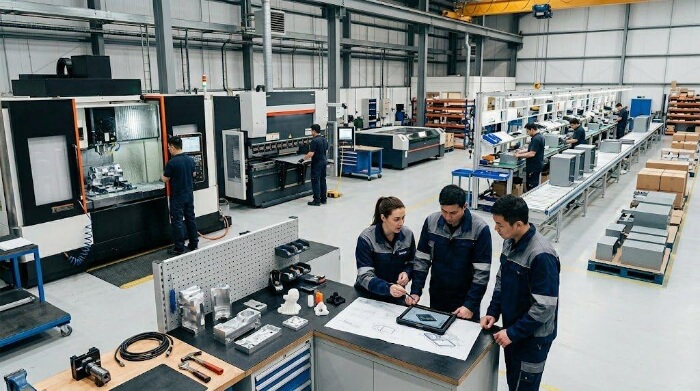
When Contract Manufacturing Makes Sense?
Outsourcing production is usually a practical decision driven by internal resource constraints or specific project requirements. It allows companies to scale operations efficiently without over-committing capital.
Prototype Demand
Internal manufacturing departments often prioritize existing, high-volume production lines. This makes it difficult to allocate machine time and engineering resources for testing new designs.
Contract manufacturers typically dedicate specific equipment and engineering teams solely to rapid prototyping. This setup allows for quick design iterations and functional testing without disrupting established internal workflows.
Capacity Limits
Transitioning from prototype to mass production requires significant capital for equipment, facility expansion, and labor.
Utilizing an external partner allows companies to scale production volume based on actual market demand. This flexibility is critical for managing seasonal spikes or initial product launches without carrying the financial burden of idle machinery during slow periods.
Complex Assemblies
Many mechanical products require a combination of different manufacturing processes. A single assembly might involve a CNC-machined housing, sheet metal brackets, and custom stamped components.
Working with a facility that offers a wide range of processing capabilities under one roof reduces the need to manage multiple specialized vendors. This simplifies the supply chain, lowers logistical risks, and makes final assembly much easier to control.
Faster Launch Cycles
Market windows are often narrow, and multiple design revisions can easily delay a product launch by months.
Experienced manufacturing teams conduct Design for Manufacturing (DFM) reviews early in the process. Identifying interference issues, material limitations, or tolerance conflicts before cutting metal reduces revision cycles and helps keep project schedules on track.
How to Evaluate Manufacturing Processes?
Selecting the right manufacturing process directly impacts both unit cost and part performance. A reliable manufacturing partner will help align the process with the required production volume and technical specifications.
CNC Tolerances
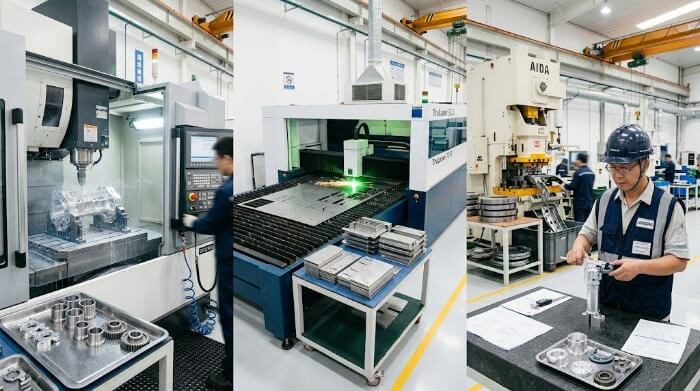
Specifying tight tolerances across every dimension is a common cause of cost overruns. While standard CNC machining can comfortably hold tolerances of ±0.1mm, pushing for ±0.01mm requires slower feed rates, frequent tool changes, and stricter environmental controls.
It is more cost-effective to apply tight tolerances only to critical mating surfaces. For non-critical areas, relying on standard shop tolerances (such as ISO 2768-m) significantly reduces machining time and inspection costs without affecting part function.
Sheet Metal Processes
The choice of sheet metal fabrication method depends heavily on the production volume. For prototypes and low-volume runs, laser cutting combined with CNC press brake bending is the standard approach, as it requires zero tooling investment and accommodates rapid design changes.
However, as volume increases (typically beyond 5,000 units), the higher piece-price of laser cutting becomes inefficient. At this stage, transitioning to custom stamping dies becomes more cost-effective. Stamping significantly reduces cycle times and per-part costs, which quickly offsets the initial tooling expense.
Material Selection
Material choices should balance structural requirements with manufacturability. In stainless steel applications, grade 304 is usually used for general enclosures due to its good formability and lower cost. If the part will be exposed to harsh chemical environments, grade 316 is required, though it is more difficult to machine and commands a higher raw material price.
For cost-sensitive structural frames, standard carbon steels like Q235 are often sufficient. When paired with the appropriate protective coating, these lower-cost alloys provide reliable strength for internal brackets and chassis components without over-engineering the material spec.
Surface Finishing
Surface treatments do more than improve appearance; they directly affect final dimensions and assembly fits. Processes like hard anodizing add measurable thickness to aluminum parts, which must be calculated into the pre-plating machine dimensions to avoid interference during assembly.
Similarly, powder coating provides a durable exterior finish for sheet metal, but it adds significant thickness. Careful masking instructions must be provided to the factory to ensure threaded holes, tight-tolerance cutouts, and electrical grounding points remain bare and within spec.
From Prototype to Mass Production
Moving a product from a digital CAD file to reliable mass production demands a systematic transition. The goal is to ensure that the processes used for high-volume manufacturing remain stable, repeatable, and cost-effective.
DFM Review
Before any metal is cut, a thorough Design for Manufacturing (DFM) review is essential. This step bridges the gap between theoretical CAD models and shop-floor reality.
Experienced manufacturing engineers will identify features that require custom cutting tools or adjust hole placements to prevent material tearing. Catching these issues early prevents costly delays when scaling up.
Prototype Validation
Once the DFM is approved, the prototype phase focuses on functional validation. This is not about hand-crafting a single perfect piece; it is about verifying that the chosen materials and methods perform under real-world conditions.
Any assembly interferences, structural weaknesses, or tolerance stacking issues must be exposed here. Correcting them at this stage is much cheaper than altering production tooling later.
Pilot Production
Jumping directly from a single prototype to a 10,000-unit run carries massive financial risk. A pilot production run (typically 50 to 200 units) serves as a stress test for the entire manufacturing line.
It validates the Process Capability Index (Cpk), proving that the factory can maintain strict tolerances across a batch. It also ensures a smooth assembly flow before committing to full-scale material orders.
Tooling Cost Control
As volumes increase, moving from soft tooling (like laser cutting) to hard tooling (like progressive stamping dies) is required to lower unit costs.
The key to controlling this transition is design optimization. Designing parts with standardized features allows the factory to use modular dies or common inserts, reducing the initial capital investment while achieving high-speed production.
Quality Control on the Production Floor
Quality cannot be inspected into a part; it must be built into the manufacturing process. However, rigorous, standardized inspection protocols verify that the equipment is performing exactly as programmed.
GD&T Execution
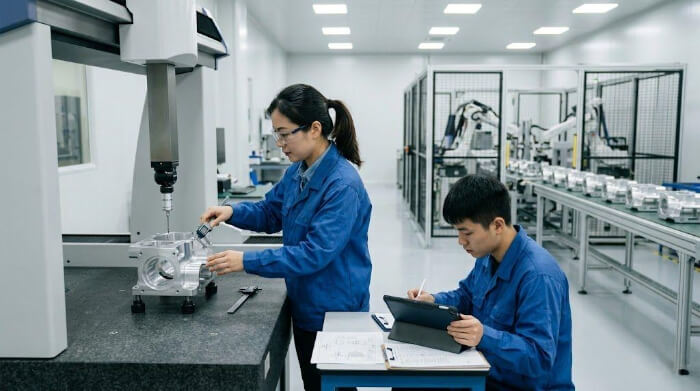
Applying GD&T (Geometric Dimensioning and Tolerancing) is only effective if the factory floor understands how to execute it practically. Proper execution means the machining setup and the CMM inspection must share the exact same reference datums.
For thin-walled enclosures, clamping distortion during machining can cause parts to spring out of tolerance once released. A reliable manufacturer designs custom workholding that mirrors the final assembly state, ensuring measurements reflect real-world function.
FAI Reports
The First Article Inspection (FAI) report is the ultimate proof that the supplier understands your print. A rigorous handover should align with PPAP (Production Part Approval Process) standards.
This includes providing a measured data point for every single callout, alongside Material Test Reports (MTR) to guarantee alloy authenticity. Reviewing this structured data allows engineering teams to sign off on full production with confidence.
CMM Inspection
For components with tight geometric requirements or complex 3D profiles, manual tools like calipers and micrometers are simply insufficient.
Routine CMM (Coordinate Measuring Machine) inspections ensure critical features, such as hole concentricity and true position, are verified directly against the CAD model. This removes human error and provides traceable data logs for quality audits.
Coating Consistency
Surface treatments frequently introduce dimensional changes and batch-to-batch visual variations. Maintaining consistency requires strict control over bath chemistry or baking temperatures.
Furthermore, factories must account for coating buildup. Clear masking instructions, custom silicone plugs, or secondary operations like re-tapping threads are necessary to ensure tight-tolerance cutouts remain functional.
What Drives Contract Manufacturing Cost?
Understanding the mechanics behind a supplier’s quote is critical for procurement. Manufacturing costs are the direct mathematical result of design choices, process selection, and order volume.
Production Volume
The strongest driver of per-unit cost is production volume. In low-volume runs, the setup time—programming the CNC and calibrating the machine—accounts for a massive percentage of the part’s price.
As volume increases, these fixed setup costs are amortized across thousands of parts. This drastically reduces the individual unit price, making large batches significantly more economical.
Tooling Investment
Hard tooling requires a significant upfront capital investment, but it permanently reduces machine cycle times.
Procurement managers must calculate the break-even point. If the projected volume is high enough, the lower piece-price achieved by custom stamping dies will quickly recover the initial tooling cost and lead to long-term savings.
Material Cost
Raw material costs fluctuate, but engineering choices dictate how much material is actually wasted. A critical metric is the Buy-to-Fly ratio (scrap rate).
Machining a complex housing from a solid block of aluminum generates a massive amount of chips, driving up costs. Redesigning that same component as an efficient sheet metal assembly minimizes scrap and significantly lowers the final price tag.
Inspection Requirements
Every required inspection step adds direct labor time. While standard AQL (Acceptable Quality Limit) sampling is cost-effective, demanding 100% inspection for every single unit will heavily inflate overhead.
To keep budgets under control, engineers should specify strict, high-frequency inspection levels only for critical-to-function features, leaving non-critical dimensions to standard sampling.
Supplier Risks and Production Delays
Even with a perfect design, external factors can disrupt your production schedule. Managing these risks requires a supplier who is transparent about their supply chain and capable of solving problems before they cause assembly line shutdowns.
Lead Time Bottlenecks
Delays rarely happen on the CNC machine itself; they usually occur between processes. Waiting for outsourced surface finishing, specialized heat treatments, or custom cutting tools frequently disrupts the schedule.
A reliable supplier accounts for these secondary operations in their initial quote. They build realistic buffer times for external treatments rather than promising a best-case scenario that fails at the last minute.
Engineering Communication
Time zones and language barriers can turn a minor drawing clarification into a week-long delay. If the factory’s sales team cannot directly translate your technical requirements to the shop floor, expensive mistakes will happen.
Working with a partner who employs bilingual manufacturing engineers ensures that critical DFM notes, GD&T callouts, and material specifications are accurately understood before any metal is cut.
Material Shortages
Relying on just-in-time (JIT) material delivery works well until a global supply chain hiccup occurs. Custom PEM fasteners or specific alloys often face sudden lead time spikes during market shortages.
A resilient manufacturer mitigates this by maintaining in-house buffer stock of standard thicknesses (such as 1.5mm and 2.0mm) for premium cold-rolled and stainless steel. This capability alone can shave two to three weeks off project kickoff times when supply chains break down.
Global Supply Risks
Tariffs, freight capacity shortages, and geopolitical shifts directly impact landed costs and final delivery dates. Ocean freight delays can easily add four to six weeks to a project schedule.
To minimize these risks, companies rely on their contract manufacturer to provide accurate Ex-Works (EXW) and FOB (Free on Board) lead times. This transparency allows logistics teams to plan alternative air freight routes when ocean shipping becomes unstable.
How to Choose a Manufacturing Partner?
Evaluating a supplier requires looking beyond the piece-price on their quotation. You are essentially hiring an extension of your own engineering and procurement teams.
Engineering Support
A factory that simply machines exactly what is on the print—even if the design is fundamentally flawed—is a basic vendor, not a partner. You need a team that pushes back when they spot a manufacturability issue.
For example, rather than just cutting to print, experienced engineers will analyze the flat pattern, correct the K-factor, and adjust the bend deductions upfront. This ensures that mounting holes align perfectly during final assembly without requiring manual rework.
Production Capacity
Assessing capacity goes beyond counting the number of machines on the shop floor. It involves understanding their equipment redundancy, maintenance schedules, and shift flexibility.
If a supplier relies on a single high-end machine for your critical components, a sudden breakdown will halt your entire order. A robust partner has overlapping capabilities, such as backup laser cutters, to absorb unexpected downtime seamlessly.
Quality Systems
Holding an ISO 9001 certification is a baseline, but actual execution on the floor matters more. You need to know how they handle non-conforming parts and Corrective Action Reports (CAR).
Ask to review sample FAI reports and CMM data logs from previous projects. A mature quality system provides full traceability, ensuring that an issue found during final assembly can be tracked back to a specific material batch or machine operator.
Supply Chain Stability
Your contract manufacturer is often responsible for sourcing raw materials, hardware, and packaging. Their financial health and relationships with local mills directly affect your production security.
A financially stable partner can secure volume discounts on raw materials and maintain buffer stock for your recurring orders. This shields your purchasing department from sudden market price fluctuations.
Conclusion
Contract manufacturing only works well when production is treated as an engineering system, not just a purchasing task. The real difference between suppliers is not only price or equipment, but how they handle design input, process control, and stability during scale-up.
Stop guessing whether your design is optimized for the shop floor. With 10 years of engineering experience in rapid prototyping and sheet metal mass production, the team at TZR knows exactly how to transition your product smoothly from concept to reality.
Upload your CAD files today for a comprehensive DFM Review and Cost Analysis. Let our engineers help you eliminate hidden manufacturing costs before your next production run starts.
FAQs
What is the difference between OEM and Contract Manufacturing?
An OEM (Original Equipment Manufacturer) typically owns the product design, branding, and intellectual property. A contract manufacturer does not own the design; they strictly provide the factory space, equipment, and labor to produce the product according to the OEM’s exact specifications.
How do I protect my intellectual property (IP) when outsourcing?
Always execute a strict Non-Disclosure Agreement (NDA) before sharing sensitive CAD files or engineering drawings. For highly proprietary products, companies often protect their IP by splitting the manufacturing of critical components across different suppliers and handling the final assembly in-house.
At what volume does it make sense to invest in stamping dies instead of laser cutting?
While it depends on part size and geometric complexity, the break-even point typically occurs around 5,000 to 10,000 units. At this volume, the drastic reduction in machine cycle time and per-piece cost from stamping quickly offsets the initial upfront cost of the hard tooling.