
 English
  Spanish
  German
  Russian
  Italian
  French
When quoting sheet metal parts, laser cutting cost is never a flat rate. Behind every supplier’s quote is a strict, standardized calculation:
Total Cost = Material Yield + Machine Time (Hourly Rate) + Assist Gas + Setup & Secondary Operations
The most common reason for budget overruns is not the material market, but the CAD file itself. Unoptimized part geometries—such as excessive piercing, tight internal radii, or poor nesting profiles—secretly inflate the active machine time and gas consumption. A small part with a complex hole pattern will frequently cost more to process than a larger part with a straightforward outline.
This guide pulls back the curtain on the shop-floor pricing model. It breaks down exactly how sheet metal fabricators calculate your quote, and provides actionable, engineering-level design rules to lower your unit price before the laser ever fires.
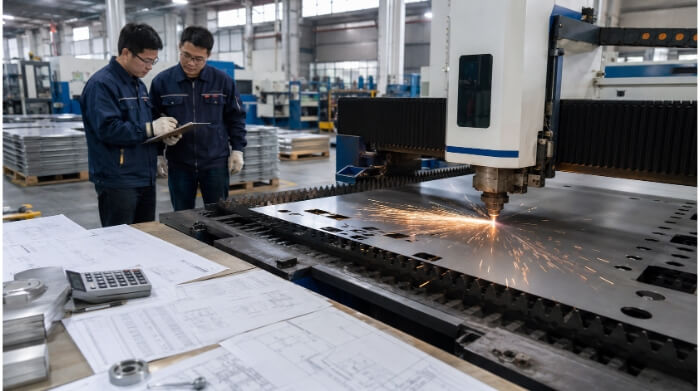
How Laser Cutting Quotes Are Built?
Most sheet metal fabricators calculate quotes using a standardized formula. The primary drivers are the hourly machine rate and raw material costs, factored against the exact time it takes to process the specific part on the shop floor.
Material
Raw material is usually the largest baseline cost, calculated by weight or total sheet area required. Thicker plates and specialized alloys, such as 316 stainless steel, naturally increase the baseline price.
Suppliers also factor in standard sheet sizes. If your part dimensions leave large strips of unused material on a standard 4×8 foot sheet, that unused material is often factored into your quote.
Machine Time
This is the total time the laser is actively running. Industrial fiber lasers have a set hourly operating rate that covers high power consumption, optical component wear, and heavy machine depreciation.
The longer a part stays on the cutting bed, the higher the accumulated cost. A 12kW laser cuts faster than a 6kW machine, but its hourly operating rate is also higher, meaning part geometry dictates which machine is the most cost-effective choice.
Piercing
Piercing is the action of the laser penetrating the solid sheet metal before starting a cut path. Piercing 2mm aluminum takes fractions of a second, but penetrating 15mm carbon steel may take 2 to 3 seconds per hole.
When a part requires dozens or hundreds of internal cutouts, these seconds quickly accumulate into expensive machine time. Excessive piercing also consumes nozzle life and increases maintenance overhead.
Setup
Setup includes programming the toolpath, loading the raw sheet onto the machine bed, and calibrating the focal length. For low-volume orders or single prototypes, this setup time represents a large percentage of the unit price.
As batch quantities increase from 50 to 500 pieces, this fixed cost becomes highly cost-effective because the initial setup is distributed across hundreds of parts.
Assist Gas
Lasers require assist gas to blow molten metal out of the cut kerf. Nitrogen is usually used for stainless steel and aluminum to prevent edge oxidation, but it is expensive. For thicker plates, nitrogen consumption can account for 20% to 30% of the total cutting cost.
Oxygen or compressed air is much cheaper but leaves an oxide layer on the cut edge. This creates a direct manufacturing trade-off: saving on gas upfront may require expensive manual grinding later if the part requires welding or powder coating.
Nesting Scrap
Parts are arranged, or nested, on standard sheet sizes to maximize material utilization. The clearance space required between parts and the remaining offcuts are considered scrap.
If a part has a highly irregular shape that prevents tight nesting, material efficiency drops. The buyer typically absorbs the cost of this unutilized material.
Design Details That Drive Machine Time
Machine time is the most controllable variable for engineers. Small design adjustments can significantly reduce the time the laser head spends moving and cutting.
Cut Path
The overall length of the cut directly dictates the machine time. A long, winding contour requires the laser head to travel further and process longer.
Straight lines and continuous paths process much faster. Consolidating multiple small features into a simpler overall outline is a direct way to reduce time on the bed.
Hole Count
Every individual hole requires the laser head to stop, pierce the material, cut the profile, and move to the next location. A part with 50 small holes takes significantly longer to process than a solid plate of the same outer dimensions.
As a general rule of thumb, hole diameters should not be smaller than the sheet thickness (a 1:1 ratio). Holes smaller than the material thickness often cause blowouts, increasing the scrap rate and adding hidden costs.
Internal Cutouts
Similar to round holes, irregular internal cutouts require individual pierces and separate toolpaths.
Complex cutouts, especially those with tight tolerances, require the machine to operate at lower feed rates to prevent thermal distortion in the surrounding metal. Simplifying these internal geometries allows the laser to maintain optimal speed.
Sharp Corners
When the laser head encounters a sharp 90-degree internal or external corner, the machine must decelerate to change direction and prevent over-burning the material.
Adding a radius of at least 0.5mm, or half the material thickness, allows the machine to maintain a continuous, higher feed rate throughout the contour.
Sheet Thickness
Cutting speed is inversely proportional to material thickness. While a fiber laser cuts 2mm carbon steel rapidly, cutting 10mm plates requires a significantly slower feed rate.
Thicker material also requires longer piercing times and higher gas pressure, compounding the overall machine time cost exponentially rather than linearly.
Material and Gas Choices That Affect Price
The raw material and the specific assist gas required to cut it form a large portion of the base price. Different metals react to the laser beam differently, dictating machine settings and gas consumption.
Carbon Steel
Carbon steel is the most cost-effective base material for general fabrication. It is typically cut using oxygen, which creates an exothermic reaction that speeds up the process on thicker plates.
While the gas cost is low, cutting with oxygen leaves an oxide layer on the edge. This layer often must be removed mechanically before painting or welding, adding secondary labor costs.
Stainless Steel
Stainless steel has a higher raw material cost and requires different processing parameters. It is almost always cut with high-pressure nitrogen to prevent oxidation and maintain a clean, corrosion-resistant edge.
This high volume of nitrogen consumption significantly increases the hourly run rate compared to cutting mild steel with oxygen.
Aluminum
Aluminum is lightweight but highly thermally conductive. It dissipates heat rapidly, requiring higher laser power to achieve a clean cut.
Like stainless steel, aluminum relies on nitrogen assist gas to prevent poor edge quality. The combination of high power draw and nitrogen usage keeps processing costs relatively high.
Reflective Metals
Metals like copper and brass are highly reflective. They bounce the laser beam back, which can damage the optical lenses of older machines.
While modern fiber lasers process them safely, cutting copper still requires lower feed rates and specific parameter controls. This slower processing speed directly drives up the machine time cost.
Oxygen, Nitrogen, and Air
Gas selection is a direct trade-off between edge quality and processing cost. Nitrogen guarantees a clean edge ready for immediate welding, but it is expensive.
Compressed air provides a highly cost-effective middle ground. For aluminum sheets under 2mm, using compressed air instead of nitrogen can sometimes slash gas costs by 40% to 50%. It leaves a slightly rougher edge, but it works perfectly for internal structural brackets where cosmetic appearance is not a priority.
DFM Changes That Lower Cost
Engineers can directly lower the quote by optimizing the CAD file for the manufacturing process. However, buyers do not have to solve all of this alone. A dedicated engineering team with 10 years of experience in sheet metal fabrication can proactively run DFM checks on your files.
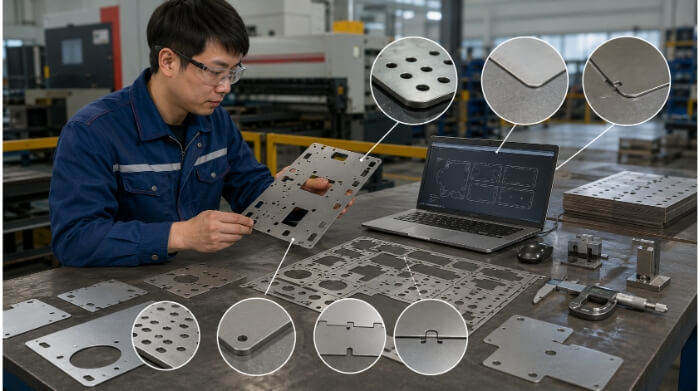
Simpler Profiles
Complex splines and irregular organic shapes require the laser head to constantly adjust speed.
Replacing these intricate contours with standard straight lines and clean arcs allows the CNC controller to process the toolpath faster. A simpler outline means less time on the machine bed.
Standard Holes
Designing parts with multiple different hole sizes requires more complex programming and tooling changes in subsequent operations.
Standardizing hole diameters across the entire part reduces setup friction. As a strict shop rule, never design a hole smaller than the material thickness to avoid blowout and scrap.
Larger Radii
Sharp corners force the machine to decelerate to prevent burning. The actionable DFM step is to proactively apply a standard radius to all internal and external corners.
Adding a radius of at least 0.5mm, or half the material thickness, allows the machine to maintain a constant, high-speed sweeping motion without stopping.
Common-Line Cutting
This programming technique allows the laser to cut a single line shared by two adjacent parts. It eliminates one full cut path and one pierce point for every shared edge.
Common-line cutting works well for simple rectangular panels and grids, directly cutting down active machine time.
Micro-Joints
Small parts under 50mm can tip up and fall through the laser bed grates. This causes machine crashes or requires technicians to manually sort through scrap bins.
Adding 0.5mm micro-joints (tabs) keeps small parts safely attached to the main sheet. This prevents downtime, speeds up the cutting process, and makes unloading predictable.
Better Nesting
Parts with large internal cutouts or awkward L-shapes waste material because other parts cannot fit tightly around them.
If a part has poor nesting efficiency, breaking it down into two simpler flat patterns that bolt or weld together often yields much better overall material utilization.
Costs Beyond Cutting
A laser cutting quote often includes the secondary operations required to finish the flat blank. Modifying the design to minimize these downstream processes is crucial for overall budget control.
Edge Cleanup
Laser cutting sometimes leaves dross or sharp micro-burrs on the bottom edge, especially on thicker plates.
Manual deburring with an angle grinder adds significant direct labor cost. For high-volume production, specifying an automated tumbling or edge-rounding process is more cost-effective than manual grinding.
Bending
Forming requires moving the flat blank to a press brake workstation. Each distinct bend angle requires about 5 to 15 minutes of initial setup, tooling changes, and first-article inspection.
In a batch of 500 parts, eliminating just one unnecessary bend can save hours of labor. If a complex multi-axis bend can be avoided in the design phase, the unit price will drop noticeably.
Threads and Hardware
Tapping threads or inserting PEM fasteners cannot be done by the laser. These are distinct operations requiring specialized equipment and manual handling.
Specifying self-tapping screws in the final assembly or reducing the total number of required hardware inserts lowers the manual handling time on the shop floor.
Welding
Welding is a highly skilled, labor-intensive process. A welded sheet metal assembly also requires custom fixturing to ensure proper alignment before the arc is struck.
Designing flat parts with interlocking tabs and slots creates self-locating joints. This drastically reduces the time required for the welder to set up and clamp the parts.
Surface Finish
Many buyers secure a low laser cutting rate, only to see the bill spike unexpectedly during powder coating or anodizing.
If a part has dozens of tapped holes or precision mating surfaces, workers must manually insert silicone plugs into each hole before spraying. This manual masking labor can quickly eat up the initial savings. Minimizing threaded holes on coated surfaces keeps finishing costs predictable.
Prototype Cost vs Production Cost
The unit price of a single prototype is inherently higher than a mass-produced part. However, the biggest hidden expense for buyers is designing a prototype that cannot be scaled efficiently. Understanding how the cost curve changes helps procurement teams plan for production-ready designs.
Setup Sharing
Setting up the machine, programming the CAM software, and loading the raw sheet takes the same amount of time whether a fabricator cuts one part or 500. For a prototype, that initial setup time is absorbed entirely by one unit. In volume production, this fixed cost is diluted across hundreds of parts, driving the unit price down significantly.
Batch Pricing
When moving into mass production, the laser runs continuously. Automated material handling systems, like tower loaders, allow the machine to operate with minimal manual intervention. This automation reduces the hourly labor burden, making large batches inherently more cost-effective.
Material Buying
Purchasing material for a few prototypes often means buying cut-to-size plates or absorbing the cost of standard sheet offcuts. For production runs, fabricators purchase metal in bulk tonnage. The raw material cost per kilogram drops, and those savings are directly reflected in the final unit price.
Repeat Orders
If a prototype is designed with mass production in mind, moving to high-volume manufacturing is seamless. The CNC programs, DFM optimizations, and inspection templates from the prototype phase are inherited by the production run. This eliminates redundant engineering hours and drastically speeds up the lead time for repeat orders.
Rush Orders
Pushing a project ahead of the standard lead time requires the fabricator to disrupt their scheduled production queue. Breaking down an active machine setup to run a rush job causes machine downtime. Expedite fees are applied to cover this lost efficiency and the overtime labor required to meet the strict deadline.
Quote Review and RFQ Checklist
Evaluating a laser cutting quote requires looking beyond the bottom-line number. Purchasing managers must ensure an “apples-to-apples” comparison. The cheapest initial bid often hides missing services that will cause budget overruns later.
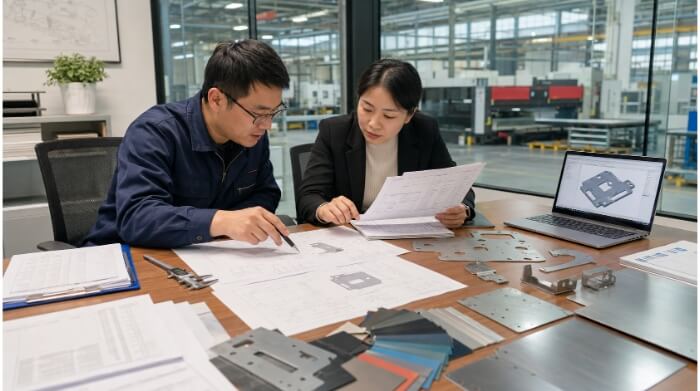
Quote Scope
The cheapest quote is usually the one missing a critical service. For example, Supplier A might bid 10% lower, but their quote delivers raw parts with sharp micro-burrs. Supplier B costs slightly more but delivers a fully deburred part ready for the assembly line. Ensure the quote explicitly states whether secondary operations like edge-rounding, deburring, and hardware insertion are included.
Unit Price
Check the pricing tiers. Fabricators usually provide volume breaks (e.g., pricing for 50, 200, and 1,000 units). Understanding these breakpoints helps buyers adjust their order quantities to hit the most cost-effective tier, rather than ordering a quantity that sits just below a major volume discount.
Material Grade
Confirm the exact material specified on the quote matches the engineering drawing. There is a significant price difference between standard 304 stainless steel and marine-grade 316L. If the part requires strict compliance, request mill test certificates upfront to avoid material failures later.
Tolerance
Standard sheet metal tolerances generally follow ISO 2768-m. If a drawing specifies extremely tight custom tolerances, the fabricator must slow down the laser feed rate and increase manual inspection frequency. This raises the scrap rate and the unit price. Only specify tight tolerances on critical mating dimensions.
Finish
Review the surface finish assumptions. If the part requires powder coating or anodizing, confirm that masking and surface preparation are included in the quote. Missing these details in the RFQ stage guarantees unexpected manual labor charges during final finishing.
Conclusion
Laser cutting cost comes from material, machine time, setup, assist gas, part geometry, batch quantity, and secondary operations. The final number on your quote is a direct reflection of how efficiently your CAD file translates to the physical shop floor.
The best way to reduce cost is not simply to negotiate the bottom line. It is to optimize the design before the laser ever fires. Do not let unoptimized drawings eat into your profit margins.
Before you send out your final RFQ, let an experienced manufacturing partner review your CAD files. At TZR, our engineering team leverages over 10 years of sheet metal fabrication experience to provide actionable DFM reviews. We will point out exactly which sharp corners, hole sizes, or nesting strategies can immediately lower your costs, ensuring you transition seamlessly from rapid prototyping to cost-effective mass production.
FAQs
Why is cutting aluminum more expensive than cutting carbon steel?
Aluminum is highly thermally conductive and reflects laser light, requiring much higher machine power to process cleanly. It also requires nitrogen assist gas to achieve a clean, weld-ready edge, whereas carbon steel is usually cut with cheaper oxygen. This combination of high power draw and expensive gas increases the hourly run rate.
How does material thickness affect the cutting cost?
The relationship between thickness and cost is exponential, not linear. Cutting 10mm steel takes significantly more than twice the time of cutting 5mm steel. Thicker plates require slower feed rates, longer piercing times, and higher gas consumption, compounding the total machine time.
Can I save money by squeezing parts closer together on my drawing?
No. Placing parts too closely causes the thin web of material between them to absorb too much heat. This accumulated thermal stress causes the metal to warp, turning the entire sheet into scrap. Experienced operators and specialized nesting software dynamically adjust the clearance based on material grade and laser power.