 English
  Spanish
  German
  Russian
  Italian
  French
Sandblasting aluminum cleans or finishes the soft metal using low pressure and non-metallic media like glass beads or aluminum oxide to prevent warping. This process prepares the surface for coating or creates a uniform matte finish, requiring immediate sealing or anodizing to prevent rapid oxidation.
This guide explains the key factors that affect aluminum sandblasting. It shows how to match the process with your surface goals. It also explains how to adjust the method based on how the part was made.
Define the Surface Goal Before Blasting
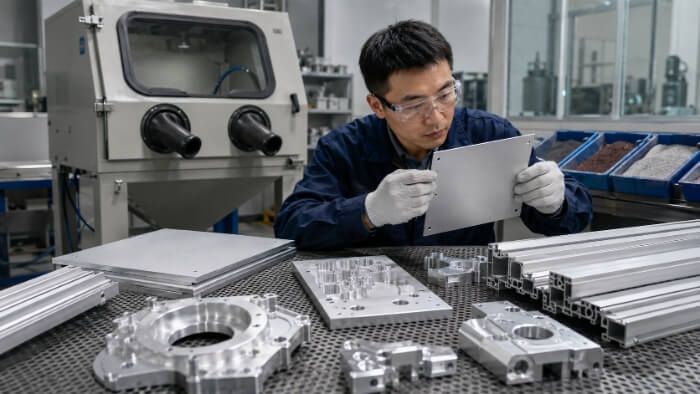
Before selecting parameters or media, it is necessary to identify the primary function of the sandblasting operation. The required outcome directly dictates the necessary equipment settings and abrasive types.
Surface Cleaning
When the objective is simply to remove oxidation, heat scale, or minor residues, mild abrasive action is usually sufficient.
Lower air pressures—typically between 40 to 60 PSI for aluminum—help clear surface contaminants without actively cutting into the softer base material. This is particularly important for softer alloy grades like 5052 or 1100, which are highly sensitive to media embedment.
Matte Finish
For cosmetic applications, sandblasting provides a uniform, non-reflective matte appearance. Achieving a consistent visual finish generally relies on spherical media, which peens the metal surface rather than etching it.
This approach often targets a specific surface roughness, commonly falling within the Ra 1.6 to 3.2 µm range. The final texture heavily depends on the chosen media size—for example, 120 mesh works well for a fine satin finish, while 60 mesh is used for a heavier, more distinct texture.
Coating Preparation
If the aluminum part will receive paint or a powder coating, the surface requires a mechanical profile to ensure proper adhesion. Angular media is usually used in this context to etch the surface.
This etching increases the total surface area and provides a mechanical “tooth” (known as the anchor profile) that allows the subsequent coating to bond securely to the substrate.
Pre-Anodizing Texture
A common misconception is that anodizing hides surface defects. In reality, the chemical process often makes existing scratches or CNC tool marks more visible.
Sandblasting the aluminum before the anodizing bath helps homogenize the surface texture. It blends minor inconsistencies and creates a uniform baseline, ensuring an even appearance across the final anodic layer.
Match the Process to the Aluminum Part
The geometry, thickness, and original manufacturing method of the aluminum part significantly influence how it responds to the blasting process. Setup and handling must be adjusted based on the part’s structural characteristics.
Sheet Metal Panels
Sheet metal components are highly susceptible to warpage during sandblasting. The physical impact of the abrasive media introduces compressive stress on the blasted side of the metal.
For aluminum panels under 1.5mm (0.060 inches) in thickness, this uneven stress often causes the panel to bow or distort. To mitigate this risk, facilities lower the blast pressure, blast both sides of the panel to equalize internal stress, or use dedicated backing fixtures during the process.
CNC Machined Parts
For precision machined components (like 6061-T6 aluminum parts), the primary engineering concern is maintaining dimensional tolerances. Sandblasting inherently alters the surface profile and removes slight amounts of material.
Critical features—such as tapped holes, bearing bores, and sealing faces—almost always require custom masking. Facilities typically use silicone plugs, Kapton tape, or custom 3D-printed masking fixtures to protect these areas, which adds manual labor but prevents functional failure.
Extruded Profiles
Aluminum extrusions naturally exhibit longitudinal die lines generated during the extrusion process.
Sandblasting is frequently used to blend these directional lines and create a uniform, non-directional texture across the length of the profile. This is a standard preparatory step before architectural anodizing or powder coating.
Cast Aluminum
Cast aluminum parts usually start with rougher surfaces and may feature mold scale, porosity, or parting line flash.
Depending on the casting method (die cast vs. sand cast), a slightly more aggressive blasting setup may be necessary. This ensures the surface is thoroughly cleaned and prepared for secondary CNC machining or final finishing.
Choose Media Based on Surface Risk
Selecting the correct abrasive media is the most critical decision in aluminum sandblasting. Because aluminum is relatively soft, the wrong media can quickly remove functional material or cause surface contamination.
Glass Bead
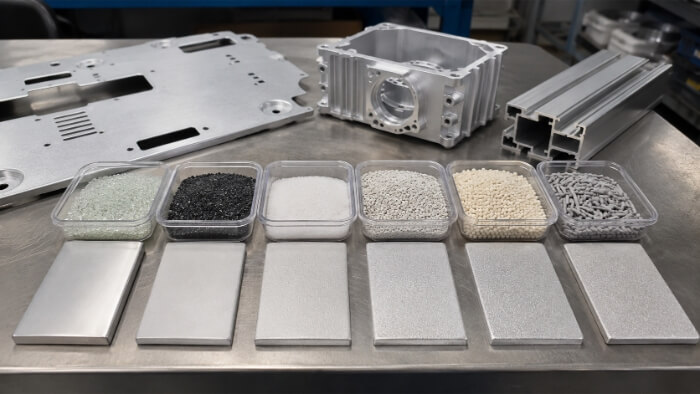
Glass beads are spherical and non-abrasive in their cutting action. Instead of etching the aluminum, they peen the surface upon impact.
This media works well for achieving a smooth, satin, or matte cosmetic finish. Because glass beads do not aggressively remove the base metal, they are usually the safest choice for parts where maintaining general dimensional accuracy is required.
Aluminum Oxide
Aluminum oxide is highly angular and aggressively cuts into the metal due to its high Mohs hardness. It is primarily used when the surface requires a deep anchor profile for subsequent heavy coatings.
Due to its cutting action, aluminum oxide will alter part dimensions and surface tolerances. It is not recommended for delicate features unless strict masking and pressure controls are applied.
Plastic Media
Plastic abrasives (such as urea or acrylic) are relatively soft and provide a very gentle cleaning action.
This type of media is usually used for stripping paint or powder coating from existing aluminum parts without altering the underlying metal. It is highly valued in aerospace or automotive rework where the original surface geometry must remain completely intact.
Steel Grit Risk
Using steel grit or steel shot on aluminum is a severe manufacturing error.
When steel media impacts soft aluminum, microscopic iron particles embed themselves into the surface. When exposed to moisture, these iron particles rust, leading to galvanic corrosion that actively degrades the aluminum part. Facilities processing aluminum must strictly isolate their media from steel-blasting operations.
Control Pressure and Exposure
Even with the correct media, poor manual technique or incorrect machine settings can ruin an aluminum component. Process control relies on standardizing several variables.
Air Pressure
As noted earlier, aluminum requires lower blasting pressures compared to steel. Operating outside the 40 to 60 PSI baseline increases the risk of part warpage and media embedment.
If a part is not getting clean at 60 PSI, operators should evaluate the media condition or type rather than simply increasing the air pressure.
Nozzle Distance
The distance between the blast nozzle and the part surface dictates the impact force and coverage area.
A standard standoff distance of 6 to 8 inches is generally recommended for aluminum. Moving the nozzle too close concentrates the impact, which may cause localized denting or uneven surface textures.
Dwell Time
Dwell time refers to how long the abrasive stream stays on one specific area. Aluminum’s softness means material removal happens quickly.
Operators must keep the nozzle moving at a consistent pace. Pausing or lingering in one spot will create visible depressions or inconsistent roughness that becomes highly visible after anodizing.
Media Condition
Abrasive media breaks down and shatters over time. As glass beads shatter, they become angular; as aluminum oxide breaks down, it turns into fine dust.
Using degraded media results in an inconsistent surface finish. Facilities must rely on proper dust collection and cyclone separation systems to automatically cycle out broken particles and maintain a consistent Ra value across production batches.
Protect Tolerances and Critical Features
Protecting specific areas from the sandblasting process is a standard requirement for functional engineering parts. However, masking adds manual labor, which directly impacts the unit cost.
Thin Panel Warpage
While pressure control helps, sometimes it is not enough to prevent thin panels from warping.
When structural distortion threatens the overall flatness tolerance, operators must use physical backing plates or dedicated rigid fixtures to support the sheet metal from behind while the front face is blasted.
Threaded Holes
Sandblasting will destroy the fine profile of machined threads or pack the holes with abrasive dust.
All threaded features must be protected. The industry standard is to insert reusable silicone plugs into the holes before blasting. This ensures bolts and fasteners will thread correctly during final assembly.
Sealing Faces
Surfaces meant for O-rings, gaskets, or vacuum seals require a specific, usually very smooth, surface finish to prevent leaks.
These flat critical zones are typically masked using heavy-duty vinyl or Kapton tape. Even minor scuffing from stray abrasive can compromise the seal’s integrity.
Masking Zones
When specifying parts, engineers should clearly define masking zones on the 2D drawing. From a purchasing perspective, it is important to note that complex masking requirements drive up labor costs.
For rapid prototyping or low-volume runs, manual taping is standard. However, if the project scales to mass manufacturing, allowing non-critical areas to be blasted is more cost-effective. For critical zones in high-volume production, developing custom 3D-printed or molded masking fixtures replaces manual taping, significantly reducing unit cost and lead times.
Prepare the Surface for the Next Finish
Sandblasting is rarely the final step. It is usually a preparatory phase, meaning the blasted surface must be handled carefully to ensure the success of the final coating.
Powder Coating and Wet Painting
Both powder coating and wet painting rely heavily on the mechanical anchor profile created by angular media, such as aluminum oxide, to ensure proper adhesion.
However, because wet paint layers are typically much thinner than powder coats, the abrasive mesh size must be strictly matched to the specified coating thickness. An overly aggressive blast profile will easily show through a thin wet paint job, ruining the final cosmetic appearance.
Regardless of the coating method, freshly blasted aluminum is highly reactive and prone to picking up skin oils. Parts must be handled only with clean gloves and moved to the coating line quickly to prevent premature oxidation or adhesion failures.
Anodizing
Anodizing chemically converts the aluminum surface. Any inconsistency in the sandblasted finish will be permanently locked in and often magnified by the anodic layer.
A uniform blast is critical. Glass beads are usually preferred here to provide a consistent, diffuse satin finish that takes the anodizing dye evenly.
Residue Removal
After blasting, aluminum parts are covered in fine abrasive dust. If this dust enters the anodizing bath or sits under a powder coat, it causes blistering and process contamination.
Thorough residue removal is mandatory. This is usually achieved through high-pressure compressed air blow-offs, followed by industrial ultrasonic cleaning or deionized (DI) water rinses to ensure a completely sterile surface.
Color Consistency
For cosmetic parts produced in batches, visual consistency is a major quality metric.
Variations in blasting air pressure, media wear, or operator technique will change how the aluminum reflects light. Even if parts go through the exact same color anodizing bath, differences in the underlying sandblasted texture will make the final parts look like different shades of color. Controlling the blast process is the only way to ensure color matching across an assembly.
Confirm Quality Before Production
To avoid disputes and expensive rework, quality expectations must be aligned before mass production begins. Words like “matte” or “smooth” are subjective. A structured approval process translates subjective descriptions into measurable manufacturing standards.
Approved Sample
The most reliable way to align on visual expectations is to create a physical “golden sample.” Before launching a full production run, the manufacturer should process a test piece using the agreed-upon media and pressure.
For mass production, it is highly recommended to establish “limit samples”—one physical sample showing the maximum acceptable roughness, and another showing the minimum acceptable smoothness. Establishing these physical boundaries prevents subjective rejections on the shop floor and stabilizes batch quality.
Surface Roughness
Visual inspection is not always enough, especially for functional surfaces. Engineers should define the required surface roughness using an Ra (Average Roughness) value.
Facilities use a digital profilometer to measure the Ra value of the blasted surface. This ensures the mechanical profile is exact enough to meet coating adhesion requirements without exceeding dimensional tolerances.
Visual Defects
Operators must inspect the blasted surface under standardized lighting for process-induced defects.
Common visual failures include “shadowing” (darker areas where the blast angle was inconsistent) and “hot spots” (depressions caused by lingering too long in one place). A properly blasted aluminum part should reflect light evenly across all exposed geometry.
Media Embedment
As discussed, aluminum’s soft nature makes it highly susceptible to trapping broken abrasive particles.
Inspectors often check for embedment using magnification or by running a gloved hand over the surface to feel for unnatural grittiness. If embedment is detected, the facility must review its blast pressure or replace degraded media before it ruins the subsequent anodizing or coating process.
Specify Cost, Quality, and Drawing Requirements
A manufacturing drawing is a legal contract. Vague notes like “sandblast to clean” leave the process open to interpretation, which often leads to inconsistent results and hidden costs.
Material Grade
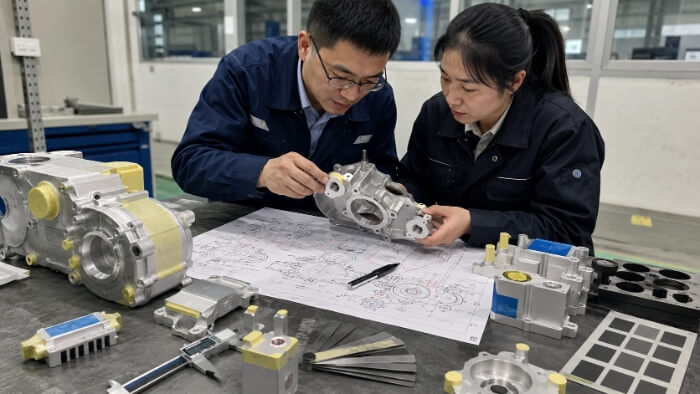
Different aluminum alloys react differently to abrasive impact. For example, 6061-T6 is relatively hard and machines well, while 5052 is softer and more prone to warpage and embedment.
Always specify the exact aluminum grade on the drawing. This tells the shop floor exactly how to adjust their air pressure and media selection to handle the specific material properties safely.
Media Type
Do not leave media selection up to the operator. If you need a cosmetic finish, specify the exact media and size.
A clear engineering callout should look like this: “Sandblast overall using 120 mesh glass beads at 40-50 PSI.” This eliminates guesswork and ensures batch-to-batch repeatability.
No-Blast Areas
If certain features must remain untouched, clearly define them. Use standard drafting techniques, such as hatching or explicit leader lines, to denote masking zones. Note clearly: “Mask tapped holes and bearing bores before blasting.”
Remember that excessive masking increases manual labor, so only protect areas where dimensional accuracy is strictly required.
Pro DFM Tip: Whenever possible, design tapped holes and bearing bores to standard sizes. This allows the manufacturer to use off-the-shelf, reusable silicone plugs, significantly reducing masking labor costs compared to custom taping or custom-molded fixtures.
Inspection Standard
Define what constitutes a passed part.
Specify whether the inspection is purely visual against the approved limit samples, or if it requires a documented profilometer report for the Ra value. Clear inspection standards prevent delays at the quality control checkpoint.
Conclusion
Aluminum sandblasting is not just a cleaning step. It physically alters the surface condition, internal stress, and dimensional accuracy of the part.
A successful outcome depends on correctly matching the blasting media, air pressure, and masking strategy to the part’s geometry and final finish requirements. For production parts, the safest approach is to lock in the surface goals, clearly define the protected areas, and establish physical quality standards before blasting begins.
When you need trustworthy solutions for your customized products, TZR’s team of engineers brings over 10 years of experience in sheet metal fabrication and CNC machining to support your project from prototype to mass production. We prioritize establishing trust, maintaining strict quality standards, and ensuring efficient production times to deliver the exact finish your aluminum components require.
FAQs
Does sandblasting remove material from aluminum?
Yes. While media like glass beads primarily peen the surface, angular media like aluminum oxide will actively cut and remove a thin layer of the base metal. Critical tolerances must be masked to prevent dimensional changes.
Can you sandblast anodized aluminum?
Yes, sandblasting can strip an existing anodized layer. However, because the anodic coating is much harder than the underlying raw aluminum, removing it requires aggressive media and higher pressure. This process will alter the original dimensions of the part.
Why does my sandblasted aluminum part look patchy after anodizing?
Patchiness or “shadowing” after anodizing is almost always caused by an inconsistent sandblasting process. Fluctuating air pressure, worn-out media, or uneven operator technique creates varying surface textures that absorb the anodizing dye differently.
How do I stop thin aluminum panels from warping during blasting?
Warpage is caused by the compressive stress of the media hitting one side of a soft, thin panel. To prevent this, operators must lower the blast pressure, use dedicated backing fixtures to support the sheet metal, or carefully blast both sides to equalize the internal stress.