 English
  Spanish
  German
  Russian
  Italian
  French
Coating delamination and warped sheet metal panels rarely start in the paint booth—they typically originate in the blast cabinet. When a finished part fails standard adhesion tests, or thin-gauge materials permanently distort, improper aluminum oxide sandblasting parameters are often the root cause.
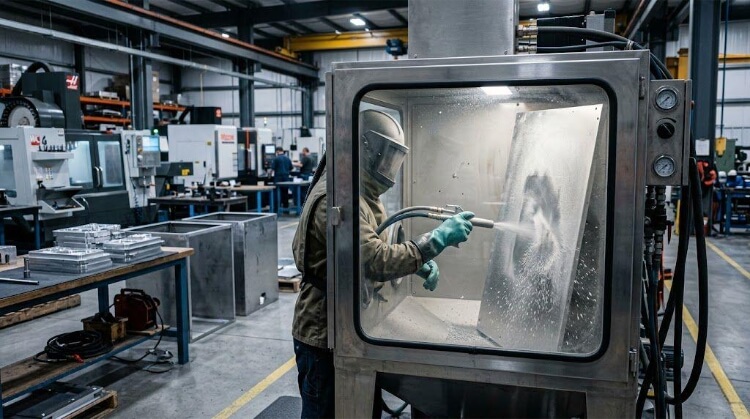
Sandblasting with aluminum oxide is a premium, high-efficiency surface profiling method. Leveraging its exceptional hardness and sharp-edged geometry, it rapidly eliminates mill scale, oxide layers, and tough coatings, creating an optimal micro-roughness profile that guarantees maximum mechanical adhesion for subsequent anodizing or powder coating.
In our daily sheet metal fabrication and CNC machining operations, theory doesn’t prevent warped parts—strict parameters do. Here are the exact grit sizes, PSI limits, and oxidation controls we use on the shop floor to secure a repeatable finish and avoid rework.
Choosing the Right Aluminum Oxide Media
Selecting the wrong abrasive type or size directly impacts cycle times and final surface uniformity. Aluminum oxide is highly efficient at removing material, but its specifications must align closely with the substrate hardness and the intended downstream process.
Brown vs. White Alumina
Industrial aluminum oxide generally falls into two categories based on purity. Brown fused alumina contains trace amounts of titanium and iron. It is highly durable, shatters less easily upon impact, and is usually used for general metal preparation, such as deburring machined parts or stripping mill scale.
White fused alumina is highly pure (typically over 99% alumina) and more friable, meaning it fractures upon impact to expose new sharp edges. It breaks down faster than brown alumina but leaves a chemically clean surface. This media works well for aerospace components or specific aluminum assemblies where trace iron contamination may cause localized corrosion or interfere with subsequent welding.
Grit Size Selection
Grit size dictates the depth of the resulting anchor profile. A coarse 60 to 80-grit media is typically specified for heavy material removal, such as stripping thick paint or preparing steel surfaces for heavy powder coating.
For finer cosmetic finishes, or preparation prior to anodizing, 120 to 220-grit is standard. Larger grit sizes remove material faster but increase the risk of altering dimensional tolerances on precision CNC parts. Selecting the appropriate grit is a balance between required surface roughness and preserving the part’s engineered geometry.
Media Hardness and Cutting Behavior
At 9.0 on the Mohs hardness scale, aluminum oxide is an angular abrasive that cuts into the substrate rather than peening or hammering it. This micro-shearing action effectively removes surface contaminants and creates a microscopic peak-and-valley texture known as an anchor profile.
While this aggressive behavior is highly efficient for mechanical adhesion, it requires careful control. If not monitored, it can easily over-etch softer materials like 6061 aluminum alloy or brass, degrading the surface quality before coating.
Optimizing Aluminum Oxide Sandblasting Parameters
Operating parameters must be calibrated to the specific part geometry and material gauge. Relying on default machine settings often leads to localized over-etching, uneven surface appearances, or severe dimensional distortion.
Air Pressure Control
Higher pressure does not automatically translate to better efficiency. For standard carbon steel plates, pressures up to 80 PSI or higher may be used to achieve a deep profile.
However, for softer alloys or thin-gauge materials, the pressure typically ranges from 40 to 60 PSI. Operating at excessive pressures accelerates media breakdown, increases dust generation, and raises the likelihood of driving abrasive particles deep into the metal substrate.
Nozzle Distance and Angle
The distance between the nozzle and the workpiece generally ranges from 6 to 12 inches, depending on the nozzle size and air pressure. Holding the nozzle too close concentrates the impact force, which may cause uneven texturing and localized heat buildup.
The angle of impingement also affects cutting efficiency. A 45 to 60-degree angle is usually used to shear off old coatings or scale effectively. Blasting at a direct 90-degree angle reduces the shearing action, increases the risk of media embedment, and introduces higher compressive stress into the part.
Pass Overlap and Coverage
Achieving a uniform surface requires consistent pass overlap. Operators and automated systems typically aim for a 50% overlap on each pass. This ensures a 100% visual coverage rate, eliminating un-profiled areas that could lead to coating adhesion failures.
Inconsistent sweeping motions often result in a striped or mottled appearance. This inconsistency remains visible and can ruin the aesthetic, especially under thin clear-coats or after anodizing processes.
Thin Sheet Warping Risk
Peening stress is a critical concern in sheet metal fabrication. When high-velocity abrasive hits a thin metal surface, it introduces compressive stress on that side. On materials under 3mm (0.118 inches) in thickness, this stress release may cause the part to bow or warp permanently.
To mitigate this risk during production, operators should lower the air pressure, increase the standoff distance, and select a finer grit size. In many cases, sweeping both sides of the panel symmetrically is necessary to balance the introduced stress and maintain panel flatness.
Controlling Surface Finish and Adhesion
Surface preparation goes beyond simply cleaning a part. The mechanical texture left by aluminum oxide dictates how well a coating will stick and how the final product will look. Failing to control the blasting process here often leads to rejected batches due to peeling paint or uneven visual textures.
Anchor Profile
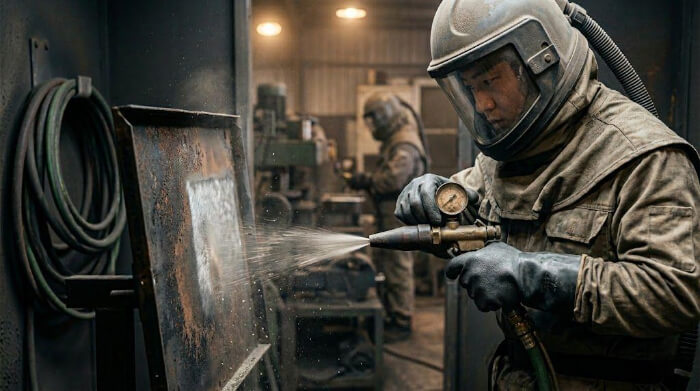
The anchor profile is the microscopic pattern of peaks and valleys created on the metal surface. This texture provides the mechanical interlock necessary for heavy coatings to adhere securely to the substrate.
For standard powder coating applications, manufacturers typically target an anchor profile depth of 1.5 to 2.5 mils (38-63 microns). If the profile is too shallow, the coating may delaminate under stress; if it is too deep, the peaks of the metal may poke through thin coatings, leading to pinpoint rust.
Matte Finish Formation
In cosmetic applications, engineers often specify a blasted finish to remove machining marks and create a uniform, non-reflective appearance. Because aluminum oxide is highly angular, it leaves a dull, flat matte finish rather than a bright, satin look.
To achieve a consistent cosmetic matte finish, operators usually drop the air pressure and use a finer abrasive, such as 120 to 220-grit. Sweeping the gun at a consistent distance and speed is critical here, as any hesitation will create a visibly darker “hot spot” on the final surface.
Coating Adhesion Performance
While an aggressive anchor profile improves mechanical grip, the surface must also be chemically clean for optimal adhesion. Blasting with aluminum oxide effectively strips away mill scale, laser-cut oxidation, and old paint, exposing the raw, active metal underneath.
However, the blasting process itself leaves behind a fine layer of abrasive dust. Before moving to the paint booth, parts must be thoroughly blown down with dry, compressed air or processed through a chemical wash. Any residual dust left in the micro-valleys will act as a barrier, causing the coating to fail standard adhesion tests, such as the ASTM D3359 cross-hatch test.
Anodizing Surface Preparation
Unlike thick powder coatings, anodizing is an electrochemical process that converts the metal surface into an oxide finish. It does not hide surface defects; it amplifies them. Heavy scratches left by coarse blasting will remain highly visible after the anodizing process is complete.
When preparing aluminum alloys like AL6061 or AL7075 for anodizing, it is essential to use fine, pure white fused alumina (150-grit or finer). This prevents trace iron contamination—which can cause black spots during the anodizing bath. Unlike paint, anodizing cannot simply be sanded off and redone. A contaminated blasted surface often means the CNC machined part must be completely scrapped or stripped, causing severe production delays and material waste.
Troubleshooting Alumina Blasting Defects
Even with the correct media and parameters, shop-floor variables can introduce defects that ruin the final product. Identifying these risks early reduces rework, minimizes scrap rates, and stabilizes production quality.
Embedded Abrasive Particles
When blasting softer metals like AL5052, copper, or brass, high-velocity aluminum oxide particles can shatter on impact and embed themselves directly into the substrate. This microscopic embedment creates a flawed surface layer.
If a coating is applied over embedded media, it often leads to blistering or localized galvanic corrosion in the field. To prevent this, operators should lower the blasting pressure to 40 PSI or below, or follow up the primary blasting step with a gentle glass bead sweep to dislodge trapped particles without altering the profile.
Flash Rust After Blasting
Raw carbon steel and iron alloys (such as Q235 or A36) become highly reactive immediately after blasting. The removal of all protective mill scale exposes the bare metal to ambient moisture, causing flash rust to form rapidly.
To prevent this, humidity in the blasting and storage areas must be strictly controlled, ideally kept below 50%. Additionally, operators must wear clean, dry gloves when handling blasted parts, as the natural oils and salts from bare hands will instantly trigger oxidation spots on the fresh metal.
Oxidation Window Timing
A blasted surface has a strict “shelf life.” Once blasted, the passive oxide layer on metals like aluminum and stainless steel begins to reform naturally upon exposure to air, which gradually reduces the chemical bonding potential for primers and conversion coatings.
In standard manufacturing practices, blasted parts should be moved to the next finishing stage (whether powder coating, painting, or chemical conversion) within 4 to 8 hours. If parts are left exposed on the shop floor overnight or over a weekend, they usually require a light re-blast to guarantee adhesion.
Surface Contamination
A frequent cause of adhesion failure is cross-contamination from the abrasive media itself. If a shop uses the same blast cabinet to strip greasy, oil-soaked parts and then blasts clean aluminum components, the media will transfer the oil directly into the pores of the clean metal.
To avoid this, oily parts must go through a degreasing wash before they enter the blast cabinet. Furthermore, facilities processing different metals must dedicate specific media hoppers to specific materials. If oil-contaminated media is used, the trapped oil will outgas during the high-temperature curing process in the powder coat oven, causing “fish-eyes” (craters) and blistering in the final finish.
Aluminum Oxide vs. Alternative Sandblasting Media
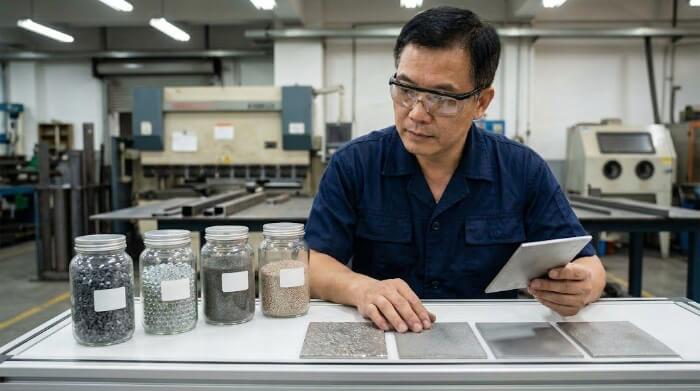
While aluminum oxide is highly versatile, it is not always the optimal choice. Understanding the mechanical limits of different abrasives allows engineers to specify the correct media for delicate jobs or high-volume structural work, preventing both part damage and unnecessary processing costs.
Glass Beads (Low Damage Finishing)
Glass beads operate on a completely different mechanical principle. Because they are spherical rather than angular, they do not cut into the metal. Instead, they impact the surface, peening the metal and creating a dimpled, bright satin finish rather than a dull matte texture.
This media works well for cosmetic finishing on CNC-machined aluminum parts or for closing surface pores to improve corrosion resistance. It is the preferred choice when an operator needs to clean light machining marks without altering the critical dimensional tolerances of a precision component.
Plastic Media (Non-destructive Stripping)
Plastic abrasive is relatively soft, typically ranging from 3.0 to 4.0 on the Mohs scale. It is designed to strip away paint, primers, and powder coatings without etching or profiling the underlying metal substrate.
This non-destructive property makes plastic media standard for stripping aerospace components, fiberglass, or extremely thin automotive panels. When processing assemblies where preserving the exact original geometry and surface smoothness is strictly required, plastic media eliminates the risk of substrate erosion that aluminum oxide would cause.
Garnet and Steel Grit (Heavy Duty Cleaning)
For heavy structural steel (such as Q235 or Q345) or thick weldments, using aluminum oxide at high volumes may become cost-prohibitive. Steel grit provides extreme durability and is the standard for closed-loop systems processing heavy carbon steel, as it can be recycled hundreds of times.
Garnet, on the other hand, is a naturally occurring mineral that cuts similarly to aluminum oxide but is generally cheaper. It is often used in outdoor or open-air sandblasting operations—like shipyard maintenance or large pipe yards—where the media cannot be practically recovered and recycled.
Reducing Costs in Sandblasting Operations
Procurement teams often focus on the initial price per pound of abrasive, but the true cost of a sandblasting operation lies in media consumption rates, air compressor energy, and equipment wear. Optimizing these factors significantly lowers the long-term operational budget.
Media Reuse Cycles
Aluminum oxide has a higher initial purchase price compared to mineral slags or crushed glass, but it is highly cost-effective when properly reclaimed. High-quality brown fused alumina can typically be recycled 10 to 15 times before the grains fracture into unusable dust.
To achieve this lifecycle, the facility must utilize a closed-loop blast cabinet or blast room. If the reclamation system is properly calibrated, the cost-per-cycle of aluminum oxide drops significantly, making it far more economical for continuous manufacturing than cheaper, single-use abrasives.
Consumption Rate Control
Running a blast gun at excessive air pressures (above 80 PSI for standard applications) causes the hard alumina grains to shatter instantly upon impact with the metal. This drastically increases the consumption rate without providing a proportional increase in cleaning speed.
Dropping the pressure to the optimal range for the specific substrate (e.g., 50 to 60 PSI for aluminum panels) preserves the integrity of the abrasive grains for multiple passes. This simple parameter adjustment directly lowers monthly media purchasing costs and reduces the burden on dust collection systems.
Dust Collection Efficiency
A media reclaim system is only as effective as its dust collector. The cyclone separator is responsible for pulling fractured, spent dust out of the abrasive mix while returning the good, reusable grit to the hopper.
If the filter cartridges are clogged or the cyclone is poorly tuned, fine dust remains mixed with the good media. Blasting with a dust-heavy mix acts as a cushion, significantly slowing down the cutting action, reducing operator visibility, and leaving a film of dust on the workpiece that compromises subsequent coating adhesion.
Nozzle Wear and Maintenance
Because aluminum oxide is incredibly hard and sharp, it aggressively wears down the internal bore of the blasting nozzle. A worn nozzle with an enlarged inner diameter consumes significantly more compressed air—often increasing CFM (Cubic Feet per Minute) requirements by 20% to 30%—and creates an erratic, inefficient blast pattern.
For aluminum oxide applications, standard ceramic nozzles wear out rapidly and should be avoided for high-volume work. Upgrading to boron carbide or tungsten carbide nozzles is highly recommended. While they carry a higher upfront cost, they hold their internal dimensions for hundreds of hours, ensuring consistent process control and saving on expensive air compressor energy.
Conclusion
Surface preparation with aluminum oxide is a highly effective process, provided it is treated with the same level of engineering control as any machining or forming operation. By strictly managing grit selection, air pressure, and equipment maintenance, manufacturers can eliminate the variables that lead to warped sheet metal, flash rust, and coating adhesion failures.
At TZR, we understand that high-quality manufacturing requires precision at every stage—from the initial laser cut to the final surface finish. If you are looking for a reliable manufacturing partner that understands the technical realities of the shop floor, contact us today to discuss your next project.
FAQs
Does blasting aluminum with aluminum oxide cause it to rust?
No, aluminum oxide is an inert, non-metallic abrasive, so it will not cause rust. However, if you use lower-purity brown fused alumina on sensitive aluminum parts, trace iron content may cause dark spots, especially during anodizing.
What is the best grit size for preparing aluminum for powder coating?
For general powder coating on aluminum, an 80 to 120-grit aluminum oxide is standard. This creates a sufficient anchor profile (typically 1.5 to 2.5 mils) for the powder to adhere mechanically without excessively altering the part’s surface dimensions.
How can I tell when the aluminum oxide media needs to be replaced?
You should replace or replenish the media when you notice a significant drop in cutting speed, excessive dust in the blast cabinet reducing visibility, or when the blasted surface appears polished rather than uniformly matte. A well-tuned cyclone separator will automatically remove the spent dust, requiring you only to top off the hopper with fresh media.
Should I use dry sandblasting or wet blasting with aluminum oxide?
Dry blasting is the industry standard for fast, heavy material removal and creating a deep anchor profile. Wet blasting (or vapor blasting) mixes the aluminum oxide with water. It is slower but eliminates up to 90% of static dust, keeps the part cooler to prevent warping, and leaves a remarkably clean, grease-free surface. We often recommend wet blasting for precision CNC machined parts where dust contamination must be strictly avoided.