 English
  Spanish
  German
  Russian
  Italian
  French
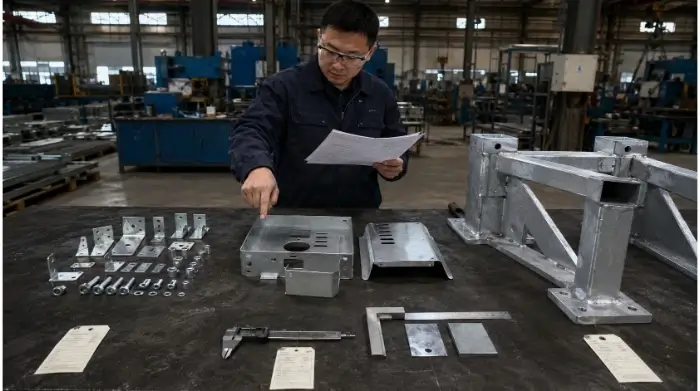
The main difference between hot-dip and electro-galvanizing is coating thickness and application. Hot-dip galvanizing immerses steel in molten zinc for a thick, weather-resistant layer. Electro-galvanizing uses an electrical current to deposit a thin, smooth zinc layer, ideal for tight-tolerance, indoor precision parts.
While the chemical element is the same, specifying the wrong zinc process causes real problems on the shop floor. For example, hot-dip galvanizing can easily fill internal machined threads with excess zinc and warp thin sheet metal enclosures. Conversely, electro-galvanized parts deployed in coastal environments will quickly develop red rust due to their thin barrier.
To help you avoid assembly failures and unnecessary rework, this guide breaks down the core differences in coating structure, tolerance impacts, and overall manufacturing costs.
Quick Decision Matrix
| Coating Route | Typical Thickness* | Surface Appearance | Edge and Weld Coverage | Tolerance Impact | Suitable Environment | Typical Production Route | Relative Total Cost |
| Electro-Galvanized (Post-fab) | 5 – 15 µm | Smooth, uniform, bright or matte | Full coverage on finished part | Minimal | Indoor, mild controlled environments | Cut → Bend → Weld → Electroplate | Low for high volume, small parts |
| Pre-Galvanized Sheet | 10 – 20 µm | Smooth, uniform spangle | None on cut edges; damaged at welds | None (accounted for in raw material) | Indoor enclosures, moderate environments | Coated Sheet → Cut → Bend → Weld → Local Repair | Low for large sheet metal runs |
| Hot-Dip Galvanized (Post-fab) | 45 – 100+ µm | Variable, matte, textured, or spangled | Full coverage on finished part | High (threads and tight fits require compensation) | Outdoor, harsh marine or industrial | Cut → Bend → Weld → Clean → Hot-Dip | Higher initial, very low lifecycle cost |
*Actual thickness requirements must be specified according to relevant industry standards (e.g., ASTM, ISO) and called out on technical drawings.
Zinc Coating Options Before and After Fabrication
Before evaluating technical performance, you must clarify the supply chain route. Procurement can specify zinc coatings on raw material, on individual machined components, or on fully welded assemblies. Confusing these routes guarantees manufacturing errors.
Electro-Galvanized Parts and Sheet
Electro-galvanizing relies on electrochemical zinc deposition. The part is placed in a chemical bath, and an electrical current drives zinc ions to bond with the steel. This process results in a very thin, tightly controlled coating. Small fasteners are usually processed via barrel plating, while larger or delicate parts use rack plating.
The resulting surface is smooth, making it ideal for precision hardware and cosmetic applications. The process is frequently followed by chemical passivation and sealing to increase baseline corrosion resistance. Note that electro-galvanizing can be purchased as raw pre-coated steel coils or applied as a post-machining finishing service.
Pre-Galvanized Sheet
Pre-galvanized material (often specified under standards like ASTM A653) is produced at the steel mill by running a continuous coil through a zinc bath.
Key Process Note: Pre-galvanized sheet is coated before the part is manufactured.
When a fabricator processes this material, the manufacturing sequence is typically: punching or laser cutting, followed by bending, and then welding. Consequently, the zinc coating is physically removed at the cut edges. The heat from welding will also burn away the coating around the joint. Bare laser-cut edges and weld zones require local repair—usually via zinc-rich paint or cold galvanizing spray—to prevent early corrosion.
Post-Fabrication Hot-Dip Galvanizing
Batch hot-dip galvanizing follows an entirely different sequence.
Key Process Note: The completed fabrication is galvanized as one single part.
The production route involves cutting, bending, and welding the raw black steel first. The entire welded assembly is then chemically cleaned, fluxed, and immersed in a kettle of molten zinc (typically at 450°C). Because it is dipped after fabrication, the molten zinc flows into hidden corners and completely encapsulates all cut edges and weld seams. However, this route is constrained by the physical dimensions of the galvanizing kettle and lifting limits. Designers must also incorporate specific venting and drainage holes to prevent trapped zinc, hollow section warping, or dangerous steam explosions in the kettle.
Electro-Galvanized vs. Hot-Dip Galvanized Performance
Coating performance is dictated by how the zinc bonds to the base steel and the resulting micro-structure. Do not rely on performance data without specifying the exact fabrication route.
Thickness and Coating Structure
Electro-galvanizing deposits a thin layer of pure zinc on the surface of the steel. Hot-dip galvanizing creates a metallurgical bond, forming multiple layers of hard zinc-iron alloys topped by a layer of pure zinc.
- Electro-galvanized thickness: Typically ranges from 5 to 15 µm (specified via standards like ASTM B633).
- Hot-dip galvanized thickness: Typically ranges from 45 to 100+ µm (specified via standards like ASTM A123 for structural steel or ASTM A153 for hardware).
A thinner coating does not mean poor quality, and a thicker coating is not automatically better for every project. The actual thickness depends on the requested coating class, bath immersion time, and the steel chemistry. For instance, high silicon and phosphorus content in the base steel will cause a hot-dip galvanized coating to grow excessively thick, resulting in a brittle, dark grey finish.
Corrosion, Edge, and Wear Protection
Both methods provide barrier protection (physically blocking moisture) and sacrificial protection (the zinc corrodes before the underlying steel).
Because electro-galvanized layers are thin and softer, they are more susceptible to abrasion during transport and installation. In standard Salt Spray Tests (ASTM B117), basic electro-galvanized parts may show red rust within 48 to 96 hours.
Post-fabrication hot-dip galvanizing offers high abrasion and impact resistance because the internal zinc-iron alloy layers are actually harder than the base steel. A standard HDG coating can endure hundreds to thousands of salt spray hours.
When evaluating edge protection, you must separate pre-galvanized sheet from post-fabrication plating. Post-fab electro-plating and post-fab HDG both coat all cut edges. Pre-galvanized sheet leaves cut edges exposed. While the surrounding zinc provides slight cathodic protection across narrow cuts, any significant bare edge or weld zone will eventually rust if not manually repaired.
Surface Finish and Paintability
Electro-galvanizing produces a highly consistent, smooth surface, which aligns well with cosmetic expectations and tight-fitting assemblies. Hot-dip galvanizing yields a much wider surface variation; the finish may range from shiny and spangled to dull, matte, or slightly textured.
⚠️ Design Warning: Painting Over Galvanized Steel
Galvanized steel is not always ready for painting without preparation. If your parts require a duplex system (zinc coating plus paint or powder coating), you must specify this clearly.
Fresh hot-dip galvanized surfaces often require outgassing, sweep blasting, or chemical etching (e.g., T-wash solutions) to prevent paint peeling, delamination, and blistering. Do not assume standard powder coating processes will adhere to un-prepped zinc.
Fabricating Electro-Galvanized and Hot-Dip Galvanized Parts
Specifying a coating is only half the job; you must account for how that coating behaves on the shop floor. The fabrication sequence dictates the types of defects you will encounter and the secondary operations required to fix them.
Cutting, Bending, and Welding Workflows
When working with pre-galvanized sheet, the material arrives at the laser cutter already coated. This creates a specific workflow:
Pre-Galvanized Route: Coated sheet → Cutting → Bending → Welding → Local repair
Fabricators must manage bare laser-cut edges and tooling marks near tight bends where the zinc may flake. Welding pre-galvanized steel introduces two major challenges: the heat vaporizes the zinc around the joint (leaving it unprotected), and the vaporized zinc creates toxic fumes (which can cause “metal fume fever” for operators). This requires high-extraction ventilation and mandatory local repair of the weld zone using zinc-rich paint.
When specifying post-fabrication hot-dip galvanizing (HDG), the workflow flips:
HDG Route: Cutting → Bending → Welding → Cleaning → Hot-dip galvanizing → Inspection
For HDG, the fabricator builds the part in raw black steel. However, preparation is critical. All weld slag and anti-spatter sprays must be mechanically removed, as zinc will not bond to them, leaving bare spots. Welds must be continuous; sealed gaps or pinholes will trap pretreatment acids, which boil and bleed out after galvanizing, ruining the finish.
Managing Threads, Holes, and Tight Fits
Zinc coatings add material thickness. While electro-galvanizing adds a predictable 5 to 15 µm, HDG can add anywhere from 45 to over 100 µm of uneven thickness.
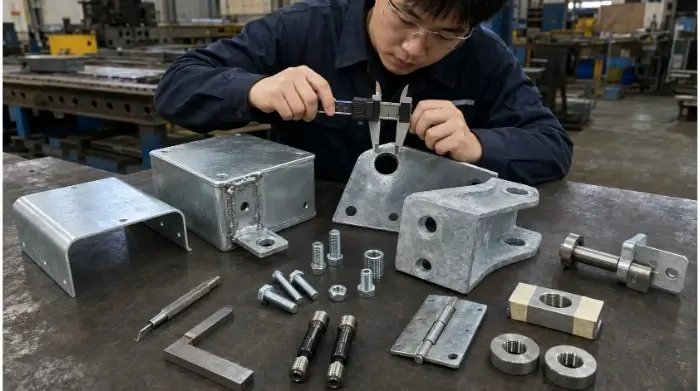
For electro-galvanized parts, standard machining tolerances usually absorb the thin layer. For HDG, precision is lost. Internal threads will fill with zinc, small holes will bridge over, and sliding surfaces or press-fit features (like bearings or dowel pins) will no longer assemble. PEM fasteners pressed into sheet metal before HDG will be rendered completely unusable.
Engineers must specify compensation methods on the manufacturing drawings. Common control methods include:
- Overtapping: Cutting internal threads oversized prior to galvanizing to accommodate the zinc buildup.
- Post-tapping or Post-machining: Clearing the threads or re-drilling critical holes after the galvanizing process. (Warning: Post-tapping adds secondary setup time, often increasing the per-part cost by 15-20%—factor this into your initial routing). Note that the exposed bare steel inside the thread is typically protected by the zinc on the mating fastener.
- Functional Masking: Using high-temperature tapes or plugs. Masking is common in electroplating but highly difficult and expensive in 450°C HDG kettles.
Do not apply a single fixed allowance (e.g., adding 2mm) for all holes. The required clearance depends on the hole diameter, material thickness, and thread pitch. Consult your machinist or galvanizer for specific tolerance offsets.
Venting, Drainage, and Thermal Distortion
Hot-dip galvanizing requires engineers to think in terms of fluid dynamics and thermal stress. The entire part is plunged into a bath of liquid zinc at 450°C.
If you design a closed tube or a hollow welded frame without vent holes, the trapped air expands rapidly, turning the part into a localized bomb inside the zinc kettle. Even if it survives, a lack of drain holes means the heavy liquid zinc will pool inside the structure, creating massive zinc pockets that drive up the part weight and cost.
Rule of Thumb: Vent and drain holes should be at least 25% of the cross-sectional area of the tubular profile. Anything smaller restricts zinc flow and leaves internal uncoated pockets.
Thermal distortion is the other major risk. Large, thin, unsupported panels (typically under 3mm) will warp violently when subjected to 450°C heat. Asymmetric welded structures or assemblies mixing thick plates with thin sheet metal will heat and cool at different rates, locking in severe dimensional distortion. For thin enclosures, pre-galvanized sheet or post-fab electro-galvanizing is almost always the safer route.
Material Risks and Common Galvanizing Defects
Even with proper design, the chemical and physical realities of zinc plating introduce specific material risks. Procurement and quality teams must differentiate between acceptable cosmetic variations and functional defects.
Mitigating Hydrogen Embrittlement Risks
During the acid pickling and electroplating processes, atomic hydrogen can diffuse into the steel lattice.
Crucial Distinction: Hydrogen embrittlement is mainly a concern for high-strength or hardened steel, not every galvanized sheet metal part. Low-carbon mild steel is generally immune.
However, for high-strength fasteners (e.g., Grade 10.9 or higher), hardened pins, or spring steel, this risk is critical. Under mechanical load, this trapped hydrogen causes the steel to become brittle and snap without warning—often experiencing “delayed fracture” hours or days after the product has shipped to the customer, leading to catastrophic liabilities.
If electro-galvanizing high-strength materials, the drawing must specify post-plating baking (stress relief). The parts must be baked at around 200°C within hours of plating to drive the hydrogen out of the metal.
Managing Galvanic Corrosion in Assemblies
Zinc is highly anodic, meaning it will readily sacrifice itself to protect other metals. Do not broadly assume that galvanized steel can never touch stainless steel. Galvanic corrosion depends heavily on the presence of an electrolyte (moisture, saltwater) and the surface-area ratio of the mixed metals.
If you use a small stainless steel bolt to secure a massive hot-dip galvanized beam, the large volume of zinc easily protects the small stainless bolt. The assembly will survive. However, if you use a small zinc-plated screw to fasten a large stainless steel panel, the massive stainless area will force the small zinc screw to corrode rapidly, causing structural failure.
When mixing galvanized steel with copper, brass, or large surface areas of aluminum/stainless steel in wet environments, specify isolation washers (neoprene or nylon) or apply barrier sealants to break the electrical contact.
Evaluating Coating Defects and Local Repair
When inspecting galvanized parts, you must distinguish between visual variations and functional failures.
- Normal Visual Variations (Cosmetic): Dull grey finishes, variable spangle patterns, and minor white rust (zinc oxide) are normal chemical reactions in HDG and do not impact corrosion resistance. They are cosmetic issues, do not affect functionality, and should not be cause for rejection.
- Functional Defects (Repairable): Small bare spots, light handling damage, or zinc loss near post-galvanizing welds. These are acceptable if repaired properly in the shop or field using zinc-rich paint according to standards like ASTM A780.
- Severe Defects (Requires Rework or Rejection): Widespread peeling or blistering (indicating poor surface prep), massive ash or dross inclusions embedded in the coating, and sharp zinc projections (“icicles”) that pose safety hazards to workers. Severe part distortion or completely blocked, un-machinable threads also warrant immediate rejection.
Specifying the Right Zinc Coating for Production
Reaching a technical decision is only the first step. If that decision is not translated accurately into manufacturing drawings and purchasing documents, the supply chain will default to whatever is cheapest or most convenient for them.
Drawing and Inspection Requirements
⚠️ Procurement Warning: Writing “Galvanized” or “Zinc Plated” on a manufacturing drawing is not a complete finish specification—it is a recipe for rejected parts.
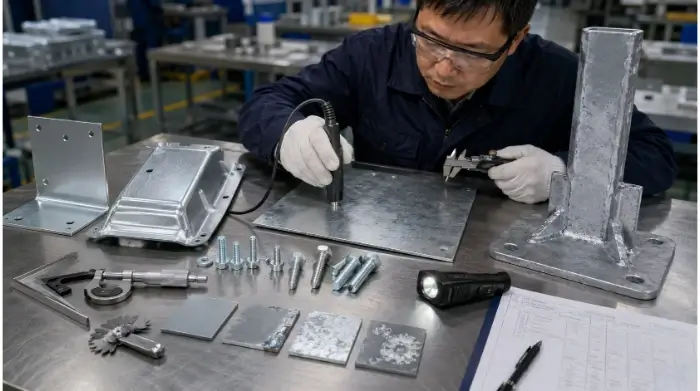
A robust technical drawing must leave no room for interpretation. It should explicitly state the coating route, the applicable standard, the required thickness or coating class, and any necessary post-treatments. For instance, when calling out chromate passivation, ensure you specify RoHS-compliant Trivalent Chromate (Cr3) rather than legacy Hexavalent Chromate (Cr6) if your parts are bound for the EU or modern consumer supply chains.
If the part will be painted or powder-coated later, this must be explicitly noted so the galvanizer skips waxes or sealants that will interfere with paint adhesion. Furthermore, the drawing must clearly indicate masked surfaces, how internal threads should be treated (e.g., overtapped before coating vs. chased after coating), where thickness measurements should be taken, and the limits of acceptable local repair.
To ensure compliance, reference the correct industry standards based on your production route:
- Electroplated parts: Specify ASTM B633 (or ISO 2081).
- Continuously galvanized sheet: Specify ASTM A653 (or EN 10346).
- Batch hot-dip galvanized fabrications: Specify ASTM A123 (or ISO 1461).
- Galvanized fasteners/hardware: Specify ASTM A153.
Cost, Volume, and Lead Time
It is a manufacturing myth that electro-galvanizing is universally cheaper than hot-dip galvanizing. Actual unit cost is heavily dependent on the fabrication route, batch size, and secondary operations.
When calculating the true cost of a coated part, do not just look at the baseline finishing charge. Factor in the hidden costs and differing pricing models: HDG is typically billed by weight ($/kg), while electroplating is often billed by the barrel or rack.
- Logistics & Pricing Traps: HDG facilities require massive environmental permits and are often located further away from machine shops, adding significant freight costs. Because HDG is billed by weight, large, bulky, lightweight tubular frames might incur premium volumetric charges—they consume a lot of valuable real estate in the zinc kettle but yield very little chargeable weight.
- Masking Labor: Highly expensive in electroplating; nearly impossible or cost-prohibitive in 450°C HDG kettles.
- Post-Machining: Clearing threads and re-reaming tight holes after HDG adds secondary CNC setup time.
- Minimum Batch Charges: HDG is a bulk process. Sending a single prototype frame to an HDG kettle will incur a steep minimum charge. Conversely, electroplating is highly scalable, ranging from barrel plating for 10,000 screws to rack plating for a dozen brackets.
Production is also limited by physics. The part size cannot exceed the HDG kettle dimensions or the electroplating tank volume.
Selection by Part and Service Environment
To streamline your routing decisions, use the following application guidelines:
Electro-Galvanizing works well for:
- Precision hardware and fasteners
- Small brackets and machined parts
- Indoor components and electronic chassis
- Tight-tolerance assemblies
- Cosmetic parts requiring a uniform, bright finish
- Components requiring controlled passivation (e.g., RoHS Cr3)
Pre-Galvanized Sheet works well for:
- Sheet metal enclosures and HVAC ducting
- Appliance components
- High-volume formed parts
- Parts with minimal or no structural welding
- Indoor equipment covers that will be powder-coated
Post-Fabrication Hot-Dip Galvanizing works well for:
- Heavy welded frames and structural steel
- Equipment bases and skids
- Highway guardrails and bridge components
- Outdoor storage racks and piping
- Solar panel mounting supports
- Long-life assemblies exposed to marine or industrial environments
Quick Routing Reference Guide (Cheat Sheet):
| Part Requirement | Recommended Route | The “Why” (Key Driver) |
| Smooth indoor precision part | Electro-galvanized | Maintains tight dimensional tolerances (<15µm). |
| High-volume bent sheet part | Pre-galvanized sheet | Lowest cost for raw material, suitable for light environments. |
| Painted electrical enclosure | Pre-galvanized or Electro-galvanized | Provides a smooth, paint-ready substrate without extreme thermal warping. |
| Outdoor welded frame | Post-fabrication HDG | Metallurgical bond completely encapsulates welds and raw cut edges. |
| Tight threaded assembly | Electro-galvanized, or HDG with post-machining | HDG fills threads unpredictably; electroplating preserves them. |
| High-strength hardened part | Electro-galvanized (with mandatory post-baking) | Mitigates the risk of catastrophic, delayed hydrogen embrittlement. |
| Coastal mixed-metal assembly | Galvanic isolation review required; HDG for base | High volume of HDG zinc sacrifices itself to protect the mixed assembly. |
| Large thin welded enclosure | Compare cut-edge rust risk vs. HDG distortion risk | 450°C HDG kettles will violently warp thin sheet metal (<3mm). |
Conclusion
Selecting a zinc coating is an engineering decision that directly impacts fabrication workflows, assembly tolerances, and field longevity. When specifying your next project, remember these three core rules:
- Electro-galvanizing is for smooth surfaces, strict dimensional control, and indoor components.
- Pre-galvanized sheet is the volume choice for sheet metal, but requires manual intervention for cut edges and welds.
- Post-fabrication hot-dip galvanizing provides the ultimate barrier for welded structures and decades of outdoor exposure, but destroys tight tolerances and can warp thin materials.
Need help routing your next project?
Send us your drawings, material grade, production volume, and service environment. Our engineering team can review the fabrication route, coating method, tolerance risks, and inspection requirements before production begins to help you avoid costly rework and delayed assemblies.