 English
  Spanish
  German
  Russian
  Italian
  French
Electrostatic painting is a highly efficient metal coating process that uses an electric charge to attract atomized paint particles to a grounded metal surface. This creates a 360-degree “wrap-around” effect, ensuring a uniform, corrosion-resistant finish on complex parts while maximizing transfer efficiency and virtually eliminating overspray waste.
The process works well for a wide range of conductive metal parts. It is usually used for CNC machined components, tubular frames, and complex enclosures where reaching every angle with a standard spray gun is difficult and highly labor-intensive.
How Electrostatic Painting Works?
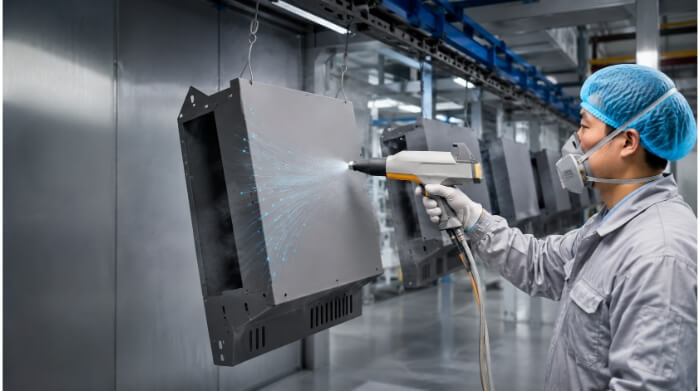
The effectiveness of electrostatic painting relies on controlling electrical fields to guide the paint. This process changes how paint particles travel from the spray nozzle and how they bond to the metal surface.
Electrostatic Principle
The core mechanism relies on electrical attraction. The spray equipment applies a high-voltage, low-amperage positive charge to the liquid paint as it leaves the nozzle.
At the same time, the metal part being painted is physically grounded, giving it a neutral or slightly negative charge. This difference in polarity causes the positively charged paint particles to be drawn directly to the grounded metal object.
Surface Preparation
Proper adhesion depends entirely on surface cleanliness. Before painting, metal parts must undergo cleaning and pretreatment. This typically starts with degreasing to remove machining oils, stamping lubricants, and cutting fluids.
Following degreasing, factories usually apply a chemical conversion coating—such as phosphating for steel or chromate conversion for aluminum. These treatments create a micro-texture for better adhesion and prevent oxidation. If residual oils remain, they disrupt the electrical conductivity and lead to weak coating adhesion.
Paint Atomization
Liquid paint is pumped to the spray gun, where it is broken down into a fine mist. This atomization is usually achieved through compressed air, fluid pressure, or rotary bells.
Creating a fine, consistent droplet size is a critical step. Smaller particles hold the electrical charge more efficiently and distribute more evenly across the part’s surface, ensuring a smoother final finish without heavy buildup.
Electrostatic Deposition
As the atomized, charged paint approaches the grounded part, the electrical field guides the droplets. Unlike standard directional spraying, the particles follow the electrostatic field lines.
This physical attraction is strong enough to alter the flight path of the paint. It pulls the droplets toward the closest grounded surface, allowing the paint to actively wrap around edges rather than just hitting the front-facing areas.
Drying and Curing
Once applied, the liquid paint requires time to cure and form a solid film. Depending on the specific paint formulation (such as epoxies, urethanes, or enamels), curing happens through air drying at room temperature or low-heat baking.
This lower temperature requirement is a significant advantage for thin-gauge sheet metal or extruded aluminum components. Because it avoids the heavy, 200°C (400°F) high-temperature ovens necessary for powder coating, it prevents the thermal warping and distortion that may cause tight-tolerance parts to fail inspection.
Why Manufacturers Choose Electrostatic Painting?
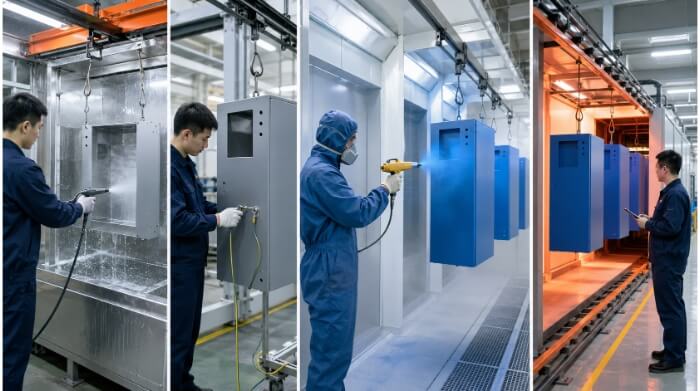
When deciding on a finishing process, engineers and purchasing managers evaluate the balance between coverage quality and processing costs. Electrostatic painting offers specific advantages over conventional air-spraying, particularly regarding labor and material efficiency.
Transfer Efficiency
Transfer efficiency measures the percentage of paint that actually adheres to the part versus what is lost to the air as overspray. Conventional spray systems often operate with a transfer efficiency of around 30% to 40%, wasting more than half the material.
With proper grounding and equipment settings, electrostatic painting typically achieves transfer efficiencies between 70% and 85%. This measurable improvement drastically reduces paint consumption and directly lowers the unit cost per part.
Wrap-Around Coverage
For complex shapes, conventional spraying requires the operator to spray from multiple passes and angles, which increases processing time. The electrostatic field creates a “wrap-around” effect, drawing charged paint particles to hidden or hard-to-reach areas, such as the back sides of cylindrical tubes or the folded edges of stamped sheet metal.
This physical property drastically reduces manual labor time. Operators spend less time repositioning parts and performing manual touch-ups in blind spots, which streamlines the overall production cycle and increases throughput.
Finish Consistency
A common issue with standard manual spraying is uneven paint thickness, which may cause drips, runs, or thin spots. Because the charged paint particles naturally repel each other in the air but are drawn to the metal, they distribute themselves uniformly.
Once a section of the metal is coated, it becomes temporarily insulated. This causes the remaining charged particles to automatically seek out uncoated or thinner areas, resulting in a much tighter tolerance on the final film thickness and a highly consistent cosmetic finish.
Material Savings and ROI
Higher transfer efficiency means less liquid paint is consumed per production run. Less overspray also translates to fewer filter replacements in the spray booth, less downtime for equipment cleaning, and lower disposal costs for hazardous waste and VOCs.
For purchasing managers, this efficiency directly impacts the bottom line. In continuous production runs, the reduction in raw material usage and waste management costs becomes more cost-effective at volume, quickly offsetting the initial investment in specialized electrostatic spray equipment.
Design Requirements Before Painting
A common mistake in product development is treating the finishing process as an afterthought. Electrostatic painting adds measurable thickness and alters surface properties, which directly impacts how parts fit together.
Coating Thickness Allowance
Electrostatic painting typically adds a film thickness of 25 to 75 microns (1 to 3 mils) per coated surface. While this provides excellent protection, it alters the final dimensions of the part.
Engineers must explicitly specify whether the dimensions and tolerances on a 2D drawing apply “Pre-paint” or “Post-paint.” For high-precision CNC machined parts or tightly toleranced sheet metal components, clearly defining this in the engineering drawing prevents dimension disputes during final quality inspection.
Assembly Clearance
When two painted parts need to fit together, the design must accommodate double the coating thickness. For sliding fits, hinges, or tight sheet metal seams, engineers usually need to leave a minimum gap of 0.1mm to 0.15mm.
If assembly clearances are too tight, operators will have to force the parts together on the assembly line. This friction often scrapes the paint off the mating surfaces, exposing bare metal to potential rust and degrading the cosmetic appearance.
Thread Masking
Because electrostatic paint wraps around edges and adheres strongly, it easily coats the inside of tapped holes. Once the paint cures inside a thread, it alters the thread pitch and causes screws to bind or strip during assembly.
To prevent this, all tapped holes—especially M4 or smaller—must be physically protected. Designers should explicitly write “Mask all tapped holes” in the title block or technical notes of the 2D drawing. On the shop floor, workers will insert high-temperature silicone plugs or specialized masking dots to seal these holes before the part enters the spray booth.
Conductive Contact Areas
Many metal enclosures are used for electronics and require specific areas to remain unpainted to serve as electrical grounding points. Because the cured paint acts as an insulator, spraying the entire part will break the electrical continuity.
Designers must clearly indicate these grounding pads, studs, or EMI shielding contact areas on the manufacturing drawings, rather than just showing them in a 3D model. The production team will then apply custom masking tape to these specific zones to ensure bare metal-to-metal contact on the final assembly.
Quality Challenges and Process Control
While electrostatic painting offers high transfer efficiency, the process is highly sensitive to physical and environmental variables. Consistent coating quality depends heavily on strict shop-floor management.
Grounding Quality
The entire electrostatic attraction process relies on the part having a solid electrical ground. Parts are usually suspended on metal hooks or racks as they pass through the spray booth.
Over multiple production runs, these hooks become coated with layers of cured paint, which acts as an insulator. If the racks are not regularly cleaned, the part loses its ground connection. To maintain electrical continuity, factories usually use high-temperature burn-off ovens or chemical stripping baths to routinely clean the racks back to bare metal.
Voltage Settings
The applied voltage from the spray gun controls the strength of the electrostatic field. While increasing the voltage generally improves transfer efficiency, setting it too high causes unintended problems.
Excessive voltage can cause a defect known as back ionization. This happens when too many charged particles accumulate on the surface and begin to repel new incoming paint droplets, resulting in a rough, uneven texture commonly known as “orange peel.”
Temperature and Humidity
The micro-environment inside the factory directly impacts the electrical conductivity of the paint and the air. If the air is too dry, the static charge does not transfer effectively, lowering the coating efficiency.
Conversely, if the humidity is too high, it may cause electrical arcing between the gun and the part, or trap moisture under the paint film. Maintaining a climate-controlled spray booth is usually required to keep these variables stable.
Faraday Cage Effect
When painting parts with deep recesses, internal corners, or U-shaped channels, the electrostatic field naturally concentrates on the outer edges closest to the gun. This creates a “Faraday Cage,” which physically repels paint particles from entering the inner corners.
To overcome this limitation, operators cannot simply rely on the electrostatic attraction. They must manually adjust the equipment—usually by lowering the gun voltage to weaken the electrical field and increasing the air pressure to physically force the atomized paint into the recesses.
Common Coating Defects
Even with strict process controls, localized defects like sagging (runs) or thin spots may occasionally occur. Because electrostatic paint bonds tightly to the prepared metal surface, simply sanding off a defect is often impractical.
Reworking a defective part usually involves a complete removal of the coating. Factories generally use chemical paint strippers or light abrasive blasting to strip the part back to bare metal. After repeating the painting process, the reworked part is typically verified against industrial standards, such as the ASTM D3359 cross-hatch adhesion test, to confirm the new layer bonds correctly.
Electrostatic Painting vs Other Coating Methods
Selecting the right finishing process requires balancing part geometry, material properties, and specific tolerance limits. While electrostatic painting is highly efficient, engineers and purchasing managers must evaluate how it compares to alternative methods.
Conventional Spray Painting
Conventional air-spraying relies purely on air pressure to atomize and direct the paint. The primary advantage is lower equipment cost and the ability to paint non-conductive materials like wood or plastic without special preparation.
However, it typically wastes 50% to 70% of the paint as overspray. Therefore, conventional spraying is usually used for very low-volume runs or oversized parts where setting up an electrostatic grounding system is impractical.
Powder Coating
Powder coating applies a dry plastic powder electrostatically, which is then melted in an oven at roughly 200°C (400°F) to form a hard shell. It generally provides a thicker (75 to 150 microns) and more durable finish than liquid paint.
However, powder coating is not suitable for assemblies containing rubber seals or plastics. The high curing temperature may also cause thin-gauge sheet metal to warp. In these cases, electrostatic liquid painting is often preferred.
Dip Coating
Dip coating involves submerging the entire metal part into a tank of liquid paint. This guarantees 100% transfer efficiency and coats internal cavities effectively, but it lacks thickness control. As the part is removed, gravity causes the paint to pool and drip at the bottom edges.
Note: Traditional dip coating is different from E-coating (electrophoretic deposition). While E-coating also uses an electrical current in a fluid bath, it requires far more complex liquid management. Traditional dip coating often results in a highly uneven finish, making it unsuitable for precision mechanical assemblies.
Process Selection
The decision usually comes down to precision and heat sensitivity. If a part requires a thick, heavy-duty protective layer and can withstand 200°C, powder coating is typically the standard choice.
On the other hand, electrostatic painting becomes the more practical option for specific scenarios. It works best if the part features tight assembly tolerances, consists of thin sheet metal prone to thermal distortion, or requires a highly specific aerospace-grade liquid paint.
Cost, Applications, and Production Suitability
Evaluating the financial viability of electrostatic painting depends heavily on the production scale and the complexity of the components.
Typical Applications
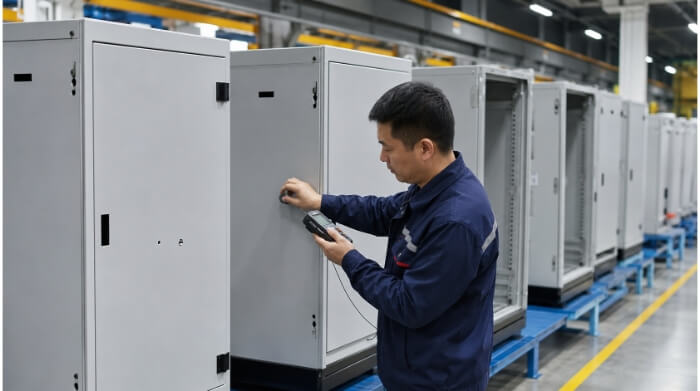
Because it offers excellent coverage on complex geometries, this method works well for open-frame structures and intricate housings.
Typical applications include medical device enclosures, telecommunications cabinets, custom CNC machined chassis, and aluminum extruded frames. It is particularly effective for parts with louvers, cooling fins, or perforated sections.
Production Volume
The setup time for electrostatic painting is longer than conventional spraying. Operators must ensure proper grounding and configure specific voltage settings. For a single prototype, the labor required to set up the fluid lines may outweigh the material savings.
However, the process becomes highly cost-effective at low-to-medium volumes (from hundreds to tens of thousands of parts). In these scenarios, the drastic reduction in paint consumption and manual touch-up time quickly absorbs the initial setup costs.
Equipment Investment
For manufacturers, integrating electrostatic systems requires a significant upfront investment in specialized spray guns, isolated fluid delivery systems, and grounded spray booths.
For purchasing managers sourcing parts, this means working with a supplier who already has this infrastructure in place. The overall unit cost from a well-equipped supplier is often lower, simply due to the sheer volume of paint saved during production.
Heat-Sensitive Components
Certain manufacturing projects involve parts that cannot be exposed to high heat. This includes pre-assembled components featuring gaskets or pressed-in plastic inserts.
It also applies to specific aluminum alloys, such as 6061-T6 or 7075, which can lose their temper and structural strength at elevated temperatures. Because electrostatic liquid paint can be formulated to air-dry at room temperature or cure in low-heat environments (around 60°C to 80°C), it safely coats these components without risking thermal degradation.
Conclusion
Electrostatic painting bridges the gap between the material waste of conventional spraying and the thermal limitations of powder coating. By utilizing electrical fields to guide paint particles, it offers superior wrap-around coverage and significant material savings on complex metal parts.
However, realizing these benefits requires proper planning. Engineers must account for coating thickness during the CAD stage and clearly define masking requirements on manufacturing drawings to avoid assembly issues.
If you are unsure how coating thickness will affect your next assembly, the engineering team at TZR can help. We review CAD models to recommend the most reliable and cost-effective finishing process for your project.
FAQs
Can electrostatic painting be used on plastic parts?
Generally, no. The electrostatic process requires the part to be electrically conductive and grounded to attract the charged paint. However, plastics can be painted electrostatically if they are first coated with a specialized conductive primer.
Is it difficult to change colors during electrostatic painting?
Changing colors takes more time than with conventional spray guns. Because the paint is liquid and travels through a specialized fluid delivery system, operators must thoroughly flush the pumps and hoses. They must clean the gun with solvent to prevent color contamination and electrical short-circuiting. Therefore, it is always most efficient to run entire batches of a single color before switching.
How does the coating thickness compare to powder coating?
Electrostatic liquid painting is noticeably thinner. It typically applies a film thickness of 25 to 75 microns (1 to 3 mils). Powder coating, on the other hand, usually starts around 75 microns and can exceed 150 microns (3 to 6 mils). The thinner profile of electrostatic paint makes it much better suited for high-precision components with tight assembly clearances.