 Spanish
  English
  German
  Russian
  Italian
  French
E-coating is a common finishing method for metal parts that need better corrosion resistance and more even coverage.
Many buyers and engineers know the term, but they are still often asking the same questions. How does the e-coating process work? When is it better than powder coating? Which parts of the design make it easier or harder to use?
This guide explains e-coating in simple manufacturing terms. It focuses on process, part design, common defects, cost, and finish selection.
What Is E-Coating?
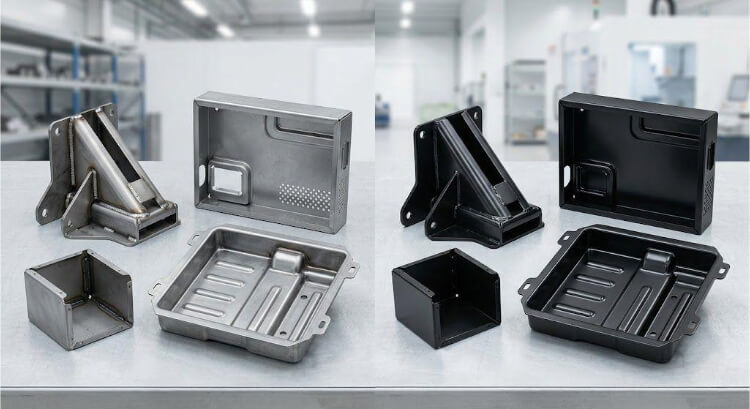
E-coating, also called e-coat or electrocoating, is a finishing process that uses electric current to deposit a paint film onto a conductive metal part.
It is mainly chosen for functional protection rather than decorative appearance. Its main value is more even protective coverage on complex metal parts, especially when seams, recesses, shielded corners, and hidden surfaces make corrosion control harder with spray-only methods.
In practical use, e-coat is usually a thin, controlled film rather than a thick decorative build, typically around 15-30 μm.
The part is cleaned, placed in a coating bath, and charged so that paint particles attach to the surface. It is widely used on soportes, housings, welded assemblies, battery supports, and sheet metal enclosures that need stable corrosion resistance in repeated production, not just an acceptable appearance on exposed surfaces.
How does the electrocoating process use electric current to deposit paint?
The coating bath contains charged paint particles. When a current is applied, those particles move toward the metal surface, forming a thin coating.
As the film builds, deposition slows down naturally. This helps create more even coverage, which is why e-coating is often a better choice for recessed, shielded, or hard-to-protect areas where spray coverage becomes less reliable and hidden corrosion risks are more likely to go unnoticed.
Why is e-coating mainly used for corrosion protection instead of decoration?
E-coating is mainly selected when protection matters more than appearance.
It helps shield metal from moisture, salt, and chemical exposure. That makes it a strong choice for industrial hardware, electrical enclosures, welded fabrications, and structural support parts, but usually a weaker choice when the project needs richer color, thicker texture, or a more decorative finish with higher visual demands.
E-Coating Process Explained Step by Step
Good e-coating results do not come from the coating bath alone. They depend on how well the full process is controlled before, during, and after deposition.
What surface preparation is needed before e-coating?
Surface preparation is the first step that affects coating quality.
Before e-coating begins, the part is usually cleaned and pretreated to remove oil, dust, oxides, and other surface contaminants. This step helps the coating bond more evenly to the metal surface and reduces the risk of weak adhesion later.
How do immersion, voltage, and deposition build the coating film?
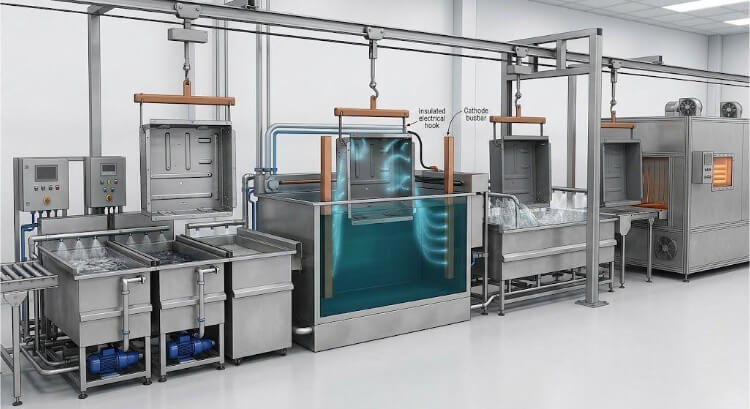
After pretreatment, the part is placed into the e-coating bath.
The bath contains charged coating particles suspended in liquid. When voltage is applied, those particles move toward the conductive part surface and begin to form a thin coating film. This is the step that creates the protective layer.
As the film builds, it starts to resist further current flow. This slows deposition naturally and helps control film thickness.
Why do rinsing and baking matter for final coating performance?
After deposition, the part is usually rinsed to remove excess coating material that did not fully attach.
The part is then baked to cure the coating. During curing, the film hardens into a more durable protective layer. If cure conditions are unstable or incomplete, the coating may not reach its expected adhesion, hardness, or corrosion resistance.
In other words, a part can appear coated before cure but still fail to meet performance targets later if the curing step is not well controlled. A visually acceptable part is not always a fully cured part.
Which process control factors most affect coating thickness and consistency?
Several factors affect coating thickness and consistency across production.
Bath chemistry, voltage, immersion time, rack design, part position, drainage, and oven control all influence final results. Even when the coating system is correct, poor rack contact or unstable settings can still create uneven build or quality variation.
For parts with seams, recesses, boxed sections, or internal channels, process stability becomes even more important because the geometry already raises the coating difficulty. The more difficult the geometry, the less room the process has for error.
E-Coating Pros and Cons: Benefits, Limits, and Common Applications
E-coating performs well in many industrial projects, but it is not the right answer for every part. Its value becomes clearer when you compare where it works well and where it falls short.
What are the main advantages of e-coating for metal parts?
The main advantage of e-coating is more uniform coverage.
Because the part is coated in a liquid bath during electrical deposition, the film can build up more evenly across corners, seams, recesses, and other hard-to-reach features. This makes it a strong option for functional parts where hidden corrosion risk matters more than surface show.
Another advantage is process repeatability. When the line is well controlled, e-coating can deliver consistent coating thickness across repeated production runs and reduce variation from part to part.
Why does e-coating work well on complex shapes, recesses, and internal areas?
E-coating works well on complex parts because the coating is deposited by immersion, not just from a single spray direction.
This gives it a clear advantage over welded brackets, folded enclosures, boxed assemblies, and stamped parts with channels or recessed features. In these cases, more even coverage is often the real reason to choose e-coating, not the finish name itself.
Still, better reach does not mean unlimited reach. Very closed sections, poor venting, and trapped spaces can still reduce coating quality and should be reviewed early. If the geometry blocks access or drainage, the process advantage drops quickly.
What are the main limits of e-coating in color, film build, and appearance?
E-coating has clear limits in visual flexibility.
It is usually not the first choice when a project needs a thick decorative build, a wide color choice, or a more premium-looking surface. Compared with powder coating, e-coating is often thinner and more functional. In many projects, it works better as a controlled protective layer than as a high-build cosmetic finish.
This means e-coating is usually stronger as a protection-focused finish than as a cosmetic finish, especially when visible surface richness is a key buying factor.
Which industries and products commonly use e-coating?
E-coating is common in industries where metal parts face corrosion risk and production consistency matters.
Typical examples include automotive components, industrial brackets, electrical enclosures, agricultural hardware, machinery parts, battery supports, and welded metal assemblies. These are the kinds of products where reliable protection across seams, recesses, and formed features matters more than a decorative outer look.
In these applications, coating quality is often judged by film consistency, adhesion, and corrosion performance, rather than solely by visible appearance.
E-Coating Design Guide
Part geometry often determines whether e-coating proceeds smoothly or poses a risk. Design details can directly affect coverage, drainage, and long-term coating performance.
How do holes, channels, and cavities affect e-coating coverage?
Holes, channels, and cavities can improve or reduce coating quality depending on how they are designed.
If these features allow pretreatment liquid, coating material, and rinse water to flow through the part more easily, coverage is usually more reliable. If they are too narrow, too deep, or poorly placed, it becomes harder to coat internal areas evenly.
This is especially relevant for boxed assemblies, support brackets, battery trays, and sheet metal housings with formed internal sections. On these parts, internal access is often the difference between nominal coverage and reliable coverage.
Why do drain holes and vent holes matter in e-coating design?
Drain holes and vent holes are small features, but they often decide whether a part coats well.
They help liquid enter, move, and escape during pretreatment, coating, and rinsing. Without proper drainage and venting, fluid can become trapped inside the part, increasing the risk of contamination, uneven film build, and later corrosion.
For welded fabrications, folded enclosures, and hollow sections, this is usually one of the first design points to review before production begins. In practice, a small drainage change can prevent a much larger coating problem.
How can trapped solutions, blind spaces, and overlapping areas cause coating problems?
Trapped solution is one of the most common geometry-related risks in e-coating.
Blind spaces, lap joints, folded seams, and overlap areas can hold pretreatment chemicals, rinse water, or coating material. When that happens, the part may show weak coverage, contamination, blistering risk, or early failure in service.
In many cases, this is not a coating-line problem first. It is a geometry problem first. If the design traps fluid, the process usually has less room to recover.
How do welds, seams, folded edges, and boxed sections influence coating results?
Welded y formed features often make coating more sensitive because they create transitions, shielded surfaces, and drainage challenges.
Weld seams can create uneven surface conditions. Folded edges can trap liquid. Boxed sections can limit flow and reduce coating access. These features do not always cause failure, but they usually make it harder to achieve stable coating results.
That is why parts with these features need more design review, not less, before they enter production.
Which design changes can improve e-coating quality before production starts?
Small design changes can reduce coating risk before the first production run.
Better drainage paths, better venting, fewer trapped spaces, smoother internal transitions, and less unnecessary overlap can all improve coating consistency. A part that is easier to clean, coat, rinse, and drain is usually easier to protect well.
E-Coating vs Powder Coating: Which Finish Is Better for Your Part
E-coating and recubrimiento en polvo are often compared, but they do not solve the same problem in the same way. The better choice depends on what the part needs most.
What is the real difference between e-coating and powder coating?
The main difference is how the coating is applied and what result it is expected to deliver.
E-coating uses electrical deposition in a liquid bath. Powder coating uses an electrostatic spray followed by heat curing. Because of this, e-coating is usually better at creating a thin, even protective layer, while powder coating is often better at building a thicker and more decorative outer finish.
Which process provides better coverage in corners, recesses, and hard-to-reach areas?
E-coating usually performs better on recessed areas, seams, channels, and other harder-to-spray features.
Because the part is immersed in a coating bath, the process can protect many areas that are harder for sprayed powder to reach evenly. This makes e-coating a stronger choice when hidden corrosion risk outweighs visible film build.
Powder coating can still work well on many shaped parts, but it is usually less reliable in deep internal or shielded sections. In practice, powder coating also builds a thicker outer layer, while e-coating is more often kept within a controlled, thinner range.
When does e-coating work better as a primer rather than a final finish?
E-coating often works very well as a primer layer.
In many production projects, it is used first to create a uniform corrosion-resistant base. A second finish, such as powder coating, is then applied to improve appearance, film build, or outdoor durability. This is a common solution when the part needs both internal protection and a stronger visible finish.
For complex fabricated parts, this combined system is often more effective than relying on a single finish. In these cases, final approval is usually tied to both corrosion testing and finish appearance, not to a single result.
When is powder coating better for appearance, thicker film build, or outdoor exposure?
Powder coating is often the better choice when surface appearance matters more.
It usually offers more flexibility in color, gloss, texture, and visible finish quality. It also builds a thicker surface layer, which can be helpful when the part needs stronger outer coverage or a more premium-looking finish.
For many outdoor products, powder coating is often chosen when the finish must protect the part and also meet a higher visual standard.
E-Coating Cost, Quality Checks, and Supplier Questions Before Production
A low coating price does not always mean a lower project cost. Before approval, teams should review quality control, supplier capability, and real production risk.
How much does e-coating cost compared with other finishing methods?
E-coating costs depend on the part, not just on the process name.
Small and simple parts can be cost-effective in repeat production. Large welded assemblies, hard-to-drain parts, and parts with higher reject risk often carry a higher real coating cost. In many projects, e-coating becomes more competitive when the goal is stable corrosion protection across repeated production runs.
Which factors affect e-coating cost beyond the quoted coating price?
Several factors can change the real cost of e-coating.
Part size, shape, material, rack density, volume, masking needs, pretreatment complexity, cure control, and rework risk all matter. A part may receive a normal coating quote, but still create extra cost later if seams, recesses, or boxed sections make quality harder to control.
What tests should confirm corrosion resistance, adhesion, and coating thickness?
A supplier should be able to verify coating quality, not only describe it.
Common checks include coating thickness, adhesion, appearance, and corrosion performance, depending on the service requirements. For some projects, teams should also review cure consistency and pretreatment control, especially when the part includes hidden surfaces or welded features.
Conclusión
E-coating is a strong choice when a metal part needs reliable corrosion protection, stable coating thickness, and better coverage on complex shapes.
It is especially useful for parts with recesses, seams, channels, and other features that are harder to protect with spray-based finishing alone. In many projects, its value comes from consistency and function more than surface appearance.
For engineers and buyers, the best way to choose e-coating is to review the part function, geometry, corrosion target, and production needs together. That approach leads to a better finish decision and fewer problems later.
Is e-coating the right finish for your part? Send us your drawings, materials, quantity, and application requirements. Our engineering team can review your part geometry, corrosion targets, and production needs, then recommend a more suitable coating solution for your project.