
 Italian
  English
  Spanish
  German
  Russian
  French
In sheet metal fabrication, CNC punching uses mechanical force and physical dies to rapidly stamp holes and formed features, making it ideal for high volumes. Fiber laser cutting uses a thermal beam for precise, tool-less cuts, making it best for low-volume prototypes and complex profiles.
Choosing the wrong process doesn’t just affect tolerances—it can inflate your per-part costs by 30% to 50% depending on your production volume. The right choice ultimately depends on the part geometry, material thickness, available shop tooling, and your total delivered cost.
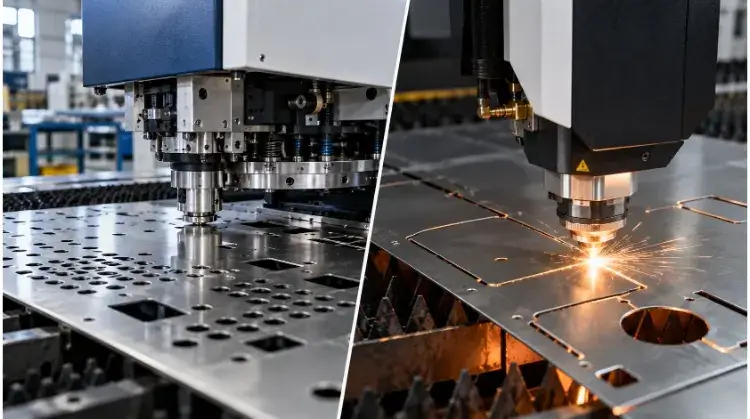
Punching vs. Laser Cutting: Key Differences
Understanding the basic mechanics of each process helps explain their distinct cost structures and manufacturing limits.
Punzonatura CNC
CNC turret punching uses mechanical force to drive a shaped punch through the sheet metal into a corresponding die, shearing the material.
- Mechanical Shearing: The process removes material through physical impact and matched tooling geometry.
- High-Speed Repetition: A modern CNC punch press can operate at up to 600 hits per minute, making it a volume powerhouse for standard hole patterns.
- Forming Capability: When equipped with specific tooling, it can create 3D formed features (like louvers, knockouts, embosses, and countersinks) directly on the machine.
Note: Machine capabilities vary. While modern CNC turret presses handle a wide range of forming tools, specific features depend on the active tooling inventory.
Fiber Laser Cutting
Taglio laser in fibra uses a focused, high-energy light beam and assist gas to melt or vaporize the material along a programmed path.
- Thermal Cutting: The process relies on localized heat rather than mechanical force.
- Zero Hard Tooling: It requires no shape-specific physical tooling. Your initial setup fee is essentially just programming and machine setup.
- Maximum Flexibility: It is highly adaptable to complex contours, organic shapes, and frequent design revisions.
Engineering Comparison
| Fattore | Punzonatura CNC | Taglio laser |
| Shape-specific tooling | Sometimes required | Not required |
| Repeated holes | Highly efficient | Cut individually |
| Complex profiles | Limited by tooling | Estremamente flessibile |
| Formed features | Disponibile | Not produced by cutting |
| Modifiche al progetto | May affect tooling | Mainly program changes |
| Edge condition | Rollover and burr | Striations or dross |
| Main thickness limit | Tonnage and tooling | Laser power and material |
| Best production fit | Stable repeated parts | Variable complex parts |
How Part Design Changes the Best Process?
The physical geometry of a sheet metal part often dictates the most cost-effective manufacturing method before production volume is even calculated.
Repeated Holes
CNC punching dominates when a design includes ventilation patterns, perforated panels, or large arrays of standard mounting holes (round or square). Because the punch stamps the entire hole geometry in a single stroke, cycle times are extremely low.
For example, a panel with 500 standard ventilation holes might take a punch press under a minute to process. A laser must pierce the material and trace the perimeter of all 500 holes individually, significantly increasing machine time. However, if a design features highly irregular mixed slot sizes, or lacks available off-the-shelf tooling, laser cutting may still be the more economical route.
Complex Profiles
Laser cutting works exceptionally well for curved outer profiles, large irregular cutouts, logos, and decorative elements. The laser beam seamlessly follows the programmed vector path without physical restrictions.
A CNC punch press can process complex outer profiles using a technique called “nibbling”—making multiple overlapping hits with a small round tool to approximate a curve. However, nibbled edges almost always leave scalloped marks that require aggressive secondary deburring to meet cosmetic or safety standards, which adds manual labor cost. For highly irregular perimeters, laser cutting is the standard approach.
Caratteristiche formate
This is where the two processes completely diverge. Laser cutting is strictly a 2D profiling process. CNC punching utilizes the Z-axis to displace material, creating 3D features without downstream operations.
During the blanking stage, a punch press can form louvers for airflow, knockouts for electrical enclosures, embosses, countersinks, and extruded holes for tapping.
💡 TZR Shop Note: When a part requires both the precision of a laser for a complex outer profile and punched louvers for ventilation, we often utilize a combined workflow. Routing the part through both machines—and designing your formed features to match TZR’s existing tooling inventory—optimizes your tolerances while eliminating custom tooling costs entirely.
How Material and Thickness Affect the Choice?
A process that works perfectly for a 1mm aluminum enclosure might fail entirely for a 3mm stainless steel bracket. Material properties fundamentally change how lasers and punch presses interact with the sheet.
Comportamento dei materiali
Different alloys introduce distinct challenges for both cutting and shearing:
- Mild Steel: Highly versatile. It punches cleanly with standard tool wear and absorbs laser energy efficiently.
- Acciaio inossidabile: Its high shear strength requires significantly more punching tonnage and accelerates tool wear. For laser cutting, it processes beautifully but requires nitrogen assist gas to prevent a blackened, oxidized edge.
- Alluminio: Being soft and ductile, aluminum is prone to “galling”—where material sticks to the punch tool, requiring specialized coatings or lubrication. Modern fiber lasers handle aluminum’s high reflectivity without issue.
- Acciaio zincato: The zinc coating can cause material buildup on punch dies. Lasers cut it well, but the zinc vaporizes, requiring excellent dust extraction to manage hazardous fumes.
- Rame e ottone: Highly thermally conductive and reflective.
💡 TZR Engineering Warning: Specifying highly reflective copper for laser cutting without verifying machine compatibility can cause laser back-reflections that damage optics. For these materials, CNC punching is often the safer, faster path for volume production.
Thickness and Tonnage
The physical limits of each machine scale differently with material thickness:
- Punching capacity is governed by machine tonnage, tool perimeter, and material shear strength. As thickness increases, the required force spikes, and the tool extraction process slows down. CNC punching becomes much less cost-effective—and harder on tooling—once thickness exceeds 3mm (0.120″).
- Laser capacity depends on the kilowatt (kW) power of the resonator and the assist gas. While a high-power laser can slice through 20mm steel, cutting speed decreases as plate thickness increases.
Maximum capable thickness does not equal economic thickness. Just because a machine can process a thick sheet does not mean it is the most cost-effective method for your production run.
Small Feature Limits
As a general rule, feature sizes cannot shrink indefinitely.
- Small Holes: For punching, the hole diameter should generally be greater than or equal to the material thickness (a 1:1 ratio) to avoid snapping punch pins. Lasers can cut smaller holes (often down to a 0.5:1 ratio), but piercing small holes in thick material risks severe heat accumulation and blowouts.
- Web Width (Space between features): Narrow webs in punched parts may twist due to mechanical stress. In laser-cut parts, thin webs may melt or warp from heat accumulation.
- Edge Proximity: Punching too close to the edge of the sheet causes the material to bulge outward.
Note: Do not rely on a single universal formula for small features. These are standard starting points; final limits must always be confirmed by your manufacturing supplier based on the specific alloy and temper.
How Production Volume Changes Part Cost?
For procurement managers, the decision between punching and laser cutting ultimately comes down to the break-even point. Understanding how upfront setup trades off against machine cycle time is critical for accurate cost forecasting.
Setup and Tooling
Every production run requires upfront investment.
CNC Punching Setup:
- Sourcing standard or custom tooling
- Loading tools into the turret station
- Machine setup and alignment
- First-piece adjustment and die clearance checks
- Ongoing tool sharpening and maintenance
Laser Cutting Setup:
- CAD file review and translation
- CNC programming and nesting
- Parameter and focal length setup
- Assist gas selection and regulation
- First-piece inspection
Core Takeaway: Laser cutting usually reduces upfront tooling cost, but it does not eliminate setup work.
Cycle Time and Automation
A machine’s advertised top speed does not dictate your final part cost. The true cycle time encompasses the entire mechanical process.
For a punch press, the cycle includes the punch hits, turret rotation (tool changes), and the physical X-Y movement of the sheet. For a laser, the cycle includes the pierce time, the total cutting path, and the rapid traverse between cuts. Furthermore, the level of automation—such as automated sheet loading, part sorting, and scrap removal—heavily influences how efficiently either machine can run unattended.
Break-Even and Delivered Cost
When comparing the two methods across different volumes, a cost curve emerges based on low, medium, and stable high volumes. The exact crossover point is influenced by the number of holes, available shop tooling, material thickness, and secondary operations.
💡 TZR Cost Benchmark:
As a general rule of thumb, if your part requires fewer than 50 holes and simple cutouts, laser cutting usually remains cost-effective up to batches of 1,000 units. However, if a component features 200+ holes and an order volume of 5,000+ units, the tooling investment for a punch press is almost always recovered within the first production run.
When evaluating a quote, use this standard cost allocation model:
Total part cost = material + setup allocation + machine time + tooling + secondary operations + inspection
How Each Process Affects Finished Part Quality?
Quality is not a generic term. Precision in sheet metal means evaluating edge conditions, dimensional repeatability, and material flatness.
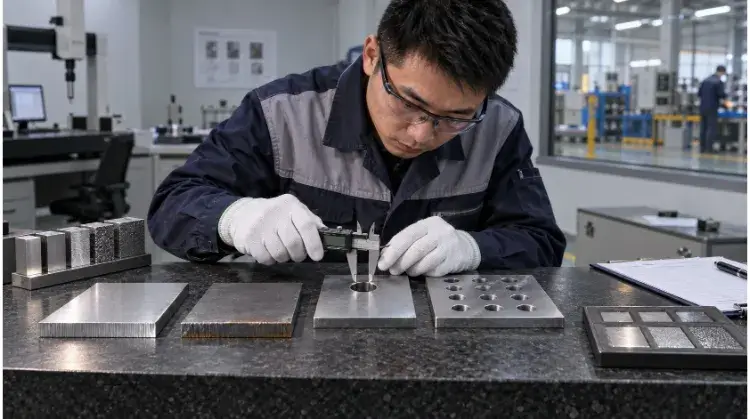
Condizione del bordo
The physical reality of shearing vs. melting leaves two entirely different edge profiles, which directly impacts assembly and finishing.
The Punched Edge:
Because a punch press shears the metal, the edge consists of four distinct zones:
- Rollover: A slight downward curve at the top edge.
- Burnished zone: A smooth, vertical section where the tool slides through.
- Fracture zone: A rougher, angled section where the material snaps.
- Bottom burr: A sharp lip on the underside.
The Laser Cut Edge:
Lasers melt the material, leaving a thermal edge characterized by:
- Cut striations: Vertical or slightly trailing lines along the edge.
- Dross (Slag): Melted material that hardens on the bottom edge.
- Oxide layer: A scale left behind if cut with oxygen.
- Heat tint: Discoloration near the cut line.
Downstream Cost Linkage: Edge condition dictates secondary operations. For example, the oxide layer left by an oxygen laser cut mosto be mechanically removed before verniciatura a polvere, otherwise, the paint will flake off. Conversely, a punched part with heavy bottom burr on 3mm stainless steel will require automated deburring or tumbling, adding roughly $0.05 to $0.15 per part. Always factor secondary finishing into your total delivered cost calculation.
Tolerance and Repeatability
Both processes are highly accurate, but they achieve precision differently.
- Hole Diameter: Punching provides exceptional consistency for hole diameters because the physical die size never changes. Laser-cut small holes may suffer from minor out-of-roundness due to lead-in/lead-out marks or localized heat.
- Hole Position & Long-Part Accuracy: Lasers excel at positional accuracy across large parts. On a punch press, moving a heavy sheet rapidly back and forth can occasionally introduce micro-positional drift over a long distance.
💡 TZR Shop Capability:
For standard processing of 1-3mm cold rolled steel, TZR typically holds general tolerances of ±0.1mm for fiber laser cutting e ±0.15mm for CNC punching. Tighter tolerances can be achieved depending on specific part geometry and inspection criteria.
Flatness and Distortion
Sheet metal warps when internal stresses are altered.
- Mechanical Stress (Punching): Punching thousands of holes into a single sheet releases internal material stresses and physically pushes material outward. A heavily perforated punched panel will often bow.
- Thermal Stress (Laser): The laser’s Heat Affected Zone (HAZ) introduces localized thermal stress. Cutting intricate geometries or closely spaced grids can cause the part to warp out of flatness.
- Mitigation: Experienced programmers control distortion by optimizing the processing sequence—such as alternating punch zones or adjusting laser cutting paths to balance heat distribution across the sheet.
DFM Rules That Prevent Costly Rework
The most common cause of delayed production and inflated costs is a CAD file designed without the specific manufacturing process in mind. Designing for Manufacturability (DFM) means understanding the physical limits of the machine.
Punching Design Limits
When designing for a CNC punch press, every feature relies on physical impact.
- Minimum Hole Size: The hole diameter must generally be greater than or equal to the material thickness (a 1:1 ratio). If the hole is too small, the force required to punch through the sheet exceeds the compressive strength of the punch pin, causing it to snap.
- Web Width and Hole Spacing: The distance between holes (the web) should be at least 1x to 1.5x the material thickness. Narrower webs will twist and distort under the mechanical stress of adjacent punch hits.
- Edge Distance: Punching too close to the edge of the sheet pushes the material outward, causing the edge to bulge. Keep holes at least 1.5x the material thickness away from the perimeter.
- Burr Direction: A punch press pushes material downward, meaning the rollover is on top and the burr is on the bottom. If the part requires mating surfaces or safe handling, the burr direction must be planned in the CAD model so the operator loads the sheet correctly.
- Tool Availability: Avoid designing custom geometric cutouts unless strictly necessary. Sticking to standard tool shapes (rectangles, squares, standard radii) eliminates custom die costs and reduces setup time.
Laser Cutting Limits
Laser cutting offers more geometric freedom, but it introduces thermal and mechanical handling constraints.
- Heat Accumulation: When cutting small holes, narrow slots, or closely spaced arrays, the material cannot dissipate heat fast enough. This localized heat buildup can cause the metal to melt rather than cut cleanly, leading to edge blowouts.
- Sharp Internal Corners: Lasers can easily cut dead-sharp internal corners, but doing so creates stress concentrators in the sheet metal. Adding a small internal radius (even 0.5mm) allows the laser head to transition smoothly and strengthens the final part.
- Part Tip-up and Micro-joints: When a laser cuts a small internal profile, the scrap piece can tip upward into the machine bed. If the rapidly moving laser head collides with this tipped scrap, it causes severe machine damage. To prevent this, programmers add “micro-joints” (tiny uncut tabs) to hold the piece in place. Be aware that these tabs may leave a slight physical mark on the edge after they are manually broken off.
Downstream Operations
The cutting stage is rarely the final step. How the part is blanked directly dictates the cost of downstream assembly and finishing.
- Oxide Removal for Coating: It is a misconception that tutti laser-cut edges must be ground down. If a part is cut with nitrogen assist gas, the edge is clean and ready for powder coating or saldatura. However, if cut with oxygen (common for thicker mild steel), it leaves an oxide scale. This scale mosto be mechanically removed before powder coating; otherwise, the paint adheres to the scale instead of the metal and will eventually flake off.
- PEM Hardware Insertion: Press-in hardware (like PEM nuts or standoffs) requires exceptionally tight hole tolerances—typically ±0.05mm to ±0.08mm—to seat properly. If the part is punched, the burr direction must not interfere with the hardware flange.
- Bend-line Clearance: If a cutout or hole is located too close to a press brake bending line, the hole will stretch and deform during the bending process. Always leave clearance equal to at least the bend radius plus the material thickness.
How to Choose for Your Project?
Translating technical limits into a final decision requires looking at the part’s total lifecycle, from initial prototype to final production run.
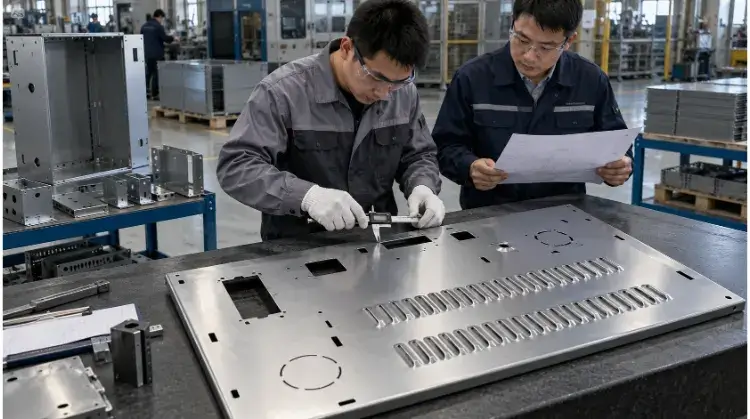
Practical Part Examples
1. Prototype Enclosure
- Profile: Complex outer geometry with specialized cutouts for custom connectors.
- Volume: Low (under 50 units).
- Stability: Design is highly likely to undergo revisions after field testing.
- Verdict:Laser cutting. The lack of tooling costs and the ability to instantly upload a revised CAD file make lasers the only cost-effective choice for early-stage hardware.
2. Ventilation Panel
- Profile: Rectangular outer perimeter with 800 standard hexagonal holes.
- Volume: Stable, recurring batches of 2,000 units.
- Verdict:CNC Punching. The machine can utilize a multi-tool to punch several hexagons per hit. The upfront setup time is rapidly absorbed by the extreme cycle-time reduction—often reducing machine time from 45 minutes on a laser to just 3 minutes on a punch press—making the per-part cost significantly lower.
3. Control Cabinet Door
- Profile: Complex outer perimeter, internal louvers for cooling, and knockouts for cable routing.
- Verdict:Combined Workflow. Lasers cannot create louvers or knockouts. The most cost-effective approach is using the CNC punch press for the 3D formed features and standard mounting holes, then moving the sheet to the laser to cleanly cut the complex outer perimeter.
Project Decision Matrix
| Project requirement | Laser | Punzonatura | Combined |
| Prototype quantity | Forte | Limitato | Limitato |
| Complex profiles | Forte | Moderato | Forte |
| Repeated holes | Moderato | Forte | Forte |
| Formed features | Limitato | Forte | Forte |
| Frequent revisions | Forte | Moderato | Moderato |
| Stable production | Moderato | Forte | Forte |
(Note: These ratings are general starting points, not guaranteed process recommendations. Final selection relies heavily on the specific alloy, thickness, and available shop tooling.)
Conclusione
Selecting the right sheet metal fabrication process comes down to balancing part geometry against production volume.
- Complex profiles, low quantities, and frequent design revisions are usually best suited for fiber laser cutting.
- High-density repeated holes, stable production volumes, and formed features typically make CNC punching the more cost-effective method.
- When a design requires both complex contours and 3D formed features, evaluating a combined workflow often yields the lowest total delivered cost.
Ready to optimize your next sheet metal project?
Send us your drawing, material, thickness, and expected quantity. TZR engineers can review your part and recommend laser cutting, CNC punching, or a combined process to guarantee the best quality and price before quotation.