 English
  Spanish
  German
  Russian
  Italian
  French
GMAW (MIG) aluminum welding is a high-deposition manufacturing process requiring specialized push-pull wire feeding and 100% argon shielding to prevent porosity. Success depends on mechanical oxide removal and managing aluminum’s high thermal conductivity through rapid travel speeds and controlled heat input.
While standard carbon steel welding is a relatively forgiving process, aluminum requires a completely different approach on the shop floor. Attempting to weld aluminum with standard steel configurations guarantees wire feeding jams, severe internal porosity, and failed Non-Destructive Testing (NDT).
Manufacturing engineers and purchasing managers need to understand the limits of each fabrication method before choosing a process.The guide focuses on the production details that matter most, including machine setup, aluminum behavior, wire feeding, and weld quality control.
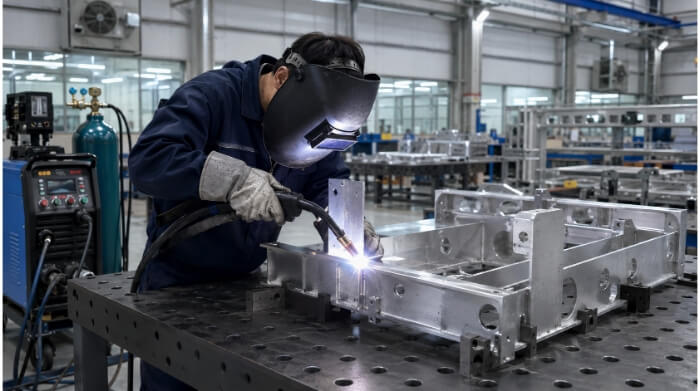
Where GMAW Fits in Aluminum Fabrication?
Selecting GMAW over other welding processes depends on production volume, material thickness, and structural requirements. It is usually used for continuous welds and high deposition rates.
Part Types
GMAW works well for structural assemblies rather than highly cosmetic components. Common applications include vehicle frames, marine structures, and heavy-duty industrial enclosures. It is frequently specified for 5xxx series (sheet and plate) and 6xxx series (extrusions) aluminum alloys.
For these applications, structural integrity and production speed take priority over a visually perfect, “stacked-dime” weld appearance. It is a highly repeatable process when set up correctly for volume manufacturing.
Thickness Range
The process becomes highly stable and cost-effective for materials 3mm (1/8 inch) or thicker. At these gauges, the base metal absorbs the necessary heat input without risking immediate burn-through.
While specialized pulsed equipment can weld aluminum down to 1.5mm under strict conditions, the required rework and higher scrap rates often make this impractical. For material thinner than 2mm, alternative joining methods or modified sheet metal designs are usually more viable for high-volume production.
Welding Speed
For production environments, the primary advantage of GMAW is its deposition rate. A standard aluminum GMAW setup can lay down weld metal at speeds between 20 to 30 inches per minute, depending on joint design and current.
This rapid travel speed minimizes cycle time. It makes the process highly efficient for long continuous linear joints and large-scale fabrications where per-part labor costs must be carefully controlled.
TIG Comparison
Engineers often need to compare GMAW and Gas Tungsten Arc Welding (GTAW/TIG). TIG operates slower, relies on manual filler addition, and generates less overall heat. It remains the standard for thin gauges, complex pipe joints, and cosmetically critical parts.
In contrast, GMAW operates as a semi-automatic process with continuous wire feed. It is specified when production requires structural stability at a lower per-part cost, sacrificing some aesthetic control for significantly higher output.
Why Aluminum Needs Tighter Process Control?
Treating aluminum like mild steel during manufacturing usually results in high defect rates. The physical and thermal properties of aluminum require specific process adjustments on the shop floor.
Oxide Layer
Structural aluminum alloys melt at approximately 660°C (1,220°F), but their natural protective oxide layer has a melting point exceeding 2,000°C (3,600°F). If not removed, this layer acts as a thermal insulator and prevents the weld metal from fusing properly with the base material.
Mechanical cleaning with dedicated stainless steel brushes and solvent degreasing is a standard prerequisite. Failure to properly break down the oxide layer leads to severe internal porosity. In production, this directly results in high failure rates during Non-Destructive Testing (NDT) and expensive rework.
Heat Transfer
Aluminum has a thermal conductivity rate roughly five times higher than carbon steel. Heat moves rapidly away from the weld zone and dissipates into the surrounding metal.
This physical trait means the weld pool freezes quickly if the power output drops. It frequently causes a defect known as “Cold Lap” (lack of fusion) at the beginning of a weld seam, where the base metal has not yet absorbed enough heat to ensure proper penetration.
Heat Input
Due to the rapid heat transfer, GMAW on aluminum requires high initial amperage to establish a stable weld pool. However, as the continuous welding process heats the entire part, the base metal’s ability to absorb further heat decreases.
To prevent the material from overheating and burning through, operators must maintain a consistently fast travel speed. This narrow operating window between “Cold Start” defects and “burn-through” requires precise parameter settings and consistent operator technique.
Distortion
Aluminum expands and contracts at nearly twice the rate of steel when exposed to welding temperatures. This high coefficient of thermal expansion makes the material highly susceptible to severe warping.
If distortion is not aggressively managed, the warped assembly will consume the machining allowances required for any subsequent CNC operations. Controlling this dimensional shift requires rigid fixtures, symmetrical welding sequences, and joint designs that anticipate shrinkage.
Crater Cracks
When a weld pass ends, the rapid cooling and severe thermal contraction of aluminum cause the center of the weld pool to shrink inward. This physical stress often leads to crater cracks at the termination point of the joint.
Standard operating procedures dictate specific techniques to prevent this. Operators must either fill the end of the joint to create a convex weld bead, or use run-off tabs to provide extra material that absorbs the contraction forces without tearing the actual assembly.
Filler Wire and Material Match
Selecting the correct filler wire determines the mechanical properties, defect rate, and final yield of the manufactured part. Using an incompatible wire on the shop floor frequently leads to hot cracking during the cooling phase or catastrophic structural failure under operational loads.
Base Alloy
In industrial fabrication, most commercial weldments utilize 5xxx (magnesium-alloyed) or 6xxx (magnesium and silicon-alloyed) series base metals. The filler wire must chemically complement the specific base alloy to prevent brittle intermetallic phases. Engineers typically specify either ER4043 or ER5356, which together cover the vast majority of production applications.
ER4043
ER4043 is alloyed with 5% silicon, which lowers its melting point and significantly increases fluidity in the weld pool. This enhanced flow makes it highly resistant to weld cracking and produces a smooth, flat bead profile, which reduces the labor costs associated with post-weld grinding.
However, ER4043 yields lower overall ductility. It is generally not recommended for welding 5xxx series base metals with a magnesium content above 2.5%, as the resulting chemistry compromises joint integrity.
ER5356
ER5356 is alloyed with 5% magnesium, providing higher tensile strength and better ductility than ER4043. Because it is a physically stiffer wire, it feeds much more reliably through standard wire delivery systems, significantly reducing equipment-related downtime.
A critical limitation of ER5356 is its sensitivity to sustained elevated temperatures. It becomes highly prone to stress corrosion cracking and should never be specified for assemblies exposed to operating environments above 65°C (150°F).
Weld Strength
During the GMAW process, the severe heat input locally anneals the surrounding metal, creating a Heat-Affected Zone (HAZ) that is mechanically weaker than the original base material temper.
Structural engineers must account for this predictable strength reduction during the design phase. Load-bearing limits must be calculated based on the reduced HAZ strength, not the base material’s original specification. Smart Design for Manufacturability (DFM) avoids placing welds in high-stress zones, anticipating that the assembly will generally yield in the HAZ long before the actual weld metal fails.
Finish Match
If the manufactured assembly requires post-weld anodizing, the filler wire directly dictates the cosmetic yield. ER4043 contains silicon, which turns dark gray or black when subjected to the anodizing process, leading to immediate cosmetic rejections and high scrap rates.
For parts requiring a uniform anodized finish, ER5356 is the mandatory standard. It color-matches the base aluminum consistently, protecting the aesthetic yield of the final product.
Wire Feeding Setup for Soft Aluminum Wire
Aluminum wire is exceptionally soft compared to carbon steel. Pushing it through standard welding cables frequently results in buckling, shaving, and erratic arc behavior. Configuring the wire delivery system correctly is the single most important factor in protecting production cycle times.
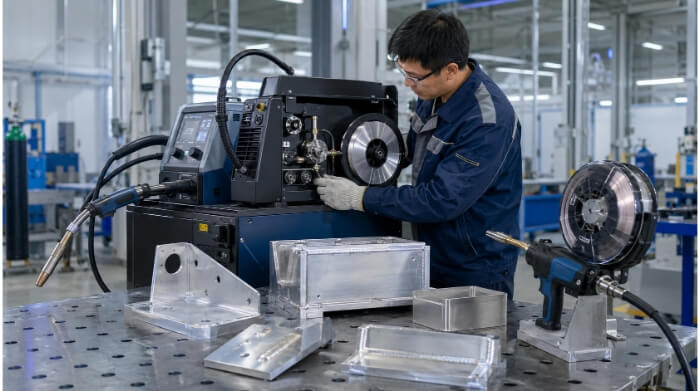
Push-Pull Gun
A push-pull system utilizes a primary drive motor at the wire feeder and a synchronized secondary motor inside the welding gun. This dual-motor setup maintains consistent, light tension on the wire across cable distances of 15 to 30 feet.
While requiring a significantly higher initial capital investment, push-pull systems accommodate large 16 lb (or heavier) wire spools. This minimizes wire changeovers, protects continuous production cycle times, and drastically reduces feed-related failures. They are the mandatory standard for high-volume manufacturing environments.
Spool Gun
A spool gun mounts a small wire spool directly on the handpiece, eliminating the need to push the wire through a long cable. While the initial equipment cost is lower, spool guns are severely bottlenecked by their 1 lb wire capacity.
In a production environment, the constant downtime required to stop and reload 1 lb spools destroys cycle times and inflates per-part labor costs. Coupled with operator fatigue from the added weight, spool guns are strictly relegated to low-volume prototyping or facility maintenance, not continuous manufacturing.
Drive Rolls
Standard V-groove drive rolls designed for steel will instantly crush and deform soft aluminum wire. Manufacturers must equip their feeders with smooth U-groove drive rolls.
U-groove rolls provide enough surface contact to move the wire forward without altering its cylindrical shape. This prevents the drive mechanism from shaving off metal flakes that eventually clog the delivery system and cause unexpected line stoppages.
Liner Type and Contact Tips
Standard coiled steel liners act like a file against aluminum wire, stripping off micro-shavings. Aluminum GMAW strictly requires low-friction, non-metallic liners, typically made of Teflon or Nylon, to ensure a smooth feed rate.
Furthermore, standard steel contact tips are a hidden point of failure. Aluminum wire expands significantly under heat. Using standard tips causes the expanded wire to seize and “burn back” into the copper tip. Aluminum-specific contact tips, which feature a slightly oversized inner diameter, are strictly required to prevent continuous consumable replacement and production downtime.
Feed Tension
Operators accustomed to steel welding often over-tighten drive roll tension to fix feeding issues. Doing this with aluminum guarantees a catastrophic failure known as “birdnesting,” where the wire buckles and tangles completely inside the drive mechanism.
This jam requires significant downtime to disassemble, cut, and clear the feeder mechanism. To protect the production schedule from unpredictable feeding jams, drive roll tension must be set to the absolute minimum force required to move the wire forward.
Heat, Gas, and Arc Stability
Managing the welding arc in aluminum GMAW requires balancing high energy input with the material’s low melting point. Process stability directly dictates the amount of post-weld cleanup and the final defect rate.
Pulsed MIG
Standard constant voltage (CV) machines often force operators into a difficult compromise: either use short-circuit transfer (which causes severe spatter and lack of fusion in aluminum) or use spray transfer (which easily burns through materials under 5mm).
Advanced pulsed MIG power sources solve this. They rapidly alternate between a high peak current to detach the wire droplet and a low background current to cool the weld pool. This achieves the clean, deep penetration of spray transfer but with a significantly lower average heat input. In production, pulsed MIG minimizes burn-through scrap rates and eliminates the labor costs associated with grinding spatter.
Spray Transfer
For aluminum plate thicker than 6mm (1/4 inch), traditional spray transfer remains highly effective. It operates at high voltages and wire feed speeds, creating a continuous stream of molten droplets.
This mode provides exceptional deposition rates and deep penetration. However, the fluid nature of the aluminum weld pool in spray transfer means it is generally restricted to flat or horizontal welding positions. Designing the assembly to allow for flat-position welding reduces cycle times and improves joint consistency.
Shielding Gas
100% Argon is the industry standard shielding gas for aluminum GMAW. For heavy structural aluminum (thicker than 12mm), engineers often specify an Argon/Helium mixture to increase arc voltage and penetration, which offsets the higher gas cost through fewer required weld passes.
However, gas purity is non-negotiable. The shielding gas must have a guaranteed purity of at least 99.99% with a strictly controlled dew point. Industrial-grade gas with trace moisture will instantly introduce hydrogen into the arc, causing catastrophic internal porosity regardless of how perfectly the machine is configured.
Travel Speed
Aluminum requires a “hot and fast” welding technique. Operators must travel significantly faster than they would with carbon steel to stay ahead of the rapidly spreading heat envelope.
If the travel speed is too slow, the heat accumulates locally, widening the Heat-Affected Zone (HAZ) and causing the weld pool to drop through the back of the joint. Consistent, rapid travel speed is a primary focus during operator training to maintain dimensional stability in the final part.
Moisture Control
Porosity is the most common cause of failed aluminum welds. While oil and dirt are obvious contaminants, micro-condensation is a hidden defect driver.
If cold aluminum stock is brought directly into a warm manufacturing environment, microscopic moisture condenses on the surface and within the oxide layer. During welding, this moisture dissociates into hydrogen. Standard shop control requires aluminum to acclimate to the welding environment temperature for 24 hours prior to processing to protect Non-Destructive Testing (NDT) yield rates.
Joint Design and RFQ Requirements
For purchasing managers and engineers, ensuring quality begins in the Request for Quote (RFQ) phase. Vague specifications lead to inconsistent pricing and unpredictable quality. A rigorous RFQ must address the following manufacturing controls.
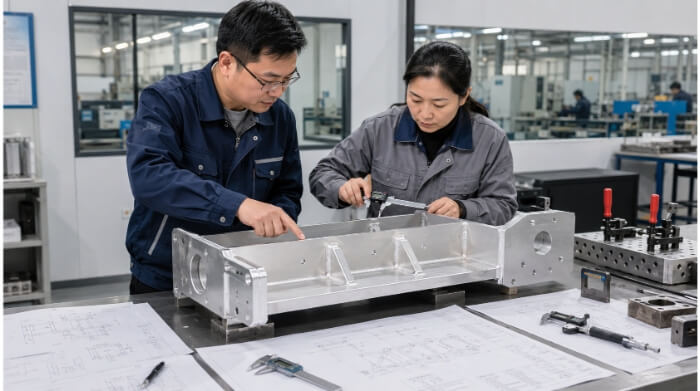
Surface Preparation
Do not assume the supplier uses proper cleaning techniques. Aluminum cannot be welded straight off the rack.
RFQ Requirement: Explicitly specify that all joint surfaces must be mechanically cleaned with dedicated stainless steel brushes and solvent-degreased immediately prior to welding. This standardizes the baseline for defect prevention across all bidding suppliers.
Fit-Up Control
Unlike steel, operators cannot easily manipulate an aluminum weld pool to bridge wide gaps. The fast-freezing nature of aluminum means that any gap forces the operator to input excessive heat, leading to severe distortion or immediate burn-through.
RFQ Requirement: Specify absolute tight tolerances for the pre-weld components, typically allowing zero gap to a maximum of 1mm depending on material thickness. Investing in high-precision laser cutting or pre-weld CNC machining for the sheet metal blanks is not an added cost; it is a mandatory prerequisite that significantly reduces welding cycle times and assembly rejection rates.
Fixture Support
Because aluminum expands and contracts aggressively, manual tack welding and free-hand assembly usually result in parts that fail dimensional inspection.
RFQ Requirement: Request line-item pricing for dedicated welding fixtures (Non-Recurring Engineering / NRE costs). Rigid, custom-machined fixtures are mandatory for maintaining structural tolerances across high-volume production runs.
Defect Control
Crater cracks at the beginning and end of a weld seam are physical realities of aluminum cooling rates.
RFQ Requirement: For critical load-bearing joints, allow the use of run-on and run-off tabs. These sacrificial tabs allow the operator to start and end the weld outside the actual part boundaries. The tabs (and the associated start/stop defects) are machined off after welding, leaving a continuous, defect-free joint.
Acceptance Standard
“Make it look good” is not a measurable standard. Without a defined code, resolving quality disputes becomes subjective and difficult.
RFQ Requirement: Call out a specific welding code, such as AWS D1.2 (Structural Welding Code – Aluminum). Clearly state the required inspection methods and percentages (e.g., 100% Visual Inspection, 10% Radiographic Testing, or Dye Penetrant inspection). This ensures all suppliers price the appropriate level of Quality Assurance into their bids.
Conclusion
Success in aluminum GMAW is determined long before the arc is struck. It requires strict adherence to material physics, precise equipment configuration, and aggressive environmental controls. Treating aluminum as a unique material—rather than just “shiny steel”—is the dividing line between consistent manufacturing yield and costly rework cycles.
Ready to move your aluminum assembly from concept to production?
Our engineering team has over 10 years of experience in sheet metal fabrication. We help turn your design ideas into parts that can be made in real production. You can send us your CAD files for a full DFM review. We check the design, material choice, tolerances, bending details, welding needs, and possible production risks before manufacturing starts.
FAQs
Can you weld aluminum with pure Argon?
Yes, 100% Argon is the standard and most cost-effective shielding gas for the vast majority of aluminum GMAW applications. Helium mixtures are only necessary when deeper penetration is required on thick plate (typically >12mm).
Why did my aluminum weld fail NDT for internal porosity?
Internal porosity in aluminum is almost exclusively caused by hydrogen entrapment. This stems from inadequate pre-weld surface cleaning, failure to remove the oxide layer, or microscopic moisture condensation on the base metal prior to welding.
Can GMAW be used on 1mm (0.040″) aluminum sheet?
Technically yes, using highly specialized pulsed MIG equipment and precise robotics. However, practically and economically, TIG (GTAW) or automated laser welding are far more stable and viable processes for materials thinner than 2mm in a production environment.
Why do I need a push-pull gun if my standard MIG gun works for steel?
Aluminum wire is exceptionally soft. Pushing it through a standard 15-foot cable creates friction that causes the wire to buckle and jam inside the feeder (birdnesting). A push-pull system uses a secondary motor in the handle to maintain steady tension, eliminating downtime and protecting cycle times.