 English
  Spanish
  German
  Russian
  Italian
  French
First Article Inspection (FAI) is a verification process used to confirm that the first manufactured part meets all design specifications and dimensional requirements. For engineering and procurement teams, it serves as a necessary checkpoint before committing to volume production.
By reviewing the initial output, buyers can verify that the supplier understands the technical requirements and that their manufacturing setup is capable of producing consistent parts. Skipping this step often leads to the worst-case scenario in manufacturing: discovering a systemic defect only after thousands of parts have already been produced.
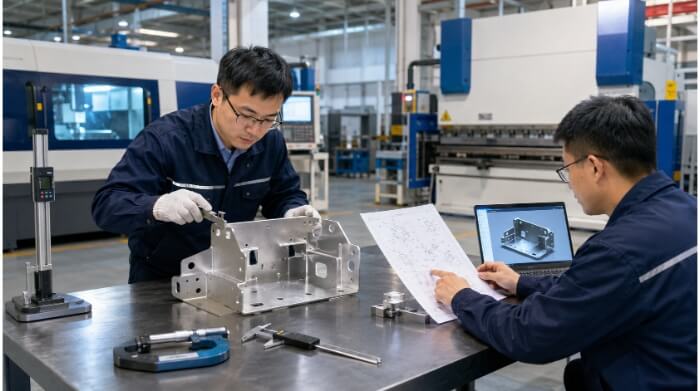
Prove the Process Before Production Release
The goal of an FAI is not just to prove that a single part is correct, but to confirm that the manufacturing environment is stable enough for a larger run.
Part Conformity
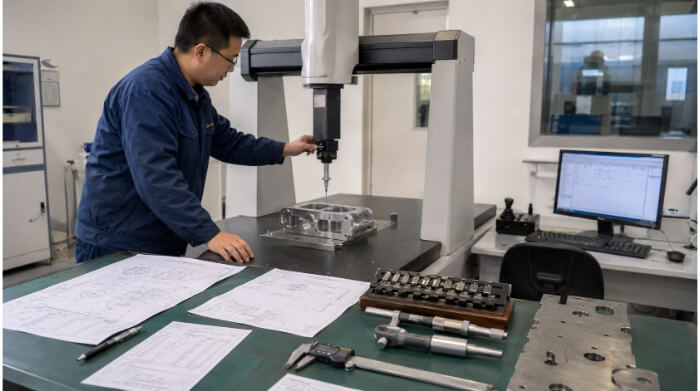
The primary function of an FAI is to evaluate part conformity. Quality inspectors measure the physical part against the 3D CAD model and 2D drawings using Coordinate Measuring Machines (CMM), optical comparators, or calibrated hand tools.
Instead of relying on simple pass/fail checks, inspectors record the actual measured values for every specified dimension. This helps engineers see exactly where dimensions sit within the tolerance band, allowing them to spot potential tolerance drift before parts go out of spec.
Process Setup
FAI also evaluates the manufacturing process itself. A conforming first article indicates that the CNC program, tooling, fixtures, and machine parameters are correctly configured for the production run.
If the first part is out of tolerance, it often points to a setup or fixturing issue that requires adjustment. Catching these machine setup errors early prevents them from being replicated across the entire batch.
Revision Control
Documenting the engineering revision is a standard requirement in any FAI report. Manufacturing defects frequently happen simply because a supplier works from an outdated file.
The FAI explicitly links the inspected part to a specific drawing revision. This ensures both the buyer and the factory are aligned on the current design requirements before raw material is cut.
Approval Point
In standard manufacturing workflows, the FAI serves as a formal hold point where volume production pauses while the first article is reviewed. Proceeding without FAI approval increases the risk of producing non-conforming parts at scale.
Identifying a tolerance failure during the FAI stage costs significantly less to correct than discovering the same defect after hundreds of units have been machined, or worse, when the parts fail to mate during final assembly.
Decide When a New FAI Is Needed
First Article Inspections are not limited to newly introduced products. Changes in the production environment introduce new variables, which often means the process must be validated again.
Design Revision
Any update to the product design usually requires a new FAI. This applies to dimensional changes, modified tolerances, or updated material notes on the drawing.
Depending on the extent of the change, engineers might request a delta FAI (also known as a partial FAI). This approach only inspects the modified features and any surrounding areas affected by the change, rather than re-measuring the entire part.
Process Change
A shift in manufacturing methods changes the variables affecting part quality. If a supplier moves production from a standard 3-axis mill to a 5-axis machine, or changes the primary process from laser cutting to sheet metal stamping, a new FAI is required.
This verifies that the new process or equipment can still yield parts that meet the original specifications, as different machining methods can introduce new thermal stresses or tool deflection.
Material Change
Switching raw materials can fundamentally alter how a part behaves during machining or forming. For example, changing from Aluminum 5052 to Aluminum 6061 may cause different springback angles during sheet metal bending, which directly affects the final geometry.
A new FAI verifies that the existing tooling and setup can still hold the required tolerances with the new material properties.
Supplier Change
Transferring production to a new facility automatically triggers an FAI requirement. Even if the new supplier receives the exact same CAD files and material specifications, their machine capabilities and fixturing methods will differ.
More importantly, their internal measurement baselines and quality control processes will not match the previous vendor. Performing an FAI establishes a baseline for the new supplier’s capability and helps set clear expectations for future batches.
Build a FAIR That Engineers Can Trust
A First Article Inspection Report (FAIR) is only as useful as the data it contains. For engineers and procurement managers, a trustworthy FAIR is a rigorous technical document, not just a checklist that the supplier fills out to get paid.
Ballooned Drawing
A ballooned drawing assigns a unique numbered bubble to every single dimension, tolerance, and engineering note on the print. This creates a clear, one-to-one map between the CAD design and the inspection report.
When a supplier reports a deviation on “Dimension 14,” engineers know exactly which hole, radius, or profile is affected without having to guess. This standardization eliminates miscommunication between the factory floor and the buyer’s engineering team.
Measured Results
A reliable FAIR provides absolute measurement values, not just “pass/fail” checkmarks. If a tolerance is 10.00 ±0.05 mm, the report must state an actual reading, such as 10.02 mm, rather than a generic “OK.”
Providing real variables prevents “pencil-whipping”—a bad habit where operators just fill out paperwork with perfect theoretical numbers without actually measuring the parts. Requiring the specific Gage ID for each measurement ensures the supplier used the right calibrated equipment on the shop floor.
Material Records
Verifying physical dimensions is useless if the part is machined from the wrong grade of metal. The FAIR must include the Certificate of Conformance (CoC) and mill test reports directly from the raw material supplier.
These documents confirm the exact chemical composition, mechanical properties, and heat lot number, proving the factory didn’t substitute a cheaper, weaker alloy. In the event of a field failure, these traceable CoCs act as your legal shield, protecting you from liability tied to substandard materials.
Special Processes
Surface finishes and thermal treatments—such as hard anodizing, powder coating, or heat treating—often require third-party validation. A complete FAIR includes certifications for these outsourced special processes.
This is critical because secondary processes can alter final dimensions or change part strength. Confirming the plating thickness or Rockwell hardness during the FAI prevents precision parts from failing final assembly or degrading prematurely.
Inspect the Features That Create Production Risk
Not all features carry the same manufacturing risk. A practical First Article Inspection pays special attention to the fabrication steps that are most likely to cause batch scrap.
Cut Features
Machined or laser-cut profiles are usually highly repeatable, but they carry risks related to tool deflection and kerf width. If a CNC mill is pushed too fast during the first article, the cutting tool can bend, causing tapered walls on deep pockets.
Measuring these cut features carefully during the FAI verifies that the factory is using the correct feeds, speeds, and tool paths. This ensures the machine can maintain straight, accurate geometry over a long production run without excessive tool wear.
Formed Features
Sheet metal bending introduces complex variables like springback and material grain direction. A thorough FAI will reveal if a supplier nested flat patterns against the grain just to save raw material—a shortcut that often leads to micro-cracking along the bend radius.
The FAI confirms that the supplier has correctly calculated the flat pattern and adjusted their bending dies. It proves they know how to compensate for how this specific material batch behaves under pressure, without cutting corners.
Welded Features
Welding introduces concentrated heat, which naturally causes metal to warp and shrink as it cools. A welded assembly can easily pull itself out of dimensional tolerance, even if the individual components were laser-cut perfectly.
FAI for welded parts focuses heavily on overall flatness, perpendicularity, and final hole positions. It proves that the supplier’s welding fixtures are robust enough to hold the assembly rigid during thermal expansion and contraction.
Finish and Assembly
The final stage of production is where many hidden defects finally surface. Powder coating, painting, or plating adds material thickness, which can easily throw precision holes out of tolerance or create severe tolerance stacking issues during final assembly.
Inspecting the parts post-finish ensures that proper masking was applied. It verifies that threads remain clean, PEM nuts sit flush, and the final coating thickness will not interfere with mating components.
Match the FAI Level to the Project Risk
Not every production run requires the exact same level of paperwork. Engineers and buyers should match the depth of the First Article Inspection to the complexity of the part and the regulatory demands of their industry.
Full AS9102 FAI
A full AS9102 FAI is the benchmark standard for aerospace, defense, and medical manufacturing. It requires strict adherence to Form 1 (Part Accountability), Form 2 (Material and Process), and Form 3 (Characteristic Accountability), tracking every single variable back to its source.
While highly secure, this level of documentation adds significant time and cost to the setup phase. It is usually reserved for highly regulated, mission-critical components where traceability is a legal requirement.
Partial FAI
Also known as a Delta FAI, this approach is used when a minor change is made to an existing, previously approved part. If an engineer simply moves a hole location or changes a thread pitch, the factory only inspects the newly modified features and any adjacent areas that might be affected.
This keeps the project moving and controls costs without forcing the supplier to run a full 100-point dimensional layout all over again.
Critical Dimensions
For commercial and standard industrial equipment, a full ballooned drawing is often unnecessary overhead. Instead, buyers can specify a Critical-to-Quality (CTQ) FAI, where the supplier only records actual measurements for the tightest tolerances and critical mating surfaces.
The rest of the standard dimensions are verified using normal shop floor controls. This approach balances quality assurance with cost-efficiency, prevents bottlenecks in the quality department, and avoids driving up the piece-price with unnecessary inspection overhead.
Fast Prototype Review
In the rapid prototyping phase, speed is the priority. A formal FAIR can take days to generate and review, which defeats the purpose of agile product development.
For early-stage prototypes, the “first article” review is often just a physical check for form, fit, and function. This allows the engineering team to validate the core design quickly before locking in the final, tighter tolerances for mass production.
Use FAI Results to Control Cost and Production Decisions
An FAI report is not just a filing requirement for the quality department. It is a financial and operational tool that procurement managers use to protect the buyer’s bottom line.
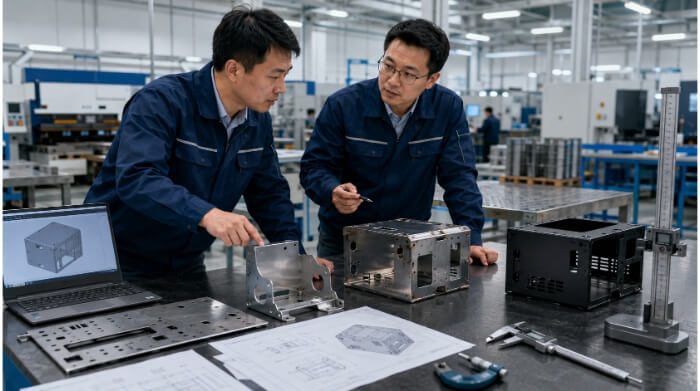
Batch Scrap Risk
The primary financial benefit of an FAI is risk mitigation. Approving a first article ensures that if the factory hits the start button on a 5,000-piece run, those parts will not end up in the scrap bin due to a misread drawing.
The upfront cost of a CMM inspection is negligible compared to the cost of raw material waste and a missed assembly deadline caused by a systemic defect.
Supplier Capability
Experienced buyers read the FAI report to assess the true capability of a new machining partner. If a factory consistently produces first articles that sit right in the middle of the tolerance band, it proves their equipment is rigid, their operators are skilled, and their fixturing is stable.
Conversely, if the FAI shows dimensions riding the absolute edge of the tolerance limits, it is a strong warning sign. It usually means the supplier’s process has a low Cpk (process capability index) and will likely drift out of spec during volume production.
Corrective Action
A failed FAI is not necessarily a disaster; it is a controlled failure. If a dimension is out of spec, the FAIR provides the exact data the factory needs to adjust CNC tool offsets, modify a bending die, or redesign a welding jig.
This forces the supplier to implement a corrective action based on hard data before they waste any more material or machine time.
Production Release
The approved first article often becomes the “Golden Sample” for the production run. It establishes a baseline and shifts the liability.
Once the buyer signs off on a conforming first article, they authorize the supplier to replicate that exact process at scale. If subsequent batches fail to match the approved Golden Sample, the buyer has documented proof that the supplier altered the process.
Conclusion
First Article Inspection is not just a quality report. It is the approval step that connects the drawing, the first completed part, the manufacturing process, and the buyer’s production decision.
By insisting on a rigorous, data-driven FAI, you eliminate assumptions from the shop floor and protect your supply chain from costly surprises.
At TZR, we understand that balancing strict quality control with aggressive lead times is the key to successful manufacturing. Whether you need a critical-dimension check for sheet metal fabrication or a comprehensive FAI for precision CNC machined parts, our engineering team provides the transparent, trustworthy data you need to launch into mass production with confidence.
FAQs
What is the difference between an FAI and a PPAP?
A First Article Inspection (FAI) only evaluates the initial part (or first few parts) to verify the machine setup is correct. A Production Part Approval Process (PPAP) is a broader automotive standard that includes the FAI, but adds statistical process control (SPC) data over a longer production run to prove the process remains capable over time.
Who pays for the First Article Inspection?
The cost of a standard FAI is typically absorbed into the Non-Recurring Engineering (NRE) or tooling fees when setting up a new production run. However, if a buyer requests a highly detailed AS9102-level report for a complex part, the supplier will usually itemize this as a separate charge to cover the extensive CMM programming and documentation time. Note: If an FAI fails due to a supplier’s machining error, the supplier is expected to bear the cost of the setup and re-inspection for the second attempt.
Does a failed FAI mean I need to find a new supplier?
Not usually. A failed FAI simply means the manufacturing setup needs a specific adjustment, such as modifying a tool offset or updating a fixture to hold the part tighter. However, if a supplier repeatedly fails multiple FAI attempts for the same part, it indicates their equipment or technical expertise is not a good fit for your tolerance requirements.