 French
  English
  Spanish
  German
  Russian
  Italian
Traditional manufacturing often follows a “forecast and pray” model. Companies estimate demand, build large batches, and store inventory until the market catches up. This model can work for stable, mature products. However, for product development, pilot builds, and changing hardware programs, it often creates unnecessary costs, slower responses, and greater supply chain risk.
That is why on-demand manufacturing has become more relevant. Its value is not limited to faster prototyping. Its real value is that it helps teams delay hard commitments until the design, demand, and production path become clearer. For procurement managers and hardware engineers, this means a more practical way to reduce inventory exposure, support faster design changes, and move from prototype to production with fewer disruptions.
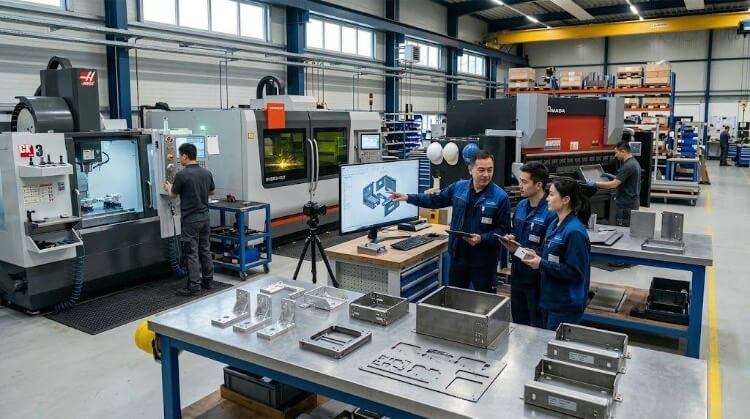
What is On-Demand Manufacturing?
On-demand manufacturing is a production method in which parts are made only after an order is placed. The factory produces the exact quantity needed instead of building inventory in advance. This model is driven by actual demand, not long-range forecasts.
This approach depends on digital manufacturing systems. Engineers can send 3D CAD files directly to automated machines, reducing setup time and shortening the path from design to production. In many cases, a digital file can become an inspection-ready part within a few days.
The Scale-Up Reality: Why “One-Stop” Matters
A fast prototype is useful, but it does not solve the full supply chain problem on its own. The real test comes later, when a project moves from sample units to repeat orders and then to higher-volume production.
A common failure happens when a company uses a small prototype shop for early samples, then moves the project to a different factory for scale-up. The second supplier must relearn the design, the process limits, and the finish requirements from the beginning. This often leads to differences in tolerance, cosmetic changes, and delayed launch schedules. A bracket that fits well in the first sample run may need rework in assembly. A surface that looked acceptable in the prototype phase may not stay consistent across later batches.
To understand the value of an agile supply chain, it helps to compare the main manufacturing models:
| Manufacturing Model | Prototyping Speed | Mass Production Scalability | Upfront Tooling Costs | Quality Consistency |
|---|---|---|---|---|
| Rapid Prototyping Shop | Very fast, often in days | Very limited | Faible | High risk when changing suppliers |
| Traditional Mass Factory | Slow, often weeks or months | Very strong | Très élevé | Stable, but less flexible for design changes |
| One-Stop On-Demand Partner | Very fast, often in days | Strong and scalable | Flexible and scalable | Very consistent, because the same team manages the project from start to scale |
This comparison shows an important point. On-demand manufacturing is not just a faster way to make samples. Its real value is continuity. When the same engineering team supports the project from prototype to production, design knowledge stays in place, quality expectations stay aligned, and scale-up becomes much more predictable.
Core Technologies Behind Industrial On-Demand Production
A strong on-demand supply chain depends on reliable digital manufacturing methods. For industrial products and hardware, the goal is not just fast output. The goal is to achieve speed, structural performance, and repeatable quality simultaneously.
Precision CNC Machining
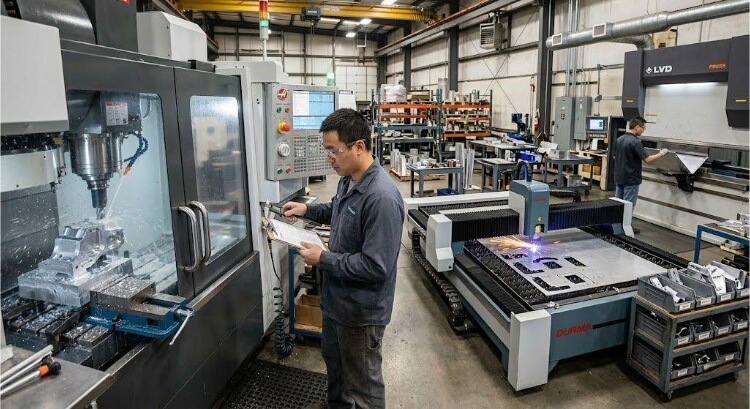
CNC machining is one of the most reliable subtractive manufacturing methods for on-demand production. Multi-axis milling and turning machines can produce tight tolerances from solid blocks of metal such as 6061 aluminum, stainless steel, and titanium.
Because CNC setup time is usually short, this process works well when designs are still changing. A hole location can be adjusted, a wall thickness can be updated, or a mounting feature can be refined without rebuilding expensive hard tooling.
A skilled engineering team does more than run a machine program. The team also improves toolpaths, reduces machining time, avoids vibration problems, and helps maintain stable surface quality across each batch.
Advanced Sheet Metal Fabrication
Fabrication de tôles is a fast, cost-effective option for enceintes, chassis, coverset structural brackets. Modern fiber lasers can quickly cut accurate 2D profiles without custom blanking dies, making design changes much easier to manage.
However, real manufacturing experience shows up after cutting. Bending is often where prototype success and production failure begin to separate. A sample may look correct when it is bent by hand or adjusted at the machine, but the same design may create assembly issues later if bend deduction, flange length, or relief details were not planned correctly from the start.
This is why sheet metal fabrication is most valuable when the supplier is thinking beyond the first sample. A strong team carefully calculates bend allowances, checks whether the geometry is practical for later production, and reduces the risk of tearing, distortion, or visible bend marks.
Key Benefits for Product Development and Procurement
For hardware teams and procurement managers, manufacturing is only part of the challenge. The other part is managing cash flow, controlling risk, and keeping the project moving. This is where on-demand manufacturing becomes especially valuable.
Slashing Warehousing Costs and Eliminating Dead Stock
Excess inventory ties up cash and reduces flexibility. In traditional manufacturing, companies often buy large quantities to get a lower unit price. They then hold those parts in storage and hope demand stays close to the original forecast.
This approach becomes risky when the design is still moving. A bracket may need a new hole pattern after pilot testing. A panel may need a thickness change after assembly feedback. When that happens, existing inventory can lose value immediately. It becomes dead stock, and the earlier cost savings start to disappear.
On-demand manufacturing changes this trade-off. Companies can buy the quantity they need when they need it. This supports a more practical Just-In-Time approach, reduces storage pressure, and protects working capital.
Accelerating Prototyping and Time-to-Market
In hardware development, speed matters because learning speed matters. A team that gets physical parts earlier can find problems earlier, revise faster, and move toward launch with more confidence.
Traditional supply chains often slow this process down. Quoting may take weeks, and tooling and first-article delivery may take months. By contrast, on-demand manufacturing uses digital workflows to shorten the path from CAD file to physical part. Laser cutting, CNC machining, and faster quotation response all help reduce delay.
This speed does more than save calendar time. It helps teams test fit, strength, assembly, and finish sooner. A housing that looks correct on screen may reveal interference after assembly. A part that seems strong enough in CAD may need reinforcement after physical testing.
De-Risking Hardware Design Iterations
Most hardware designs need revision after the first version. Engineers often need to adjust tolerances, change material thickness, move features, or simplify geometry after real testing begins.
In a traditional model, each change can become expensive. New tooling may be required, timelines may reset, and the team may hesitate to fix problems because the penalty is too high. That is one reason many projects carry known design compromises longer than they should.
On-demand manufacturing reduces that pressure. In many cases, the team only needs to update the CAD file and revise the CNC program or bending setup. This makes iteration less painful and, in most cases, more realistic.
Transitioning from Prototype to Mass Production
The move from prototype to scaled production is often where hardware projects begin to struggle. A prototype can prove that a design works. However, that does not automatically mean the design is ready to scale.
The Loss of Tribal Knowledge Trap
A common problem appears when one supplier builds the early prototype and another supplier takes over for higher-volume production. On paper, this handoff may seem simple. In practice, it often leads to delays, inconsistencies, and repeated engineering work.
The new factory must learn the product again from the beginning. Small details can easily get lost during the transfer. The original shop may have adjusted bend sequence, fixture position, or finishing expectations in ways that were never fully documented. As a result, the new supplier may produce parts with a different fit, different cosmetic quality, or longer lead times while trying to match the earlier version.
This is why prototype success should not be judged solely by sample quality. A prototype only creates full value when it also reduces risk for later production.
The One-Stop Scalability Advantage
A more reliable path is to work with a manufacturer that can support the project from prototype through mass production. In that model, the same engineering team keeps the design knowledge, process history, and quality expectations in one place.
The factory may use CNC machining and rapid sheet metal bending for the first few hundred units. Later, when demand becomes more stable, that same team can move the project into estampillage or another higher-efficiency process. Because the geometry, tolerances, and finish requirements are already understood, the transition is much smoother.
This continuity does not just improve convenience. It reduces supplier handoffs, keeps process decisions aligned, and makes production planning more predictable. For many hardware teams, that is the real meaning of scale-up support.
Early DFM: Engineering for Scale from Day One
A part that works well in a small prototype batch may still fail in mass production. It may be too expensive, too slow to make, or difficult to control at higher volume. That is why an early Design for Manufacturability review is so important.
A capable engineering team does more than produce the first sample. The team also checks whether the design can scale without a major redesign later. For example, they may flag bend relief details that are too tight, internal corners that are difficult to produce, hole positions that pose forming risk, or tolerances that are unnecessary for the part’s actual function.
These checks matter because they protect the project from late surprises. The best prototype is not simply one that works. It can move into repeatable, cost-effective production with fewer changes when demand grows.
Managing Quality and Supply Chain Challenges in Agile Production
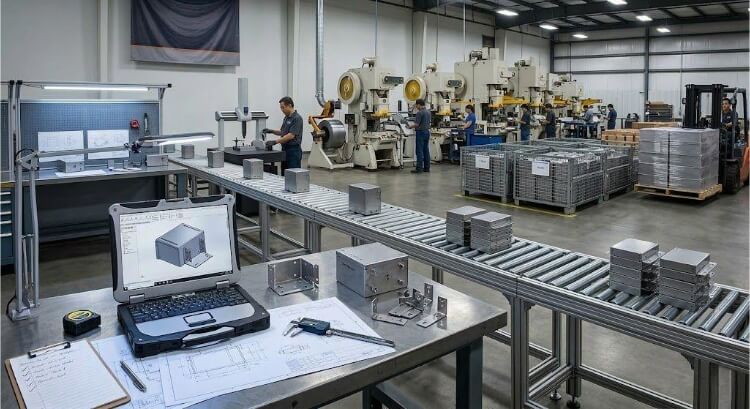
On-demand manufacturing gives teams more speed and flexibility. However, faster production does not automatically mean lower risk. If process control is weak, smaller and more frequent batches can actually create more variation points.
Ensuring Absolute Quality Consistency Across Batches
When production shifts from a single large order to multiple smaller batches, consistency becomes a primary concern. A first batch may perform well, but subsequent orders can still show changes in hole position, finish appearance, or assembly fit if the process is not carefully controlled.
A common case looks like this. The first 50 machined parts pass inspection and are assembled correctly. Then, a later order of 500 parts shows anodizing shade differences or mounting holes that no longer align as expected. In many cases, the root cause is not the machine itself. The real problem is weak process documentation, poor setup control, or limited material traceability.
A capable manufacturing partner does not rely solely on final inspection. The team defines Critical-to-Quality dimensions early, builds inspection planning into the job, and keeps process standards stable from batch to batch. A reliable traceability system also matters. If a problem arises, the team should be able to quickly trace it back to a material lot, a setup condition, or a process change.
Protecting Intellectual Property and CAD Files
In digital manufacturing, CAD files and technical drawings account for much of a product’s value. If these files move through too many unknown parties, the risk increases quickly. For that reason, file security should be treated as a supply chain issue, not just a legal detail.
Procurement teams should use clear non-disclosure agreements and confirm that they are working directly with the factory that will actually produce the parts. That point matters because the risk is often higher when drawings are passed through brokers or loosely managed quoting networks. A direct manufacturing relationship usually gives better process visibility and better protection for the design itself.
Bridging the Communication Gap with International Suppliers
Global sourcing helps companies balance cost, capacity, and capability. However, it also increases the chance of misunderstanding. Time zone differences, language gaps, and different working habits can all affect how a drawing or revision is interpreted.
For this reason, strong communication is not a soft advantage. It is a production requirement. A capable partner should provide direct access to engineers, not only sales support. When engineers speak directly to engineers, DFM feedback becomes clearer, revision intent is easier to confirm, and material or finish changes are less likely to be misread.
What to Look for in a Truly Reliable Manufacturing Partner
A strong on-demand strategy depends heavily on the manufacturer behind it. The right partner does more than make parts quickly. The right partner helps the project stay manufacturable, scalable, and controllable as demand changes.
Evaluating Deep, Hands-On Engineering Experience
In hardware development, practical engineering experience often matters more than sales promises. A supplier may offer fast quoting and attractive pricing, but those advantages mean little if the team cannot identify design risks early.
A strong manufacturing partner should have real, hands-on experience in processes such as sheet metal fabrication, CNC machining, and stamping. More importantly, the engineering team should be willing to challenge weak geometry before production starts. A good team does not simply follow the CAD file without comment. The team checks the bend strategy, reviews the tolerance practicality, and looks for details that may create trouble later in assembly or scale-up.
Balancing Competitive Pricing with Strict Quality Standards
Cost always matters, especially in procurement. However, the lowest quoted price is often not the lowest project cost. If cheap parts cause rejection, delay, or rework, the early savings disappear quickly.
A reliable partner should offer competitive pricing while clearly defining quality expectations. The team should explain how material choice, process route, tolerance level, and finish requirements affect price. That kind of transparency builds trust and makes cost decisions easier to manage.
The best suppliers do not compete only by cutting prices. They compete by helping customers avoid the hidden cost of poor quality, weak process planning, and late engineering changes.
Timely Delivery and Comprehensive Customer Support
On-demand manufacturing only creates value when delivery stays reliable. A part that arrives late can block testing, delay assembly, and slow the entire launch schedule. For that reason, lead time control should be treated as part of product execution, not just logistics.
A dependable manufacturing partner should understand where schedule pressure typically arises and respond quickly when technical issues arise. That support matters for both startups validating new products and larger teams preparing for repeat production.
Conclusion
On-demand manufacturing is not simply a fast way to make small batches. Its real value is that it gives hardware teams more control during the most uncertain stages of a project.
When designs are still changing, demand is not fully proven, or production decisions are still evolving, this model usually reduces more risk than traditional build-ahead purchasing. It helps teams test faster, revise with less penalty, and avoid the common break between prototype work and later production.
Get a DFM Review Before You Release the Next Build
If your design is moving toward prototype, pilot production, or scale-up, this is the right stage to check whether the part is truly ready for manufacturing.
Send us your CAD files for a free DFM review. Our engineering team will look at manufacturability, tolerance risk, bend and machining feasibility, finish considerations, and scale-up readiness. We will also provide a clear quotation and practical feedback to help you reduce production risk before the next order is released.