 English
  Spanish
  German
  Russian
  Italian
  French
Hard tooling for metal stamping demands tens of thousands of dollars and months of engineering time. If you are launching a new product, running a market test, or managing a low-volume assembly line, that upfront investment is a massive risk. Short run stamping solves this.
Short run stamping is a cost-effective manufacturing process for low-to-mid volume production (typically under 50,000 units). Instead of building one large and expensive tool, engineers use a set of simple, flexible tools. This approach saves money on upfront costs. It also helps you get your parts much faster. It is a great choice for testing new designs or making quick changes without spending too much.
By using modular tools and simple setups, you can test your designs and find mistakes early. Here is a direct breakdown of how short run stamping changes your cost structure, where it fits into your production cycle, and where its mechanical limits lie.
When Short Run Stamping Makes Sense?
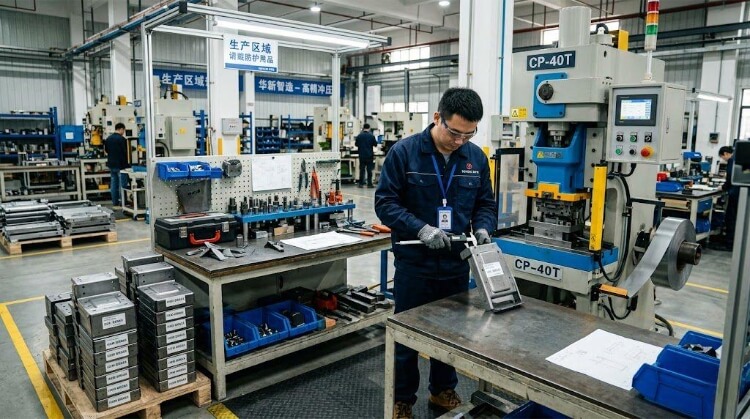
Short run stamping is not a lesser process; it is a calculated manufacturing decision. It fits specifically into the gap between manual fabrication and full-scale progressive stamping.
Low-volume production
For orders ranging from 100 to roughly 10,000 units, the math for permanent tooling rarely works out. Short run stamping absorbs the initial manufacturing demand without requiring you to amortize a high-cost die across a small production batch.
Fast product changes
Hardware goes through revisions. A hard die locks your design in steel; changing a hole location means machining a new die section. Short run processes utilize flexible, modular setups that allow engineers to shift hole coordinates, modify bend angles, or change blank profiles with minimal friction and zero scrapped tooling.
Repeated flat geometries
While laser cutting is excellent for outlines, it struggles with dense hole patterns (like ventilation panels). A laser must pierce and cut every single hole, creating localized heat-affected zones (HAZ) and bottlenecking cycle times. Short run stamping clears these arrays instantly. You drop your per-part machine time from minutes to seconds.
Short lead times
Progressive dies take 10 to 14 weeks to design, machine, heat-treat, and tryout. Short run tooling uses pre-existing master frames and standard punch inserts. Parts hit the shop floor and enter the assembly line in 1 to 3 weeks.
Cost and Break-Even Points
The financial logic of short run stamping comes down to avoiding capital expenditure (CapEx) at the expense of piece-price.
Soft tooling
Instead of D2 or carbide tool steel meant to survive millions of cycles, short run uses A2, pre-hardened plates, or even aluminum for forming dies. These are vastly cheaper to machine.
The trade-off? Tool wear. A soft punch hitting 304 stainless steel might start showing edge roll or throwing excessive burrs after 15,000 hits, requiring maintenance. It is an intentional compromise: you sacrifice long-term die life for immediate production speed.
Modular tooling
You do not pay for a custom die block. The shop floor uses universal master die sets. Only the specific punches and die cavities unique to your geometry are machined and inserted into the master frame. You pay only for the inserts.
Piece-part cost trends
Because the tooling is simplified, parts often require manual transfers between single-hit presses—blanking, then piercing, then forming. This increases labor and handling. Consequently, your individual piece-part cost will be higher than parts dropping fully formed out of an automated progressive press.
Setup frequency
Machine setup time is the hidden cost driver in short run production. Tearing down and setting up a press takes 2 to 4 hours. Running 5,000 pieces in a single batch is exponentially cheaper per unit than ordering 1,000 pieces five separate times. Batch sizes must be optimized to dilute this setup cost.
Volume break-even points
Every part has a mathematical break-even point where the high tooling/low piece-price of progressive stamping crosses the low tooling/high piece-price of short run stamping.
Consider a simple steel bracket:
- Progressive Tooling: $15,000 die + $0.30 per part.
- Short Run Tooling: $800 modular tooling + $1.10 per part.
At 5,000 units, the progressive path costs $16,500, while the short run path costs only $6,300. You do not hit the break-even point until you cross 17,750 units. If your annual forecast is 10,000 pieces, short run is the only mathematically sound choice.
Short Run Stamping vs Laser Cutting and CNC
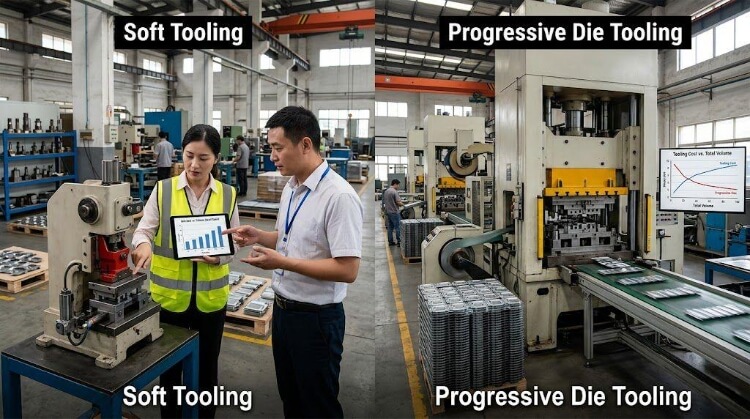
When quoting a mid-volume run, buyers frequently debate whether to route the job through laser/CNC centers or shift to short run stamping. The decision dictates not just the piece price, but the physical characteristics of the final part.
Cycle time
Laser cutting is a continuous thermal process. If a part has an intricate perimeter and forty ventilation holes, the laser head must travel the entire outline and pierce every single hole, which bottlenecks your production speed. CNC machining is even slower, carving away material chip by chip.
Stamping, however, is a mechanical impact. A punch clears that entire 40-hole array in a fraction of a second. At 5,000 units, the cumulative cycle time difference between laser profiling and stamping is measured in weeks, not days.
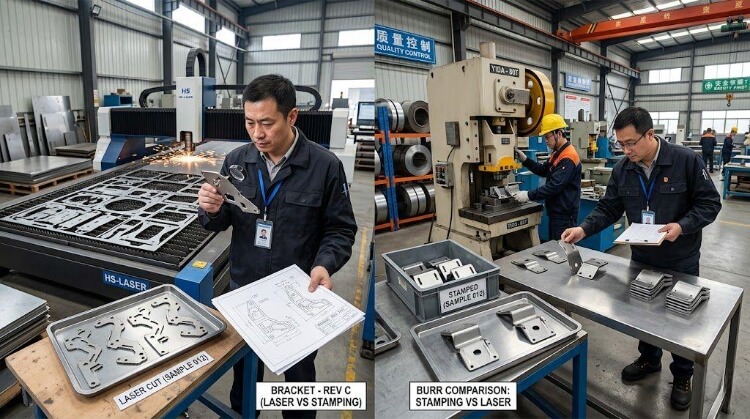
Burr consistency
Laser cutting leaves heat-affected zones (HAZ) and potential dross on the underside, especially on thicker plates or aluminum. CNC machining leaves tool marks that vary as the end mill inevitably wears down during the run.
Stamping produces a highly predictable edge consisting of a clean shear zone and a uniform break zone. Because the burr is always pushed in a consistent direction, secondary deburring operations become highly controllable and repeatable across the entire batch.
Forming capability
A flatbed laser cannot form metal; it only cuts. Every louver, dimple, or 90-degree flange requires routing the flat blank to a secondary press brake, creating a backlog of work-in-progress (WIP) inventory on the shop floor.
Short run stamping consolidates these steps. Forming stations within the modular setup can punch a hole, extrude it, and tap it in continuous succession, drastically reducing material handling and labor costs.
Design flexibility
Here is where CNC and laser hold the definitive advantage. Changing a laser-cut profile takes a programmer five minutes to update the G-code without touching the machine.
Changing a stamped profile requires machining a new physical punch and die block. While short run stamping is much more flexible than hard tooling, it still relies on physical steel modifications. You must lock in your design geometry before hitting the press.
Design and Process Limits
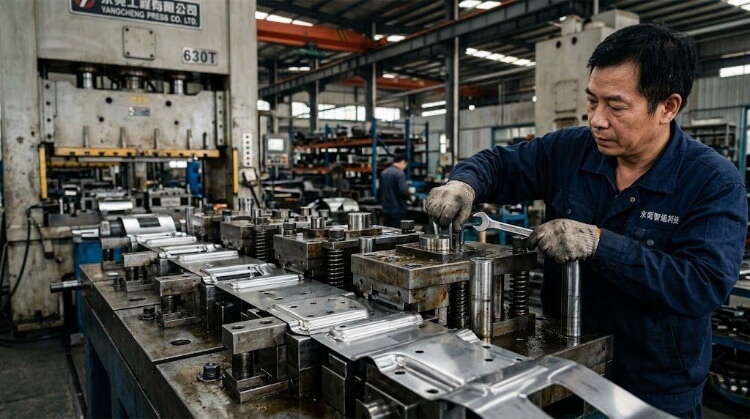
Short run stamping is not magic; it operates under strict mechanical constraints. Because you are not using heavy, fully guided progressive dies, certain design features must be tightly controlled to prevent scrap.
Hole spacing
When punching holes too close to the edge of the material or too close to each other, the web (the metal between the cuts) risks bulging or tearing under pressure.
To prevent this, the standard engineering rule applies: keep the distance between a hole and a bend line, or between two holes, at least 1.5 to 2 times the material thickness.
Bend radius
Tight, razor-sharp radii look great on a CAD model but cause severe cracking on the shop floor. This is particularly true for harder materials like 304 stainless steel or 6061-T6 aluminum.
Soft tooling is less forgiving when pushing material to its fracture point. Always standardize your inside bend radii to at least 1x the material thickness to ensure consistent forming without stress fractures.
Springback control
Metal naturally wants to return to its original flat state after bending. In expensive hard tooling, dies are precisely engineered to over-bend the material, allowing it to relax into perfect tolerance.
Short run soft tooling struggles to manage aggressive springback on high-yield-strength materials. Engineers must compensate through manual press brake tuning or secondary straightening operations, which adds slight variability.
Split operations & Tolerances
Progressive dies hold tight tolerances (often ±0.05mm) because the part remains attached to the carrier strip through every station.
Short run stamping typically uses split operations—the blank is physically moved from the punching press to the forming press. Every time a part is re-located against a gauge pin, tolerance stacking occurs. Expect realistic tolerances of ±0.1mm to ±0.2mm for these runs.
Scaling to Mass Production
A successful short run acts as a critical engineering bridge. It removes the guesswork and proves your design before you write a massive check for a progressive die.
Early DFM validation
What fails in a short run will absolutely fail in a progressive die. By running 2,000 parts through modular setups, engineers quickly identify material tearing, weak punch designs, and inefficient layouts.
This gives your team the opportunity to tweak hole diameters, widen tolerances on non-critical features, and optimize material nesting while the cost of making changes is still negligible.
Capturing Springback data
The most expensive and time-consuming phase of progressive die manufacturing is the “tryout” phase, where toolmakers spend weeks grinding the die to compensate for real-world material springback.
A short run produces physical springback data from the exact material grade and coil you plan to use. This data is fed directly into the hard tooling CAD, often cutting mass production tryout times in half.
Seamless Tooling transition
You do not have to throw away the engineering work from the short run. The sequence of operations tested on the shop floor—where to pierce, where to notch, where to bend—becomes the proven blueprint for your final progressive strip layout.
The transition from modular stations to a fully automated die becomes a matter of transferring established logic, significantly reducing engineering risk.
Real-world Production validation
A short run serves as a functional Production Part Approval Process (PPAP) dry run. You can build physical sub-assemblies, test for interference fits, and run salt-spray tests on the stamped edges.
Once the short run parts pass real-world testing, you can transition to mass production with absolute confidence, knowing your geometry and material choices are fully verified.
Material and Tolerance Stability
When you step away from million-cycle carbide dies, the physics of your material dictate your production success. Short run tooling forces engineers to deeply understand the relationship between material yield strength and tooling degradation.
Material springback
Harder materials fight back. When bending 304 stainless steel or high-tensile alloys in soft tooling, springback becomes a moving target.
Unlike hard dies that lock the material under immense bottoming tonnage, short run tooling often relies on air bending or urethane pads. Engineers must actively monitor and adjust the press stroke to maintain bend angles, especially as material batches vary slightly in hardness.
Tool wear behavior
This is the hidden reality of short run production. Because punches are often made from standard A2 or pre-hardened steel, they wear faster than progressive carbide tooling.
You will experience edge roll on the punch and potential galling on the die block. To counter this, reputable stamping houses enforce strict maintenance schedules, pulling and sharpening short run punches every 5,000 to 10,000 hits to prevent excessive burrs.
Surface marking
Short run stamping involves split operations and manual handling. Every time an operator slides a blank against a steel gauge pin, or a urethane stripper pad compresses against the metal, there is a risk of witness marks.
If your part requires a flawless cosmetic finish, like clear anodizing or straight-line brushing, you must specify this upfront. The shop will need to apply protective films or use specialized non-marking urethane dies. However, if the part will receive a heavy powder coat, minor tooling marks are typically acceptable and easily masked.
Tolerance stability
Do not expect Six Sigma (Cpk > 1.33) stability on a ±0.05mm tolerance from a short run setup. Because the part is relocated manually between different press stations, tolerance stacking is inevitable.
For standard sheet metal features, a stable, repeatable tolerance zone of ±0.1mm to ±0.2mm is highly realistic. If a specific hole diameter or critical mounting distance requires tighter control, the shop will plan a secondary CNC machining or reaming operation just for that feature.
Production Example: Laser Cutting to Stamping
To see how this math works on the shop floor, consider a real-world transition. A client needed 5,000 units annually of a 5052 aluminum power supply chassis.
Original process
The part was initially produced using flatbed laser cutting and a manual CNC press brake. It featured a complex perimeter, 60 small ventilation holes, and four 90-degree flanges.
Production bottlenecks
The laser had to pierce the aluminum 60 separate times for the ventilation array, taking almost 3 minutes per blank. Afterward, a highly skilled operator spent another 2 minutes handling the part to execute the four bends on the press brake. The heavy labor and machine time drove the piece price to $5.50.
Tooling approach
Moving to a hard progressive die would have cost $35,000—impossible to justify for 5,000 parts a year. Instead, the engineering team designed a $2,800 short run modular setup.
They utilized a custom “cluster punch” to clear all 60 ventilation holes in two press strokes. The bending was moved to a dedicated wipe die, allowing all four flanges to be formed simultaneously in a single hit.
Cost reduction
The results were immediate. By switching from laser cutting to the short run tooling approach:
- Cycle Time: Plummeted from 5 minutes to just 40 seconds per part.
- Piece Price: Dropped from $5.50 to $1.80.
- First Batch ROI: Even after paying the $2,800 for the modular setup, the client saved over $15,000 on their very first 5,000-unit run. The tooling paid for itself in less than a month.
Conclusion
Short run stamping is not a compromise; it is a highly strategic manufacturing bridge. It allows you to bypass the crippling capital expenditure of progressive hard tooling while escaping the painfully slow cycle times of laser cutting and CNC machining.
By understanding the limits of soft tooling, managing tolerance expectations, and leveraging modular setups, you can de-risk your product launches and gather invaluable physical data for future mass production.
Ready to bridge the gap between rapid prototyping and mass production?
Stop overpaying for laser cutting or risking capital on unproven hard dies. Send your 3D CAD or 2D prints to our engineering team. Backed by 10 years of sheet metal fabrication experience, we will analyze your geometry, identify critical tolerances, and provide a direct DFM review with a short run tooling breakdown within 24 hours.